


Lebanon's private sector continued to shrink in March, as business conditions were affected by inflation, which led to weak purchasing power, as well as the continuing political crisis in the country.
The Blom Lebanon PMI, which measures operating conditions in the country's private sector, declined slightly to 47.4 in March from 47.5 in February, although it remained above the survey average of 46.1. The reading remained below the 50 mark that separates growth from contraction.
Firms in the country were hit by rising cost pressures as an unfavourable exchange rate against the US dollar - trading at $1 for 1,507 Lebanese pounds at 5pm UAE time - was compounded by increasing fuel prices, the report said.
"With potential food supply disruptions, rising worldwide energy prices, in addition to the internal political stress and pre-electoral chaos, companies are exposed to further challenges that are weighing on their performance," said Aline Azzi, research analyst at Blominvest Bank.
"Lebanon has a lot to consider in the upcoming period, including developments associated with the Ukraine-Russia war, rising inflation exacerbated by soaring fuel prices, and multiple juridical decisions against the banking sector. In response, extensive reform and recovery commitments are enormously required in the period ahead and should not be delayed any further.”
Lebanon’s economic depression, orchestrated by the country’s elite, is among the worst economic collapses since the 1850s, the World Bank said in January. Its economy collapsed after the government defaulted on about $31 billion of Eurobonds in March 2020, with its currency sinking more than 90 per cent against the dollar on the black market.
The country’s real gross domestic product is estimated to have declined by 10.5 per cent in 2021, following a 21.4 per cent contraction in 2020, according to the World Bank.
Inflation soared an annual 215 per cent in February, marking the 20th consecutive triple-digit increase of the Central Administration of Statistics' Consumer Price Index since July 2020. The index increased 4.31 per cent from January 2022.
The country requires a comprehensive social, economic and financial reform programme to stabilise the economy, International Monetary Fund staff said in February, after the conclusion of their virtual mission meetings with Lebanese authorities. The meetings discussed the framework and policies of an economic reform programme that can be supported by the IMF.
“Obtaining broad-based buy-in for this multi-year programme will be fundamental for its timely and decisive implementation. At the same time, strong upfront actions will be necessary to start turning the economy around and rebuilding confidence,” Ramirez Rigo, IMF’s mission chief for Lebanon, said at the time.
-
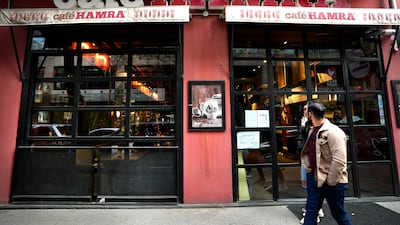
A coffee shop on Hamra Street in Beirut. The street has changed dramatically over the years, reflecting one of the three biggest financial crashes globally since the 1850s. All photos by AP -

Michel Eid, 88, works in his music shop on Hamra street. Mr Eid has witnessed the rise and fall of Lebanon through the changing fortunes of this famed boulevard for more than 60 years. -
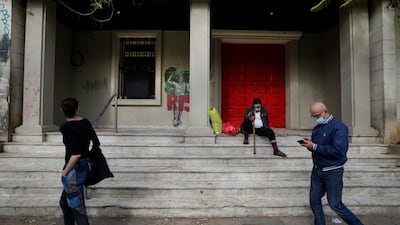
People pass in front of a beggar, centre, on Hamra Street. Fuelled by massive debt and the unsustainable way it was financed, the crisis has slashed Lebanon's gross domestic product by 58.1% since 2019, the World Bank said. -
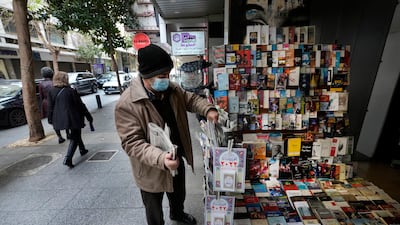
Naim Saleh, who sells newspapers, magazines and books. Mr Saleh said business has dropped dramatically - he used to sell 50 books a day, compared with only about two a month now. -

Shoppers pass a masks street vendor sitting on the ground next to a shop that has closed amid the country's economic crisis. -
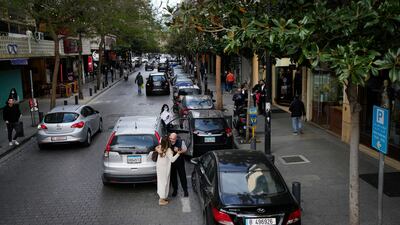
Hamra Street once was home to the region's top movie theatres, shops selling international brands and cafes where intellectuals from around the Arab world gathered. -
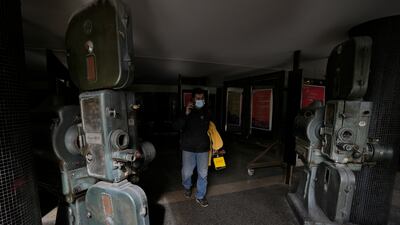
A man passes next to old movie projectors placed outside a theatre in Hamra Street. The projectors were used in the past at the movie theatre once known as Saroula. -
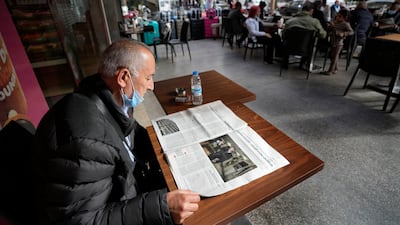
Today, Hamra Street reflects Lebanon's devastating multiple crises, with closed stores, beggars and piles of trash on the corners. -

Beggars sit in front of shops that have been closed since the economic crisis. -

A sign from an old clothes shop set by Hamra Merchants Committee. -
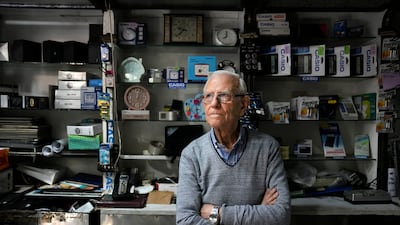
Michel Eid in his music shop. -

Elie Rbeiz, 70, a hairdresser at his shop in Hamra Street. Mr Rbeiz expanded his business 20 years ago to include men clothes. "Hamra is not the Hamra of the past," he said. His business has dropped 60% over the past two years. -

In January, the World Bank blasted Lebanon's ruling class for "orchestrating" one of the world's worst national economic depressions due to their exploitative grip on resources.


Private sector business activity in the country fell at the fastest pace for three months during March, the PMI found, with both input costs and output charges having risen at quicker rates last month.
The drop in output levels was attributed to weak demand conditions. New orders placed with private sector firms in Lebanon fell at the end of the first quarter, reportedly due to reduced purchasing power.
However, the decrease in overall intake of new business was the softest since last June.
The survey also highlighted a reduced strain on capacities, with backlogs of work falling, mainly due to fewer new intakes.
Price pressures intensified at the end of the first quarter, with the overall rate of input price inflation accelerating to a three-month high. This led private sector firms to raise their selling charges at a quicker rate, the report found.
Meanwhile, there was a marginal reduction in staffing levels, extending the current sequence of job losses to five months.
Looking ahead, due to the challenging domestic situation, private sector firms remain "downbeat" on their prospects for the next 12 months, the report said.

