

The Russia-Ukraine conflict is worsening the outlook for the world economy as rising food, fuel and fertiliser prices become “alarming” for developing nations particularly, the UN Conference on Trade and Development (Unctad) said.
Developing countries — which are already affected by the Covid-19 pandemic, rising debt levels and climate change — will be hit the hardest by disruptions in food, fuel and finance, the agency said in report that evaluates the impact of war on trade.
About 26 African countries, including some least-developed ones, import more than a third of their wheat from the two nations at war, the report said.
For 17 of these African countries, the share of imports is more than half.
On average, more than 5 per cent of the world's poorest countries’ import basket is composed of products that whose prices are expected to increase due to the Russia-Ukraine war, Unctad calculations showed. The share is below 1 per cent for richer countries.
“Soaring food and fuel prices will affect the most vulnerable in developing countries, putting pressure on the poorest households which spend the highest share of their income on food, resulting in hardship and hunger,” Unctad secretary general Rebeca Grynspan said.
“This is cause for great concern as social and political stability and increasing food prices are highly correlated.”
Russia and Ukraine are major players in the global agricultural commodity markets, representing 53 per cent of the global trade of sunflower oil and seed trade and 27 per cent of wheat trade worldwide, said Unctad.
International food and feed prices could rise by up to 22 per cent as a result of the continuing conflict and the ensuing supply gap, the UN's Food and Agriculture Organisation said last week.

Some countries are particularly dependent on agricultural commodities from Russian and Ukraine.
The share of imports from the two countries — as a percentage of total imports of wheat, maize, barley, colza, sunflower oil and seeds — is 25.9 per cent for Turkey, 23 per cent for China and 13 per cent for India, Unctad said. Poor countries face the highest exposure.
The risk of civil unrest, food shortages and inflation-induced recessions cannot be discounted, the report said, particularly given the fragile state of the global economy and developing countries due to the pandemic.
“Agrifood commodity cycles have coincided with major political events, such as the 2007–2008 food riots and the Arab Spring,” Unctad said.

Freight rates to rise even higher
The conflict could also drive up cargo rates, which were already elevated as a result of the pandemic, the UN agency warned.
“Such increases would have a significant impact on economies and households,” the report said.
Restrictive measures on airspace and security concerns are complicating all trade routes going through Russia and Ukraine, it said. Global air freight capacity will be further constrained and air cargo prices are set to rise as airlines are forced to take longer routes and spend more money on fuel.
The already expensive and overstretched maritime trade will find it difficult to replace these suddenly unviable land and air routes, the agency said.
Reversal of green investments trend
Unctad's rapid assessment of the war's impact beyond the humanitarian crisis in Ukraine shows heightened financial volatility, sustainable development divestment, complex global supply chain reconfigurations and mounting trade costs.
“Countries already under severe pressure due to the costs of the pandemic will see disruption in trade”, widening deficit and a contraction in investment, Ms Grynspan said.
Moreover, the sharp rise in oil and gas prices can shift investment back into fossil fuel-based energy generation, which raises the risk of reversing the trend towards renewables as the world deals with an acute climate crisis, said Unctad.
-
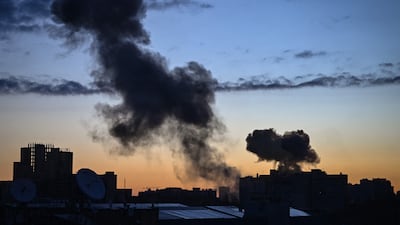
Smoke rising in Kyiv, which mayor Vitali Klitschko says faces a 'difficult and dangerous moment' as Russian forces step up strikes. AFP -

Pope Francis meets visitors holding the Ukrainian flag during his weekly general audience in the Vatican. AFP -

An anti-war protester demonstrates against Russia's invasion of Ukraine in front of the Nato headquarters in Brussels. AFP -
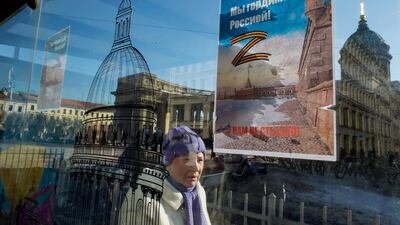
A poster in Saint Petersburg carries the letter Z, a symbol of support for the invasion, and reads: "We are proud of Russia! We are not ashamed!" AFP -

Amid the Ukraine war, there's time for a seaside stroll in Odesa. Reuters -
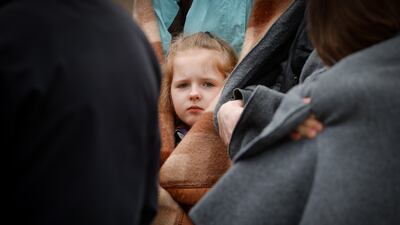
A child who fled from Ukraine to Belgium waits outside an immigration office in Brussels. EPA -
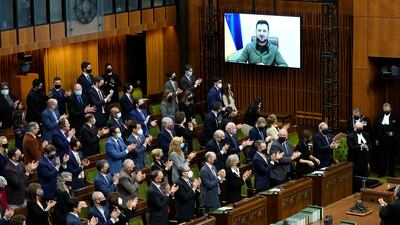
Ukrainian President Volodymyr Zelenskyy receives a standing ovation as he appears via videoconference to make an address to Canada's Parliament. AP -
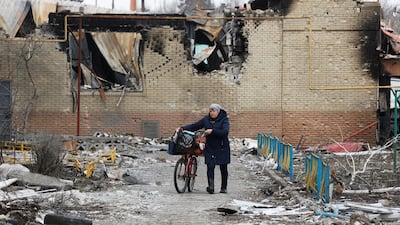
A woman walks with a bicycle next to a building damaged during the conflict in the separatist-controlled town of Volnovakha, Donetsk region. Reuters -
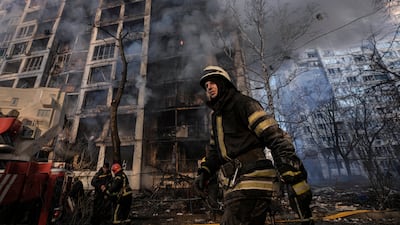
A firefighter outside a destroyed apartment building in a residential area of Kyiv. AP -

Ukrainian soldiers pay tribute to Col Valeriy Gudz, who was killed in battle against Russian troops, at a cemetery in the town of Boryspil. AP -
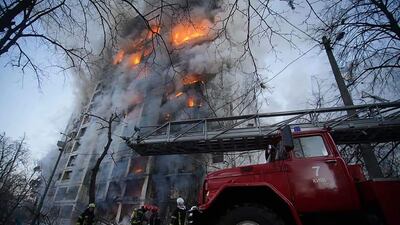
Firefighters work to extinguish a fire in a housing block hit by shelling in the Sviatoshynsky district, in western Kyiv. AFP -
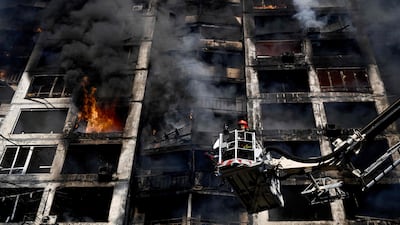
Two people were killed as a series of powerful explosions rocked residential districts in Kyiv just hours before talks between Ukraine and Russia were set to resume. AFP -

The Met Opera and Chorus performs during 'A Concert For Ukraine' in New York City. AFP -
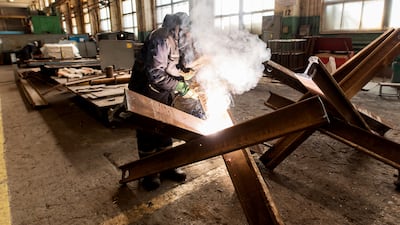
A worker welds metal at the Interpipe Steel plant in Dnipro, Ukraine. Hundreds of Interpipe’s 10,000 employees have joined the fight against Russia. AP -
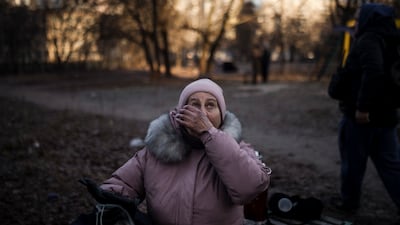
A woman is rescued by firefighters from her apartment in a burning building that was hit by artillery shells in Kyiv. AP -

Rescuers work at a building damaged by an air strike, in central Kharkiv, Ukraine. Reuters -

A woman who fled Ukraine to Belgium waits outside an immigration office, in Brussels. EPA -
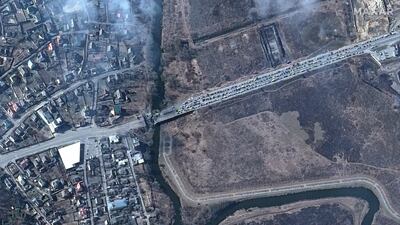
Cars stuck at the Irpin River bridge, as Russia unleashes a barrage of air strikes on cities across Ukraine. AFP -
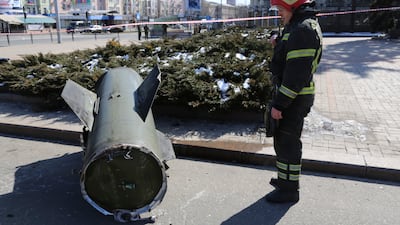
A firefighter looks at a section of a Ukrainian Tochka-U missile on a street in the separatist Donetsk region. The Russian military said 20 civilians were killed by a ballistic missile launched by the Ukrainian forces. AP -
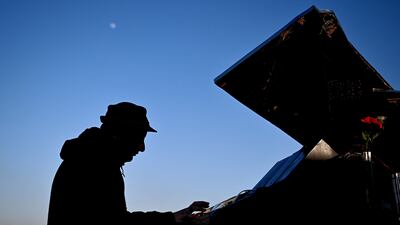
Musician Davide Martello plays a piano near the Ukrainian border in Medyka, Poland. More than 1.76 million people have crossed the Polish-Ukrainian border into Poland, the Polish Border Guard reported on March 14. EPA -

Ukrainian President Volodymyr Zelenskyy, left, snaps a selfie with a wounded man during a visit at a military hospital after fighting in the Kyiv region.AFP -
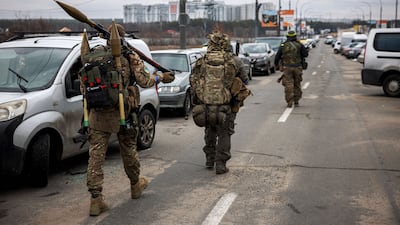
Ukrainian soldiers carry rocket-propelled grenades and sniper rifles as they walk towards the city of Irpin, north-west of Kyiv. AFP -

Troops carry an elderly woman on a stretcher across a makeshift bridge as Ukrainians flee Irpin. AFP -
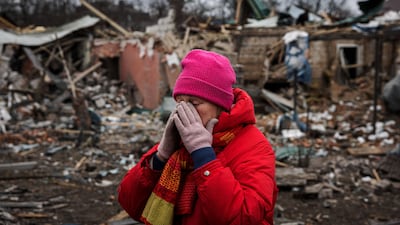
Irina Moprezova, 54, stands in front of a house that was damaged by an air strike in Irpin. AFP -
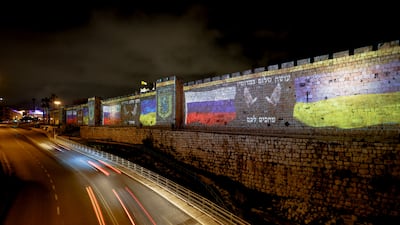
The flags of Russia and Ukraine are projected on the walls of Jerusalem's Old City, which a representative from the Jerusalem Municipality said is a show of support for diplomatic dialogue between the countries. Reuters -
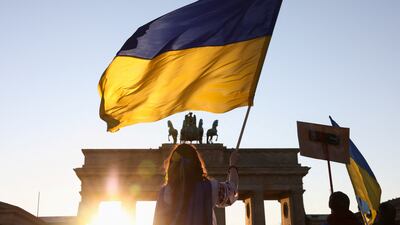
A person holds a Ukrainian flag during an anti-war demonstration at the Brandenburg Gate in Berlin, Germany. Reuters -
A Ukrainian soldier takes cover as people flee Irpin. AFP -

Ukrainians shelter in an underground train station during the day in Kyiv. EPA -
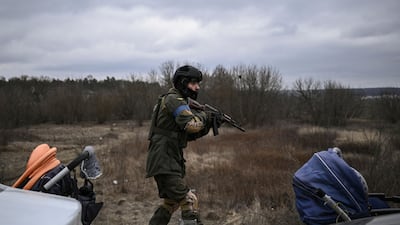
A Ukrainian serviceman walks carefully with his weapon in the city of Irpin, near Kyiv. AFP -
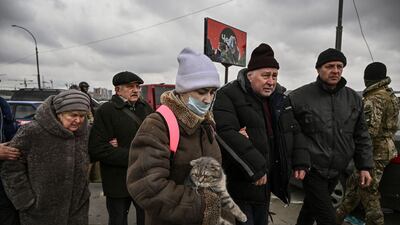
Ukrainian people flee the city of Irpin, north-west of Kyiv. AFP -
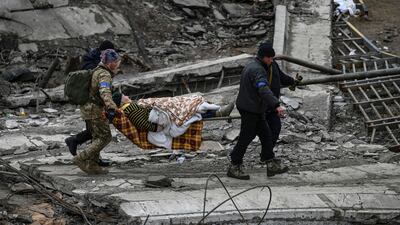
Ukrainian servicemen carry an elderly woman on a stretcher from the city of Irpin. AFP -

A girl plays games on her tablet inside a subway carriage being used as a bomb shelter in Kyiv. AFP -
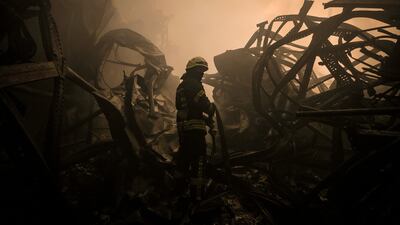
A Ukrainian firefighter drags a hose inside a large food products storage facility which was destroyed by an air strike on the outskirts of Kyiv. AP -

Ukrainian troops with a Javelin anti-tank missile on the front line in the northern Kyiv region. Reuters -
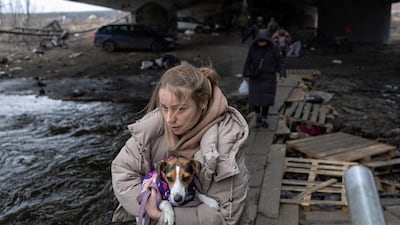
A woman carries her dog during an evacuation in Irpin. Reuters -
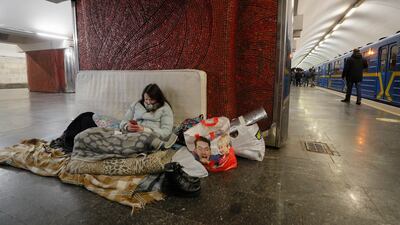
A Ukrainian woman takes shelter in a metro station during the day in Kyiv. EPA -
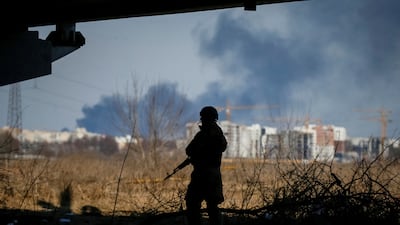
A member of the Ukrainian armed forces on patrol in Irpin. Reuters -

A Ukrainian fighter takes cover behind a car in the city of Irpin. AFP -
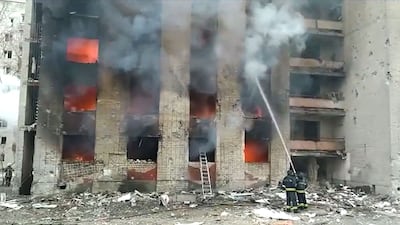
Firefighters at work after air strikes hit residential buildings in Chernihiv, northern Ukraine. AFP -
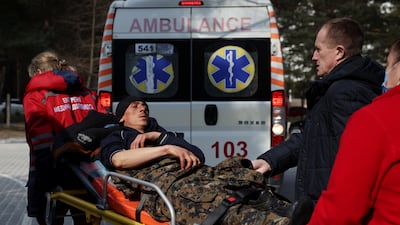
A man wounded in an air strike is helped by medical staff in Novoiavorivsk, western Ukraine. Getty -
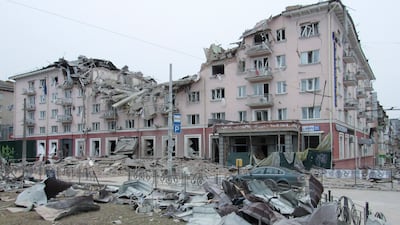
The ruins of the Ukraine Hotel after recent shelling in Chernihiv. EPA


“All these shocks threaten the gains made towards recovery from the Covid-19 pandemic and block the path towards sustainable development,” Ms Grynspan said.
Mounting debt burdens, rising climate change costs, continuing pandemic effects and commodity price shocks increase the risk of a debt crisis in developing countries, the report said.
The combination of high food and fuel prices and macroeconomic tightening will place severe pressure on households in developing countries: real incomes will be squeezed and economic growth will be constrained, the UN body said.
“Even in the absence of disorderly moves in financial markets, developing economies will face severe constraints on growth and development,” the report said.

