


Live updates: follow the latest news on Russia-Ukraine
Ukraine faces a deep recession and a large funding gap amid a drop in tax revenue this year as Russia’s military offensive in the country continues to worsen, the International Monetary Fund has said.
The conflict is expected to force a 10 per cent contraction in Ukraine’s real gross domestic product this year, the Washington-based lender said on Tuesday.
Given the fluidity of developments, the country’s near-term real growth projection should be considered “preliminary and subject to unusually large uncertainty”, with serious economic consequences going forward.
The European country’s real gross domestic product grew 3.2 per cent in 2021 as a record grain harvest and strong consumer spending helped to lift growth in the last quarter of the year.
Before the conflict, the country had gross foreign exchange reserves of $30.9 billion and its revenue remained strong in the first two months of this year.
-
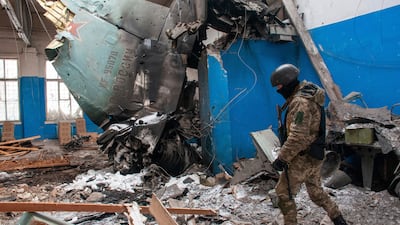
A Ukrainian serviceman walks past the vertical tail fin of a Russian Su-34 bomber lying in a damaged building in Kharkiv, Ukraine. AP Photo -
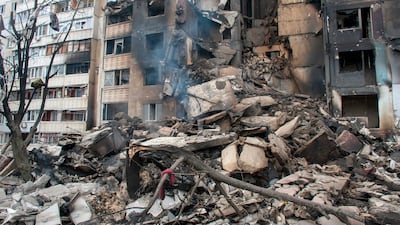
An apartment building damaged after shelling in Kharkiv, Ukraine. AP Photo -
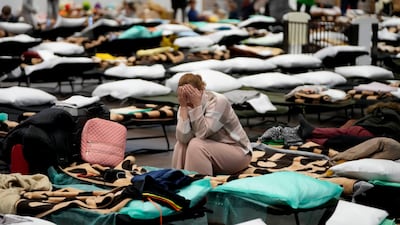
A woman puts her head in her hands as she sits on a cot in a shelter, set up for displaced persons fleeing Ukraine, inside a school gymnasium in Przemysl, Poland. AP Photo -
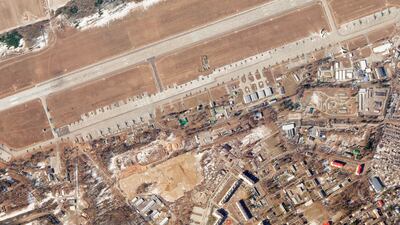
Belarussian and suspected Russian helicopters on the flight line at Machulishchy Air Base outside Minsk, Belarus. AP Photo -
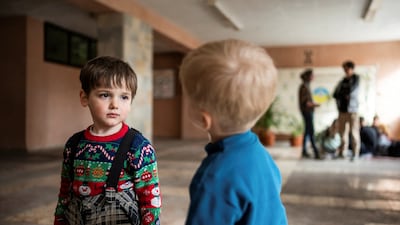
Children look on as people fleeing Russia's invasion of Ukraine shelter in a school, in Drohobych, Ukraine. Reuters -
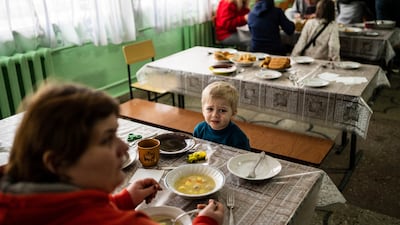
Families eat in the shelter. Reuters -
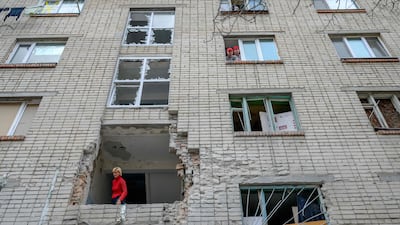
A woman looks out from a building damaged by Russian shelling in Mykolaiv, 100 kilometres away from Odesa, western Ukraine. AFP -
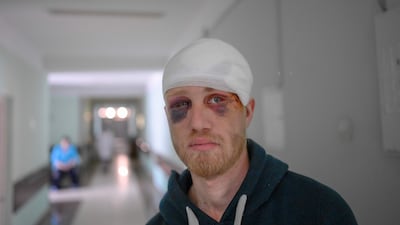
A wounded Ukrainian man waits in the corridor of the central hospital of Mykolaiv. AFP -
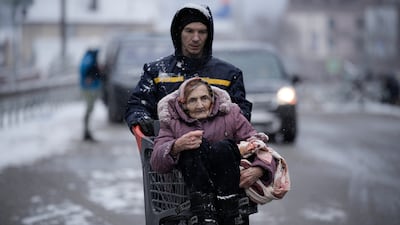
An elderly woman is carried in a shopping cart after being rescued from Irpin, on the outskirts of Kyiv, Ukraine. AP -
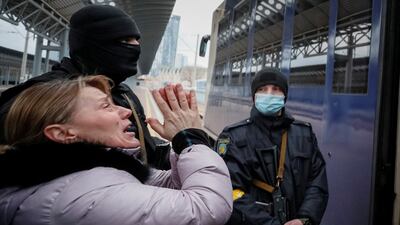
A woman reacts as a train carrying children from Kyiv's Central Children's Hospital leaves the Ukrainian capital on its way to Lviv. Reuters -
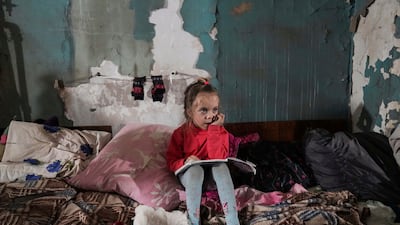
A girl sits in an improvised bomb shelter in Mariupol, Ukraine. AP -
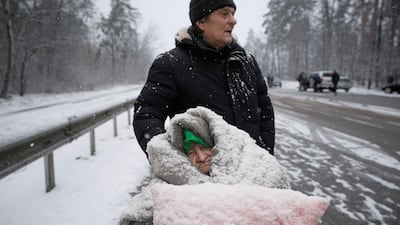
An elderly woman is coated in snow as she sits in a wheelchair after being rescued from Irpin. AP -
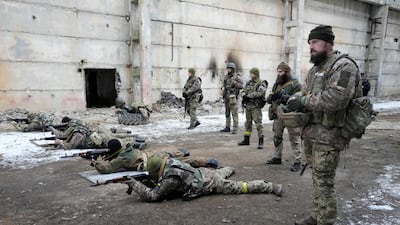
Belarusian volunteers take part in military exercises at the Belarusian Company base in Kyiv. AP -
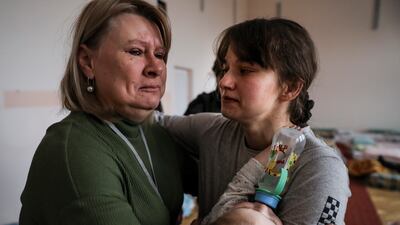
Lessa, left, director of a nursery school turned into a refugee shelter, cries as she hugs Olega, who arrived from Kyiv with her baby, near Lviv. EPA -
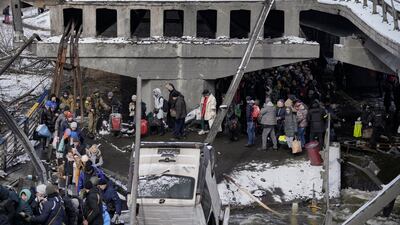
Ukrainians pass a damaged bridge as they flee from Irpin. AP -
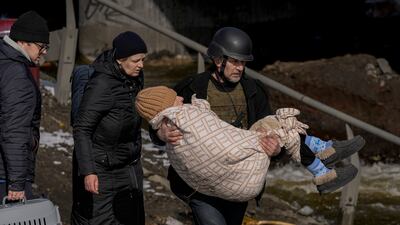
A man carries an elderly woman as people continue to leave Irpin. AP -
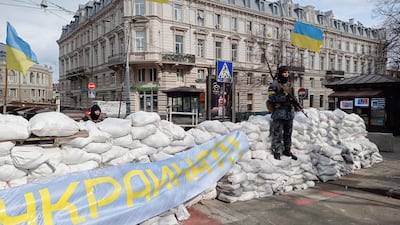
A soldier stands on a barricade made of sandbags in central Odesa, Ukraine. Reuters -
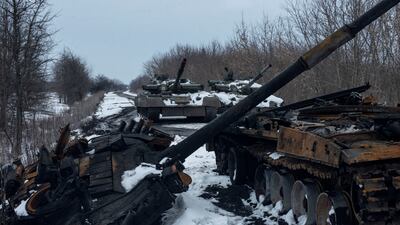
A charred Russian tank and captured tanks in the Sumy region. Reuters -
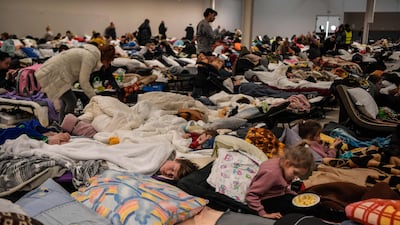
People rest at a temporary shelter for Ukrainian refugees in Przemysl, Poland. AFP -
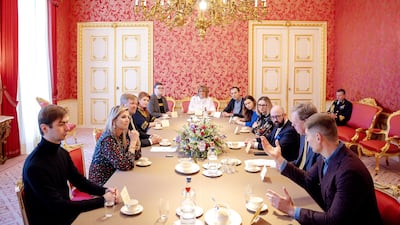
Ukraine's ambassador to the Netherlands, Maksym Kononenko, third right, and his wife Tetiana Doroshenko, fourth left, attend a meeting of members of the Ukrainian community with Dutch King Willem-Alexander, third left, and Queen Maxima, second left, to discuss the situation in Ukraine, in The Hague. EPA -
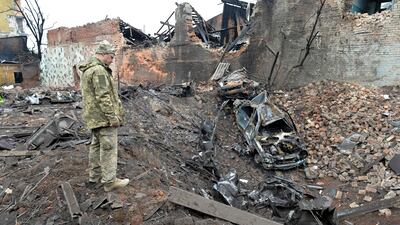
A Ukrainian soldier looks at the destruction after shelling in Ukraine's second-largest city of Kharkiv. AFP -
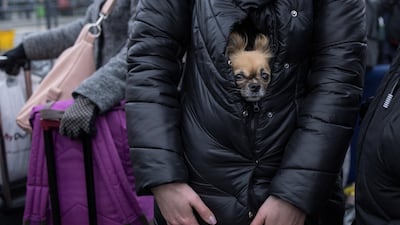
A refugee holds her dog as they wait for trains to Poland in Lviv, Ukraine. Reuters -
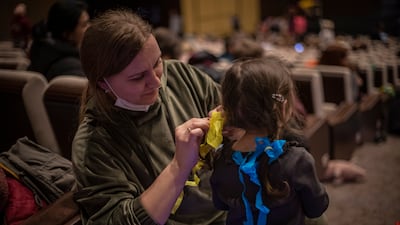
A woman ties ribbons in Ukrainian national flag colours in a girl's hair as people wait at a refugee assistance centre in Prague, Czech Republic. EPA -
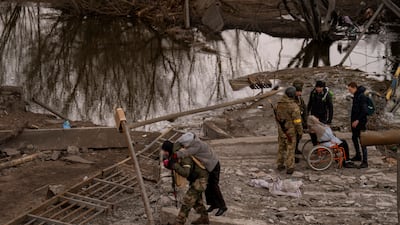
A Ukrainian soldier carries an elderly woman crossing the Irpin river on the outskirts of Kyiv. AP -
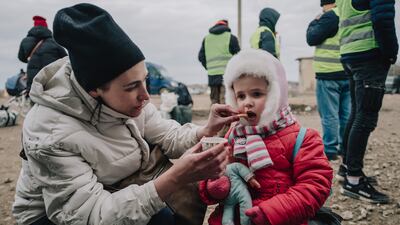
Lena, who had never left Ukraine before fleeing into Moldova, feeds Dasha, 3, soon after crossing the border. Erin Clare Brown for The National -
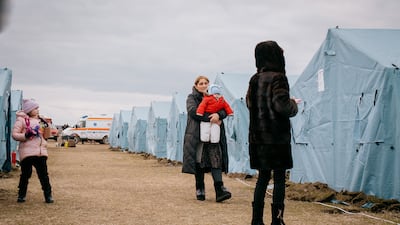
Refugees without immediate plans to move further inland can stay the night in tents set up on Moldova's side of the border. Erin Clare Brown for The National -
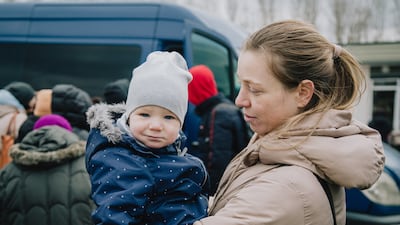
Tatiana and her son wait for a van that will carry them from the Moldovan border to Chisinau. Erin Clare Brown for The National -
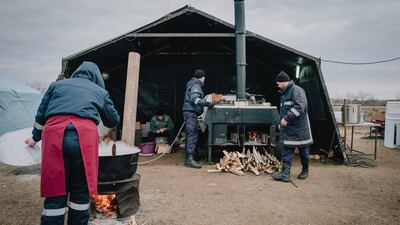
Each night, the Palanca refugee camp in Moldova feeds up to 300 people who arrive with no onward plans. Erin Clare Brown for The National -
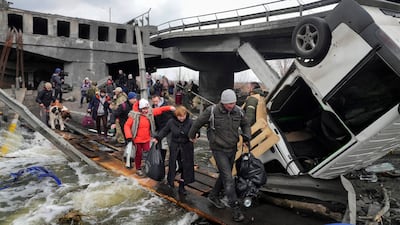
People pass a damaged bridge while fleeing the town of Irpin, close to the Ukrainian capital of Kyiv. AP -
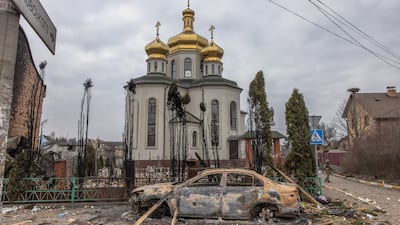
A Ukrainian soldier stands guard next to a church in Irpin. EPA -
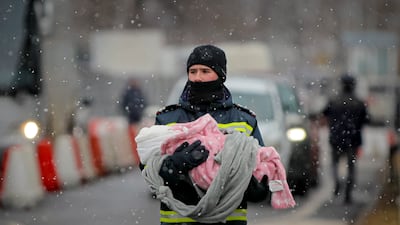
A firefighter holds the baby of a Ukrainian refugee at the border in Romania. AP -
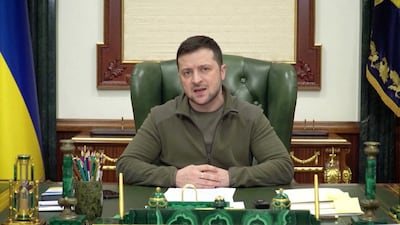
Ukrainian President Volodymyr Zelenskyy speaks in Kyiv. Reuters -
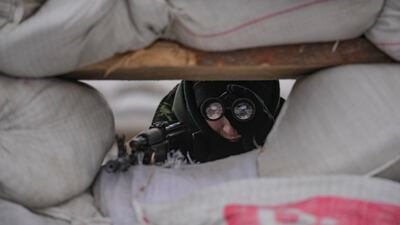
A Ukrainian soldier at a checkpoint in Kyiv. AP -
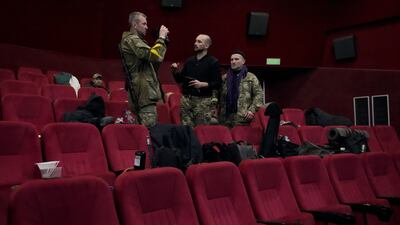
Ukrainian activist Ihor Mazur, left, a veteran of the war in the country's east, looks at a night-vision device in Kyiv. AP -
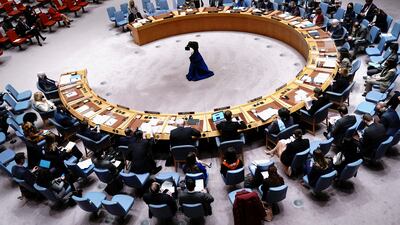
Ambassadors attend a UN Security Council meeting on threats to international security after Russia's invasion of Ukraine, in New York. Reuters -
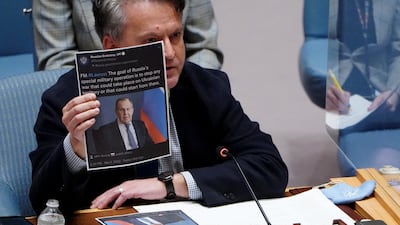
Ukraine's UN ambassador Sergey Kyslytsya holds a paper with an image of Russia's Foreign Minister Sergey Lavrov as he addresses the Security Council in New York. Reuters -
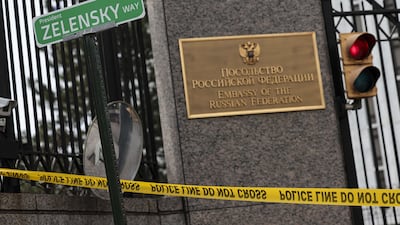
A road sign put up in support of Mr Zelenskyy outside Russia's embassy in Washington. AFP -
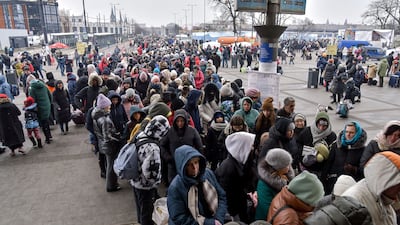
Ukrainian refugees at the train station in Lviv, western Ukraine. EPA -
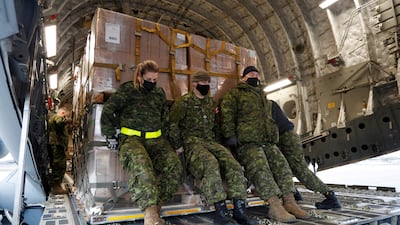
Lethal and non-lethal Ukrainian aid is loaded on to a plane bound for Poland by Canadian soldiers in Trenton, Ontario. Reuters -
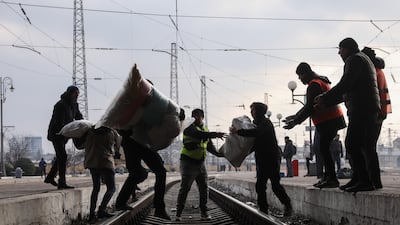
Volunteers carry medical aid and necessities at a train station in Lviv. EPA -
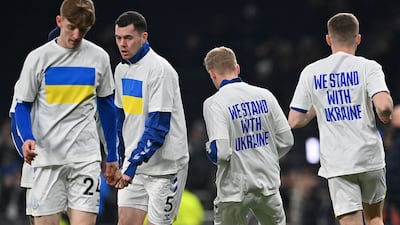
Everton players wear T-shirts in support of Ukraine as they warm up for an English Premier League football match against Tottenham Hotspur. AP -
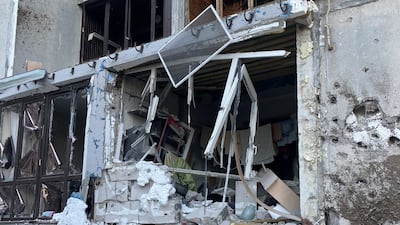
A residential building damaged by Russian shelling in Chernihiv, Ukraine. Reuters -
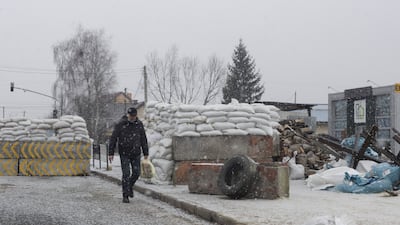
A man walks past a checkpoint in heavy snow in Lviv. Getty -
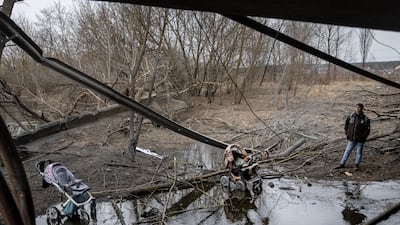
A man fleeing fighting in Irpin waits to cross a river after Russian forces entered the city. Getty -
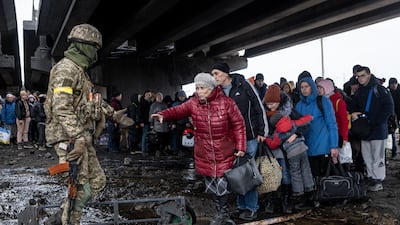
Soldiers assist Irpin residents underneath a damaged bridge as they flee. Getty -
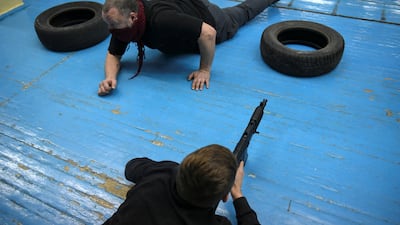
Ukrainian civilians who volunteered to join the Territorial Defence Forces take part in a training exercise in Odesa after Russia's invasion. Reuters -
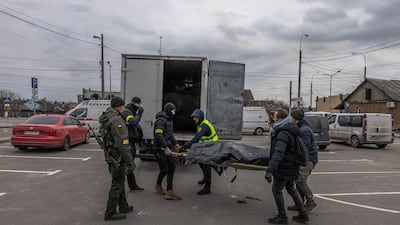
Men carry a body to a lorry as people flee from the frontline town of Irpin. EPA -
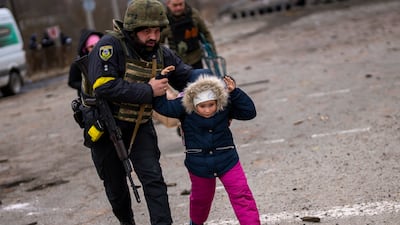
A Ukrainian police officer runs with a child as the sound of shelling echoes nearby in Irpin. AP -
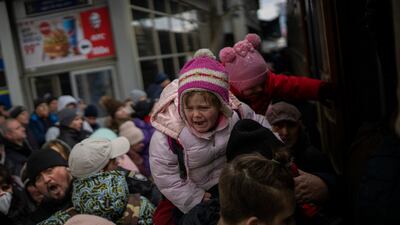
Parents and children struggle to board a train in Lviv. AP


However, its tax collection capabilities are now severely hampered and its economic output faces a massive decline.
Data on wartime real GDP contractions in Iraq, Lebanon, Syria and Yemen suggests that Ukraine’s annual output contraction could eventually be in the range of 25 per cent to 35 per cent.
The fund estimates that Ukraine’s gross external financing needs could grow to $4.8bn this year in its baseline scenario where the conflict is resolved quickly.
“Financing needs are large, urgent and could rise significantly as the war continues,” the fund said.
The current financing gap estimates should be considered to be a “bare minimum and a bridge towards the point in time when a comprehensive post-war damage assessment will allow for an adequate estimate of total financing needs, which would likely be significantly higher”.
The fund expects the Ukrainian financing gap to be covered by multilateral lenders, the EU and G7 economies.
On Monday, the IMF executive board also approved the disbursement of $1.4bn under the Rapid Financing Instrument to help Ukraine meet urgent financing needs.
The disbursement, equal to 50 per cent of Ukraine’s quota in the fund, will help the country to meet its balance of payment needs, the fund said on Tuesday.
The World Bank also approved $200 million in additional financing to bolster Ukraine’s social services for vulnerable people. The funding is on top of the $723m mobilised for the country, of which $350m has already been disbursed.
This financing is part of the previously announced $3bn package of support for Ukraine, which will be disbursed over the coming months, the World Bank said on Monday.
However, despite support from multilateral financial institutions and western allies, refugee flows of more than 2.7 million and the destruction of Ukraine’s key infrastructure only serve to highlight the country’s uphill struggle to stave off an economic catastrophe.
The fund expects Ukraine’s revenue to shrink as the conflict weighs on individual and business incomes, and inflates expenditure.
The primary deficit is expected to widen by 2 percentage points of GDP to 3.1 per cent in the fund’s baseline scenario, where revenue will rebound quickly once the conflict is over.
“These assumptions depend on the duration and depth of the conflict, which is highly uncertain,” the IMF said.
“The authorities [in Ukraine] are rightly focusing on ensuring the continuity of critical government operations, preserving financial stability and protecting priority spending,” the fund said.
So far, the emergency policy response has been “remarkable”, although administrative and capital controls have been introduced to preserve foreign exchange reserves and reduce exchange rate uncertainty.
The National Bank of Ukraine has established a new liquidity facility and introduced regulatory forbearance measures. There are cash withdrawal limits but cashless transactions have not been barred.
As fiscal policy focuses on ensuring priority payments, Ukraine “has stayed current on all debt obligations”, the fund said.
managing director, IMF
Russia’s economy has also taken a massive hit after the US and its allies took punitive action against Moscow for its military offensive.
Earlier this month, the Institute of International Finance projected that Russia's economy will shrink 15 per cent this year as it slides into a recession twice as severe as the 2009 contraction.
Earlier this month, Moody’s downgraded 95 Russian companies after cutting the country’s sovereign rating deeper into non-investment grade territory.
The IMF has also raised concerns over Russia’s ability to service its debt, joining a growing number of rating agencies and investors who expect an imminent debt default by Moscow.
As oligarchs in President Vladimir Putin's inner circle face sanctions, many western companies have exited or temporarily suspended operations in Russia.
The US and UK have banned the import of Russian crude while Europe has pledged to reduce its reliance on Moscow for its energy needs.

