

Oil runs in Scott Sheffield’s veins — almost literally. In 2021, the chief executive of Pioneer Natural Resources bought out his son Bryan’s Parsley Energy for $4.5 billion.
Now ExxonMobil is rumoured to be interested in acquiring Pioneer, whose market capitalisation is around $49 billion.
So, his words carried weight when, at Columbia University’s Centre on Global Energy Policy on April 12, he gave his opinion that US shale oil production would never regain its historic peak.
It's fair to note that a fellow chief executive on the panel, Occidental’s Vicki Hollub, was more optimistic. But US oil company chiefs in general believe output from the Permian of West Texas and New Mexico, the main “tight oil” basin, will peak within five to six years.
Opec itself sees total US petroleum output rising 1 million barrels per day this year.
Washington’s own Energy Information Administration estimates output this year will hit 12.5 million bpd, just above 2019’s record, and 12.75 million bpd next year. This is still reasonable growth, but a far cry from the 1.3-1.6 million bpd the US added annually in its glory years between 2012 and 2019.
Four things have changed. The shale patch has become consolidated into a smaller group of large companies, who face less competitive pressure to grow. If ExxonMobil does buy Pioneer, it would become the Permian’s largest producer, ahead of Chevron, ConocoPhillips and Occidental, themselves major acquirers in recent years.
Shareholders have grown tired of burning money, and demand dividends and stock buybacks ahead of capital spending, while several major investors now avoid the fossil fuel sector.
The pandemic has exacerbated supply-chain bottlenecks from a lengthy period of low oil prices and cost-cutting, leading to rising costs for new drilling. Restrictions from the more environmentally-minded administration of President Joe Biden, although not very onerous yet, contribute to a more negative long-term mood.
But the biggest factor is the relative maturity of the shale oil plays. This shows in the divergent outlooks for oil versus gas.
The main American shale gas formations, the Haynesville, Permian and Marcellus, are forecast to grow robustly until at least 2030.
By contrast, of the three big shale oil basins, the Eagle Ford of south Texas and the Bakken of North Dakota reached peak production in 2015 and 2019 respectively; only the Permian is still growing, and more slowly than before.
Watch: Joe Biden admits US will 'still need oil' despite climate change fight
As pressure declines, the shale oil wells produce a larger share of associated gas, requiring more spending on processing facilities and pipelines.
Technology still has a role: refracturing existing wells can boost the amount of oil recovered, but is done so far only on a small scale. Injecting carbon dioxide also increases recovery, and is favoured by generous new tax credits.
Applied aggressively, these methods could yield further growth, or at least slow the decline in the legacy well stock, but would not give the breakneck expansion of the past.
So, if not in the US, where could new non-Opec growth come from?
Other western countries are constrained by mature fields and environmental policies. Other shale basins might emerge, notably in Argentina and China, but their growth so far has been much slower than the US case.
Many of the other most promising “tight oil” formations are in Opec+ countries, with the UAE and Saudi Arabia, for example, prioritising shale gas.
Russia faces long-term declines because of sanctions, wartime spending, the expense of developing new frontier areas in East Siberia and the offshore Arctic, and its position in Opec+.
Brazil grows but consistently underperforms its potential, while Mexico’s turn to resource nationalism has scared off more private investment.
Abu Dhabi's first shipment of oil in 1962 — in pictures
-
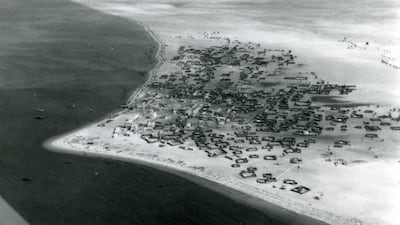
Abu Dhabi, then part of the Trucial States, pictured from above in the late 1950s / early 1960s. The emirate's coastline and palm dwellings can be seen. Photo: BP Archive -
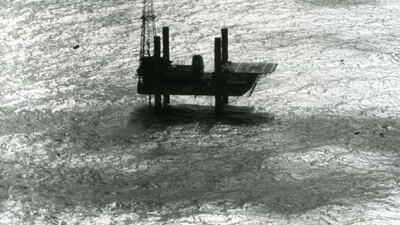
The oil rig Adman Enterprise off Das Island in 1958. Oil was struck on March 28, 1958. Photo: BP Archives -
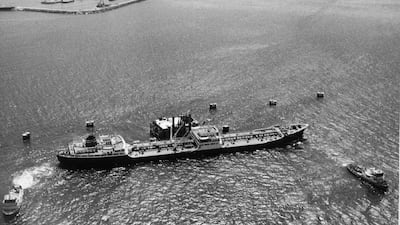
The tanker 'British Signal' moves away from the Das Island after loading with crude oil on July 4, 1962. Photo: BP Archive -
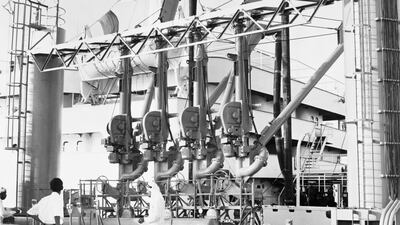
A loading berth off Das Island with BO Tanker Company's 35,000-tonne 'British Signal' loading crude in July 1962. -
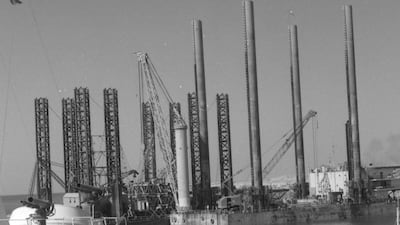
The harbour at Das Island from the deck of the ADMA tug 'Arzanah' showing the work barge 'ADMA Constructor' and the drilling barge 'Offshore 55' at berth in 1962. Photo: BP Archive -
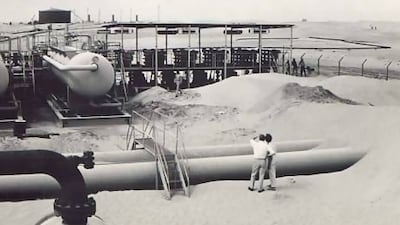
Abu Dhabi Petroleum Company production at Bu Hasa, an Empty Quarter oilfield for which a concession was granted in 1939. Photo: Total -
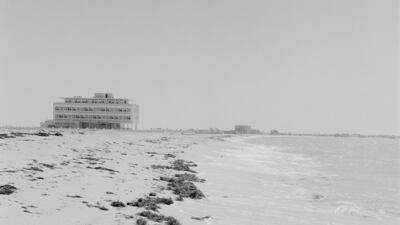
The Beach Hotel along Abu Dhabi's coast, pictured in 1962 - the year the emirate exported its first shipment of oil. Photo: BP Archive. -
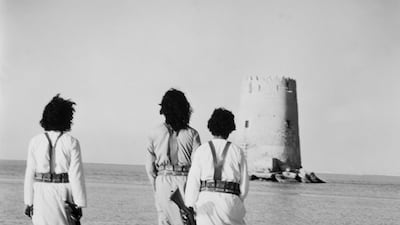
Crossing from the mainland to Abu Dhabi island in the 1950s beside the Maqta Tower, now overshadowed by the Maqta and Sheikh Zayed bridges. Photo: BP Archive -
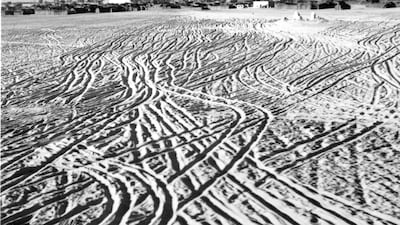
Abu Dhabi in the late 1950s or early 1960s, the view of the town from the home of a British family working in the oil industry. Photo: BP Archive -
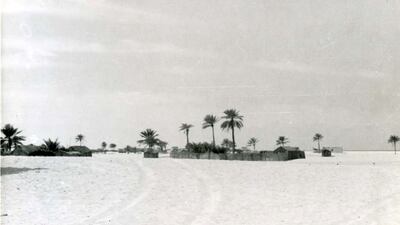
The town of Abu Dhabi in 1953. Photo: BP Archives -
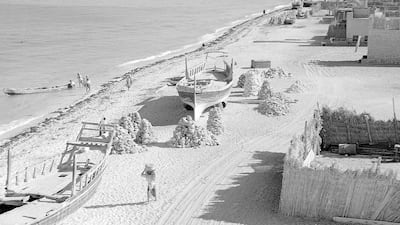
Stacks of coral dry on the beach in Abu Dhabi in the mid-20th century. Coral stone was used in the construction of many of the country's historic buildings, including Qasr Al Hosn. Photo: BP Archive -

Jacques Cousteau on board 'Calypso' in the Gulf in 1954. Photo: BP Archive -
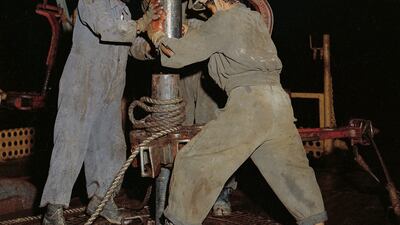
Three local workers prepare the drilling bit for an exploration well at Shuweihat on the Abu Dhabi coast in 1956. Despite reaching a depth of more than 4,000 meters, the well was dry, prompting a return to the Murban Bab field, where commercial quantities of oil were discovered four years later. Photo: Adnoc -
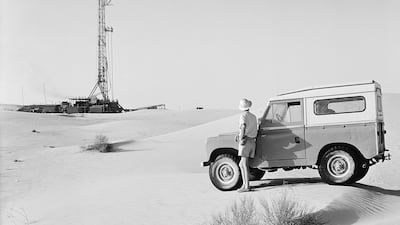
Deep in the desert, a worker with his Land Rover watches a drilling rig at the Murban Bab oil field in 1964. Photo: Adnoc -
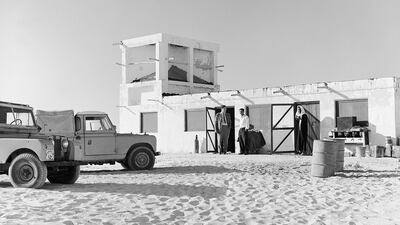
The oil company guest house in Abu Dhabi informally known as Henderson's Folly, after the UK's political officer Edward Henderson who had it built, in 1961. The building was later handed over to residents for social use to start The Club. Photo: Adnoc -

Sheikh Zayed meets with a senior official from BP in late 1957, as the concession prepares to begin drilling for oil. Photo: BP Archives -
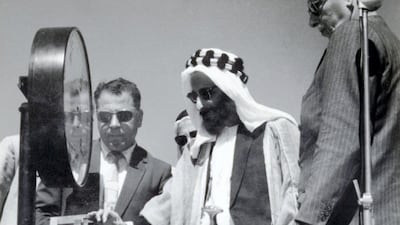
Sheikh Shakhbut, Ruler of Abu Dhabi, at the inauguration of Abu Dhabi Marine Areas Ltd's Umm Shaif oilfield October 1962. Photo: Abu Dhabi Department of Culture and Tourism -
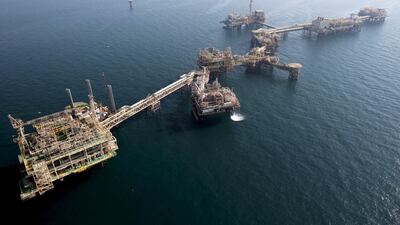
The supercomplex at Umm Shaif field in modern times. Located 150km offshore of Abu Dhabi, the oilfield is operated by Adnoc's Adma-Opco unit. Photo: Adnoc


New entrants will play some role: the massive recent deepwater discoveries in Namibia by Shell, TotalEnergies and QatarEnergy are optimistically hoped to begin output by 2026, though 2030 is more likely. South American neighbours Guyana and Suriname could produce 1-1.5 and 0.65 million bpd respectively by 2030, with smaller amounts from Uganda and Kenya.
But the emergence of other hotspots is much more difficult because of the lack of exploration spending by the western international oil companies, who are focusing their capital on the US, gas and low-carbon businesses, not on wildcatting. Even then, lengthy development timelines would see substantial oil output only by the 2030s.
Opec has faced substantial competition on three occasions: the rise of the North Sea, Alaska and Mexico in the late 1970s, the post-Soviet recovery in the early 2000s, and US shale from 2008 onwards. In the first two cases, Vienna tried unsuccessfully to entice its rivals into co-operation. That was never a prospect in the case of the fragmented, free-market American system.
Instead, US shale gave the impetus to the formation of the Opec+ alliance of 23 producers. The original Opec members realised they could not compete simultaneously with Texas and Siberia, so towards the end of 2016, they brought Russia into a wider grouping, along with some other important non-Opec states.
Opec’s all-time highest petroleum market share came in 1973 at 50.3 per cent, on the eve of the first oil shock. Now, even with strong production cuts, the proportion from the Opec+ group reached 52.4 per cent in 2021.
Historically, Opec also faced internal tensions, where at various times Iran, Iraq, Venezuela and Nigeria made dashes for higher market share. Now sanctions and political struggles mean that only Iraq remains a serious contender to the core Gulf trio of Saudi Arabia, the UAE and Kuwait.
This lack of competition may tempt the leading Opec countries to tighten the market further and aim for much higher prices. But this may not be the right course of action because unlike in the 1970s, there is an alternative to their oil today — the electric vehicle, whose use is already soaring as prices, performance and choice of models improve, and climate policy tightens.
The apparent end of the American shale revolution is a welcome relief for Opec — but also a warning to use newfound market power moderately and wisely.
Robin M Mills is CEO of Qamar Energy, and author of The Myth of the Oil Crisis

