


“We can survive. We will survive this winter season,” said Maksim Timchenko, chief executive of DTEK, the largest private energy company in Ukraine.
His company and its workers are battling to keep the country’s electricity flowing under a hail of Russian drones and missiles. The war may — hopefully — end soon, or it may drag on. But what happens to European energy supplies afterwards?
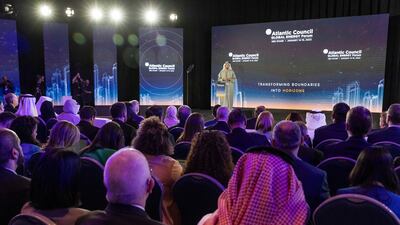
The Atlantic Council’s Global Energy Forum, held in Abu Dhabi at the weekend, contained a fascinating cast of characters of the gas business: Gulf, European and US government, major international and national oil companies, gas exporters and buyers.
Their perspectives had many commonalities but some sharp points of divergence.
Global Energy Forum — in pictures
-
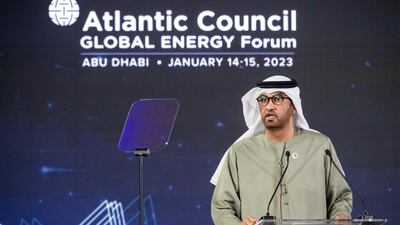
Dr Sultan Al Jaber, President-designate of Cop28, told the Atlantic Council Global Energy Forum that the world will require 'transformational' progress to meet net-zero targets. All photos: Antonie Robertson / The National -
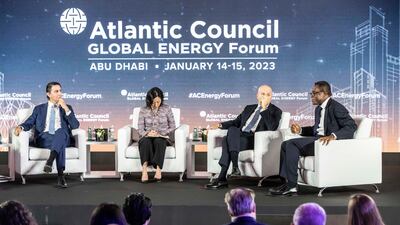
The energy forum brings together heads of state, policymakers and industry leaders for dialogue on movement towards to a net-zero future. -

Delegates at the Atlantic Council Global Energy Forum in Abu Dhabi on Saturday. -
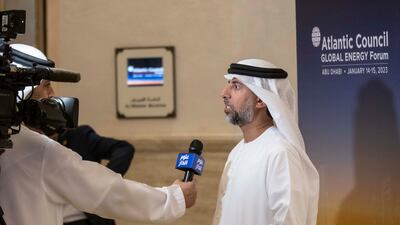
Suhail Al Mazrouei, Minister of Energy and Infrastructure, speaks to media on the sidelines of the event. -
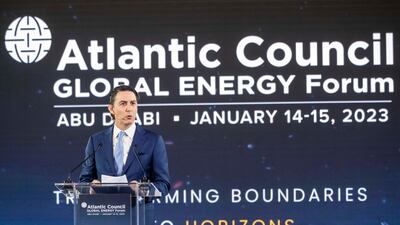
Amos Hochstein, special presidential co-ordinator for global infrastructure and energy security with the US Department of State, addresses a session. -

The Atlantic Council Global Energy Forum is a part of the Abu Dhabi Sustainability Week, which will run from January 14 to January 19. -
Dr Sultan Al Jaber, Minister of Industry and Advanced Technology, was named as president-designate of the UN Cop28 climate change summit, which will be held in the UAE this year.


The keenest differences regarded the war in Ukraine and Europe’s energy situation. These have two huge implications.
During the forum, Saad Al Kaabi, Qatar’s Minister of State for Energy Affairs and president and chief executive of QatarEnergy, said that Russian gas would be coming back into Europe at some point.
Claudio Descalzi, chief executive of Italian energy company Eni, on the other hand, answered a question about forgiving Russia with: “We have to forget Russia? It is not easy to forgive.”
Europe’s looming eastern neighbour supplied nearly 40 per cent of its gas in 2019, before the Covid-19 pandemic and war intervened.
Apart from deliveries to Turkey, only a dribble of gas via Ukraine remains and that too may soon be cut entirely. The International Energy Agency thinks Europe will be short of about 30 billion cubic metres (bcm) this year.
Historically, liquefied natural gas delivered by tanker to Europe has been a balancing factor, meeting the deficit after domestic production and Russian imports by pipeline, and accounting for swings in demand owing to weather and the economy.
Europe took in more than 80 bcm in 2011, dropping to barely 40 bcm in 2013 and 2014 as prices rose, then a record 107 bcm in 2019, a fifth of its total needs.
A Europe devoid of Russian gas will be very different. Like the Asian trio of Japan, South Korea and Taiwan, it will need huge quantities of LNG as baseload. Most of that will come from Qatar, the US and Africa. But for how long?
EU gas consumption in the August-November period was 20 per cent lower than the average of the preceding five years — even including the Covid year of 2020.
Yes, the winter was unusually warm, but the summer was hot and dry, and French nuclear reactors were down for maintenance. Despite warnings of deindustrialisation, the German economy actually grew a reasonable 1.9 per cent.
The continent has hastened its pursuit of energy efficiency and renewables. Large-scale imports of hydrogen could begin around 2026.
It plans to cut greenhouse emissions steeply by 2030 on its way to net-zero carbon by 2050 (and between 2035 and 2045 for some European countries, including Germany).
Watch: This will be 'a Cop of solidarity' says Cop28 President-designate Dr Sultan Al Jaber
Almost no new LNG export capacity will hit the market between now and 2025.
High prices and scant provisions will encourage growing Asian economies to rely on a mix of coal and renewables instead, and Japan and South Korea will try to boost their nuclear output, so Asian gas demand will not grow much.
However, from 2025 until the end of the decade, there will be a vast wave of supply from Qatar, North America, the UAE, and east and north-west Africa.
QatarEnergy is one of those carrying out a huge expansion of its LNG export capacity. Mr Al Kaabi complained of the difficulty of investing in multi-decade projects for clients who are only willing to sign up to buy gas over two to three years.
His wish for long-term contracts is very understandable given his belief that Russian gas will eventually return to Europe.
This would require an end to the war on acceptable terms to both Brussels and Kyiv, and probably major changes within the Russian political sphere.
Even then, although some relabelled Russian gas will arrive via Turkey, Europe would surely never go back to relying on Moscow for anything more than a sliver.
A combination of some returning Russian supplies, a lot of new LNG, and weakened demand in Asia and Europe gives our first major implication: global gas in the decade’s second half may suddenly be heavily oversupplied, meaning prices could tumble.
LNG output is inflexible: plants are costly to build, so they generally run as close to maximum capacity as possible.
Users of American facilities, which usually buy their gas from the grid, might cut back exports if domestic prices are relatively high and international prices low, as happened in 2020, but that is a rarity.
Russia used to provide global flexibility, scaling back exports when demand was low, as in the 2009 financial crisis.
The Netherlands’ Groningen field did the same on a smaller scale; it is now being closed down. That leaves only Norway as a likely flexible supplier of scale.
So prices will be much more volatile. They might have to drop very low at times to choke off unwanted supply.
Prices can then soar when the market tightens, as they did in August when the German government spent some €7.8 billion ($8.4 billion) to refill stocks, leaving it sitting on a paper loss of some €4.4 billion when the warm weather caused prices to tumble again.
Gas traders, sellers with access to a range of different markets and pricing mechanisms, buyers able to switch fuels or store large quantities of gas, will benefit.
Investors in long-term production and export projects will face a more challenging task in attracting financing, to a sector already suffering from banks’ aversion to fossil fuels.
The gas stakeholders gathering in Abu Dhabi might differ on forgiving and forgetting, but no one doubts that the war is a watershed for their business.
Robin M. Mills is chief executive of Qamar Energy, and author of The Myth of the Oil Crisis

