

We have pledged one of the biggest steps in the history of our organisation — to reach net zero in 10 years. For any company in any sector, that is a huge goal. For us, it is an ambitious target. We are a fossil fuel company in a country that is the third-largest member of Opec.
The UAE is based in the world’s historical centre of fossil fuel production.
Equally, we believe the energy industry lies at the core of making net zero possible. We are determined to make the next decade truly count as we strive to support the three Ps — people, planet and profit — while supporting energy security, a cornerstone of modern-day civilisation.
The need for rapid change has never been greater. The Middle East is warming at twice the global average, according to the Max Planck Institute for Chemistry.
The impact of global strain will also reverberate across the region. For one, the number of climate-related disasters worldwide has surged fivefold in the last five decades, according to the World Meteorological Organisation.
Fossil fuels 2.0
For more than 150 years, the oil and gas industry has continued to innovate, propelling the growth of the sector.
The industry has ventured into an uncharted and difficult territory to explore and produce fossil fuels. It has nurtured cross-border partnerships, often insulated from turbulent geopolitics, finding common ground and establishing best standards, especially in health and safety, as well as technology advancements.
Against this backdrop lies a rallying cry for the sector to pivot, using decades of experience in troubleshooting to tackle the challenges of net zero, efficiently and effectively.
We are already seeing the positive power of this transition in the UAE, the first nation in the Mena region to announce a net-zero target, by 2050, when others have set 2060 or 2070 as targets.
The UAE and the world’s other energy giants will have a global stage to showcase how they can help achieve one of the trickiest balancing acts in modern history — achieve net zero without jeopardising energy security — at Cop28 in Dubai later this year. The biggest global climate gathering must move the needle this year.
Hitting the accelerator
We have a busy and exciting decade ahead. Our plans include establishing a carbon capture and storage business by 2025 and building solar power stations to replace our energy consumption by 2032.
We will also sponsor research on energy storage and green hydrogen at the American University of Sharjah and the University of Sharjah, supporting the UAE’s goal to capture 25 per cent of the world’s low-carbon hydrogen market by 2030.
Plans to convert our fleet of company vehicles to make them electric are under way too, among many other endeavours.
The road ahead will bring challenges but we have some practice; we have been making environmental strides for decades. For one, nearly all our methane emissions — the second largest man-made cause of climate change after carbon dioxide emissions — have been abated since 2000.
This is important considering the oil and gas industry is the number one cause of global methane emissions, which can be 28 times more potent on a 100-year time scale than carbon dioxide.
Sharjah National Oil Corporation (SNOC) introduced a zero-operational-flare policy more than 20 years ago. Even during operational upsets, we prioritise “no flaring” over “production”.
-
-
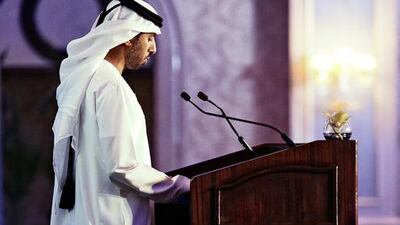
The experience of Suhail Al Mazrouei, the Energy Minister, represents Abu Dhabi’s new priorities of becoming a global player and not just in oil but also in solar, wind and nuclear. Lee Hoagland / The National -
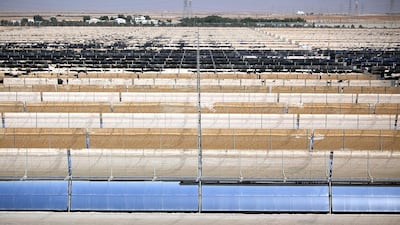
The Dh2.2 billion Shams 1 solar power plant, with a capacity of 100 megawatts, can provide power to 20,000 homes. Silvia Razgova / The National -
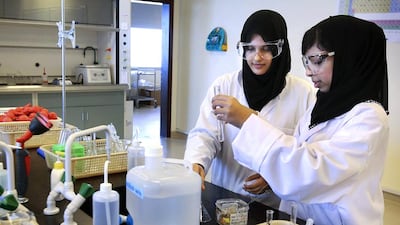
Female Emiratis are entering Abu Dhabi’s dedicated women’s college for petroleum engineering at the Petroleum Institute and its MIT-affiliated clean technology university, the Masdar Institute. Delores Johnson / The National -
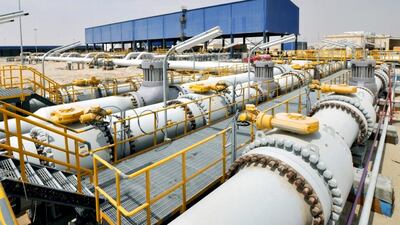
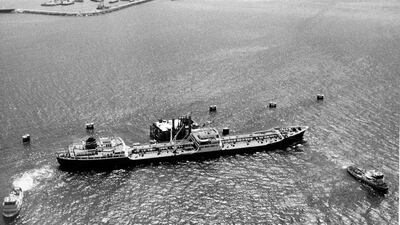
Abu Dhabi Crude Oil Pipeline allows the transportation of Abu Dhabi’s onshore crude from Habshan in Abu Dhabi to a terminal and export facilities in Fujairah, bypassing the potential bottleneck of the Strait of Hormuz. Courtesy Ipic


We also have a continuing programme to identify and mitigate all leaks in the flare system. Tackling flaring is key to enhancing energy efficiency; the natural gas flared worldwide in 2021 was equivalent to the total volume of natural gas imported into Germany, France and the Netherlands, according to the International Energy Agency.
Another environmental campaign of ours from 1998 to 2003 included shutting down redundant equipment to reduce gas consumption. Meters were also installed on all flares to monitor volumes and a robust greenhouse gas (GHG) measurement and accounting system was established — one that is still in use today.
Over the years, we have also converted 15 per cent of power consumption at our liquefied petroleum, gas and condensate export terminals into solar power.
We also launched an education campaign called ‘Net Zero in SNOC and Beyond’ in 2022, which focuses on enhancing awareness of climate change, global warming and the linkage to GHG emissions.
It is focused on our employees, their families, university students and the community at large — the energy guardians of the future.
We wholeheartedly believe that the dedication and creativity of our hearts and minds will make our journey to net zero — the toughest goal the world’s energy sector has ever collectively faced — possible in less than 10 years.
Hatem Al Mosa is chief executive of Sharjah National Oil Corporation

