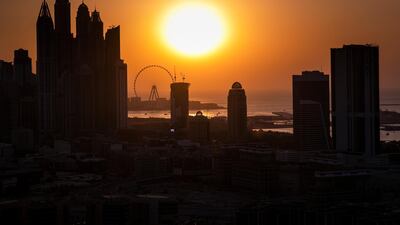

UAE companies are more optimistic than their global peers about profitability returning to pre-Covid levels in the next two years as business slowly recovers.
About nine in 10 companies in the country said they expect to be profitable by the end of 2022, compared with the global average of 81 per cent, according to the HSBC Navigator survey.
The study revealed that 18 per cent expect to be profitable by the end of this year.
“UAE companies have always been resilient and innovative,” said Daniel Howlett, HSBC’s regional head of commercial banking in the Mena region and Turkey.
“Despite the slowdown during the pandemic, business is slowly returning to pre-Covid levels and companies are finding ways to maximise their potential, adapt to the new environment and really focus on sustainable measures that will help their companies grow and be able to future-proof them from unexpected disruptions.”
The survey polled more than 10,368 companies in 39 markets, including 151 companies in the UAE and another 560 in the Mena region and Turkey.
The study gauged their sentiment and expectations in the short to medium term on issues such as outlook, future strategy, international trade, supply chains and sustainability.
The UAE was one of the first countries in the region to unveil stimulus packages to protect businesses from the coronavirus-induced slowdown.
Last month, the UAE Central Bank extended its Dh50 billion ($13.61bn) Targeted Economic Support Scheme to June 30, 2021, to continue supporting the economy.
Sheikh Mohammed bin Rashid, Vice President and Ruler of Dubai, said on Saturday the country will recover from the pandemic quicker than other countries, with an economic rebound expected next year.
More than eight in 10 UAE businesses said they will increase their investments next year, compared with 67 per cent worldwide, according to the survey.
Product and process innovation, marketing and customer experience were the three most cited investment priorities.
______________
Coronavirus around the world – December 6
-
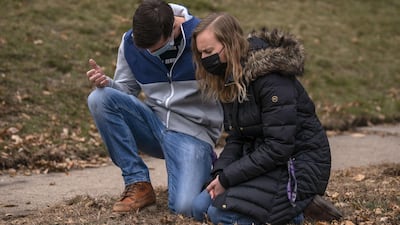
A couple kneel and pray as a group of counter protesters arrive to face off with conservative protesters rallying near the Governor's Mansion in St Paul, Minnesota. People gathered to demand a response from Governor Tim Walz and protest the state's coronavirus lockdown measures and the results of the recent presidential election. AFP -

Santa Claus greets a child from inside a bubble during the Lights on Broadway event in Oklahoma City, Oklahoma, US. Bloomberg -

Santa Claus greets a child from inside a bubble during the Lights on Broadway event in Oklahoma City, Oklahoma, US. Bloomberg -
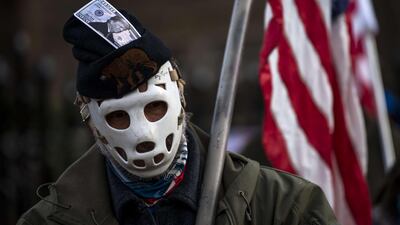
A man wears a hockey mask and a hat with a dollar bill imprinted with President Donald Trump looks on as protesters rally outside the Governor's Mansion in St Paul, Minnesota. AFP -
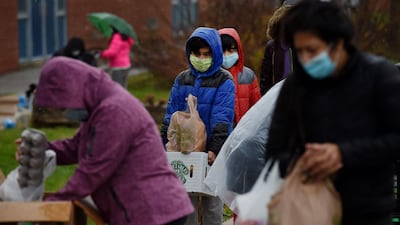
People carry food donated by volunteers from the Baltimore Hunger Project outside of Padonia International Elementary school in Cockeysville, Maryland. AFP -

A group of artists entertain people driving through with their cars on the eve of St Nicholas Day in Prague, Czech Republic. Getty Images -
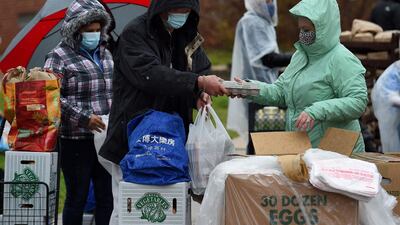
Volunteers from the Baltimore Hunger Project pass out food to people in need outside of Padonia International Elementary school in Cockeysville, Maryland. AFP -
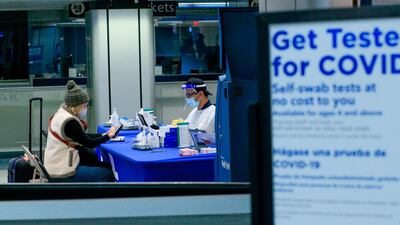
A woman gets a self coronavirus test at a free walk-up Covid-19 testing site inside Penn Station in New York City. AFP -

Crowds of people listen to a busker in Covent Garden in London, England. Getty Images -
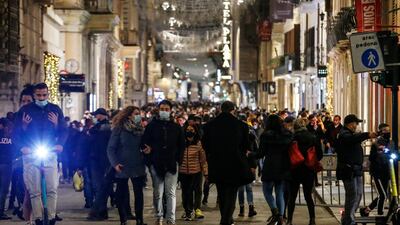
People stroll in Via del Corso shopping street, downtown Rome. AP -
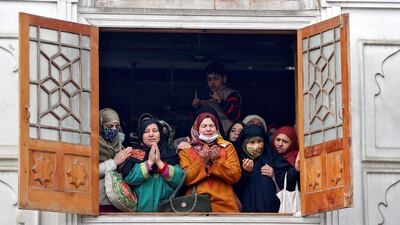
Kashmiri Muslim women react upon seeing a relic of Sheikh Abdul Qadir Jeelani, a Sufi saint also known as Shah-e-Baghdad (King of Baghdad), a week after Jeelani's death, at his shrine, amidst the spread of the coronavirus disease in Srinagar. Reuters -
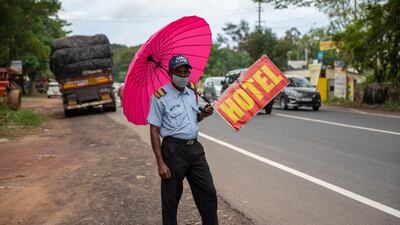
An Indian security guard wearing a mask as a precaution against the coronavirus stands holding a signage by the side of a highway to attract customers to a restaurant in Alappuzha, Kerala state, India. AP Photo -

Pakistani religious students wear face masks as they reads verses from the Quran at a Mosque during lockdown after new cases were reported in Karachi, Pakistan. EPA


______________
While 74 per cent of businesses from the UAE said international trade had become more difficult, their commitment to pursue international opportunities appears to be undiminished, the survey said.
Nine in 10 UAE companies said they are optimistic about the next one to two years, compared with 72 per cent worldwide. Only 8 per cent had a negative outlook, compared with 22 per cent globally.
Issues related to sustainability have also become important for companies.
More than 85 per cent of companies in the UAE said they had set targets for a broad range of environmental, social and governance issues.
Almost all companies in the UAE said there were several opportunities to improve their environmental and ethical sustainability goals, with customer demand, investment inflows and employee well-being at the top of the list.
In September, HSBC helped the Saudi Electricity Company raise $1.3 billion in the first public, US dollar-denominated green issuance from the kingdom.
A few weeks later, the bank helped Egypt issue the region's first sovereign green bond.
HSBC also helped Saudi Arabia’s Ministry of Finance to raise $258 million through the region’s first green Export Credit Agency loan.

