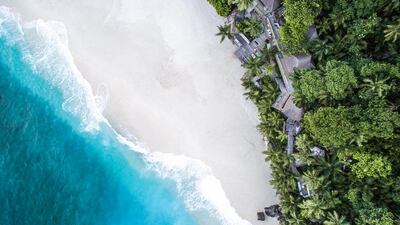
The government of the Seychelles has purchased Etihad Airways’ 40 per cent stake in its flag carrier. Courtesy North Island, Seychelles.

Etihad divests full stake in Air Seychelles


Deena Kamel
  • English
  • Arabic

Etihad Airways sold its 40 per cent stake in Air Seychelles to the Indian Ocean island as the Abu Dhabi airline moves away from a strategy of growth through investments in other airlines.

Etihad announced that its management contract had also ended but said Air Seychelles' chief executive Remco Althuis and chief financial officer Michael Berlouis would stay on until June 30 to assist with the airline’s transition.

An Etihad spokeswoman said the UAE airline would no longer be a shareholder in Air Seychelles but she did not provide the value of the sale. Etihad acquired the stake in 2012.

The move is in line with Etihad’s five-year restructuring plan under which it is stepping back from its global equity alliance strategy and repositioning itself as a mid-sized boutique airline operating smaller, wide-body aircraft.

Boeing's 787 Dreamliner will serve as the “backbone” of the fleet.

For the Seychelles, famous for its turquoise beaches and diving spots, the deal is an opportunity to focus on profitable routes as air travel recovers from the coronavirus-induced slowdown that crimped demand.

“This is a time of opportunity for both Air Seychelles and the country as tourism starts to rebuild following the reopening of its borders,” Etihad said.

The airline said it remained committed to Air Seychelles as a commercial codeshare partner.

“The Seychelles is an important destination on Etihad’s global network, with bookings steadily increasing following its reopening to tourism,” Etihad said.

Patrick Payet, the island nation's Secretary of State in the Ministry of Finance, said a debt of $72.3 million that Air Seychelles owed Etihad had been discounted by 79 per cent, according to the Seychelles News Agency. Repayment of the remaining debt will start from 2022 onwards.

The Seychelles also offered to pay $20m of the $71.5m still owed to bondholders, he said.

The island nation is in discussions with the Trade Development Bank for a government loan to pay bondholders and Etihad, he said.

“All of these liabilities will be in the government’s books, so Air Seychelles will have a clean sheet from the liability that they have,” said Mr Payet.

A new board of directors has been appointed at Air Seychelles that will appoint a new chief executive and chief financial officer, the news agency reported, quoting government officials.

The board will also review the airline’s operations and make recommendations to the government, it said.


In numbers: China in Dubai

The number of Chinese people living in Dubai: An estimated 200,000

Number of Chinese people in International City: Almost 50,000

Daily visitors to Dragon Mart in 2018/19: 120,000

Daily visitors to Dragon Mart in 2010: 20,000

Percentage increase in visitors in eight years: 500 per cent

How it works

A $10 hand-powered LED light and battery bank

Device is operated by hand cranking it at any time during the day or night 

The charge is stored inside a battery

The ratio is that for every minute you crank, it provides 10 minutes light on the brightest mode

A full hand wound charge is of 16.5minutes 

This gives 1.1 hours of light on high mode or 2.5 hours of light on low mode

When more light is needed, it can be recharged by winding again

The larger version costs between $18-20 and generates more than 15 hours of light with a 45-minute charge

No limit on how many times you can charge


ANATOMY%20OF%20A%20FALL
%3Cp%3E%3Cstrong%3EDirector%3A%20%3C%2Fstrong%3EJustine%20Triet%3C%2Fp%3E%0A%3Cp%3E%3Cstrong%3EStarring%3A%20%3C%2Fstrong%3ESandra%20Huller%2C%20Swann%20Arlaud%2C%20Milo%20Machado-Graner%3C%2Fp%3E%0A%3Cp%3E%3Cstrong%3ERating%3A%3C%2Fstrong%3E%205%2F5%3C%2Fp%3E%0A

Mercer, the investment consulting arm of US services company Marsh & McLennan, expects its wealth division to at least double its assets under management (AUM) in the Middle East as wealth in the region continues to grow despite economic headwinds, a company official said.

Mercer Wealth, which globally has $160 billion in AUM, plans to boost its AUM in the region to $2-$3bn in the next 2-3 years from the present $1bn, said Yasir AbuShaban, a Dubai-based principal with Mercer Wealth.

Within the next two to three years, we are looking at reaching $2 to $3 billion as a conservative estimate and we do see an opportunity to do so,” said Mr AbuShaban.

Mercer does not directly make investments, but allocates clients’ money they have discretion to, to professional asset managers. They also provide advice to clients.

“We have buying power. We can negotiate on their (client’s) behalf with asset managers to provide them lower fees than they otherwise would have to get on their own,” he added.

Mercer Wealth’s clients include sovereign wealth funds, family offices, and insurance companies among others.

From its office in Dubai, Mercer also looks after Africa, India and Turkey, where they also see opportunity for growth.

Wealth creation in Middle East and Africa (MEA) grew 8.5 per cent to $8.1 trillion last year from $7.5tn in 2015, higher than last year’s global average of 6 per cent and the second-highest growth in a region after Asia-Pacific which grew 9.9 per cent, according to consultancy Boston Consulting Group (BCG). In the region, where wealth grew just 1.9 per cent in 2015 compared with 2014, a pickup in oil prices has helped in wealth generation.

BCG is forecasting MEA wealth will rise to $12tn by 2021, growing at an annual average of 8 per cent.

Drivers of wealth generation in the region will be split evenly between new wealth creation and growth of performance of existing assets, according to BCG.

Another general trend in the region is clients’ looking for a comprehensive approach to investing, according to Mr AbuShaban.

“Institutional investors or some of the families are seeing a slowdown in the available capital they have to invest and in that sense they are looking at optimizing the way they manage their portfolios and making sure they are not investing haphazardly and different parts of their investment are working together,” said Mr AbuShaban.

Some clients also have a higher appetite for risk, given the low interest-rate environment that does not provide enough yield for some institutional investors. These clients are keen to invest in illiquid assets, such as private equity and infrastructure.

“What we have seen is a desire for higher returns in what has been a low-return environment specifically in various fixed income or bonds,” he said.

“In this environment, we have seen a de facto increase in the risk that clients are taking in things like illiquid investments, private equity investments, infrastructure and private debt, those kind of investments were higher illiquidity results in incrementally higher returns.”

The Abu Dhabi Investment Authority, one of the largest sovereign wealth funds, said in its 2016 report that has gradually increased its exposure in direct private equity and private credit transactions, mainly in Asian markets and especially in China and India. The authority’s private equity department focused on structured equities owing to “their defensive characteristics.”