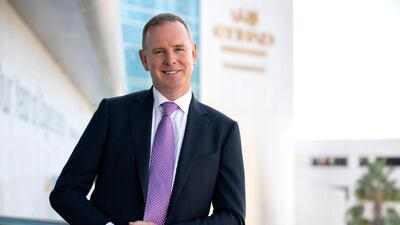
Tony Douglas, group CEO of Etihad airways. The airline reported full-year results for 2020 on March 4.

Etihad Airways sees more travel corridors in summer with vaccines easing restrictions, CEO says


Deena Kamel
  • English
  • Arabic

Etihad Airways expects the list of travel corridors between countries to grow this summer as the pace of Covid-19 vaccinations accelerates, herd immunity strengthens and rapid testing technology improves, its chief executive said.

While the current lockdowns imposed by governments are a concern for the industry, a higher vaccine curve and faster PCR testing could ease travel restrictions and unlock pent-up travel demand, Tony Douglas, chief executive of Etihad Aviation Group, told The National. 

As the vaccination curve rises into the 60th or 70th percentiles in Europe, Asia, Israel and the UAE, more governments will lift travel restrictions if passengers have the appropriate vaccine or testing certificates on arrival and departure, he said.
"As we get into the summer months, unless vaccine programmes slow down or there is a flaw in the strategy, things will start to tip back into the right direction in a whole bunch of countries," Mr Douglas said.

"My expectation is that we'll start to see the list of countries that are able to have travel corridors will get longer and longer, which will be heavily impacted by the way in which vaccines give that assurance."

We will come out of this fine.

New virus variants are prompting governments to tighten travel restrictions, which is hurting the outlook for airlines, according to the International Air Transport Association (Iata).

Mr Douglas said he does not expect air travel to return to pre-crisis levels until 2023.

"We're expecting 2021 to be a very difficult year, we're expecting 2022 to be a transition year and we're expecting 2023 sees us slowly getting back to pre-Covid passenger numbers," he said. "We've budgeted for 2021 to be a continuation of many of the challenges we faced last year."

Etihad's core operating loss in 2020 more than doubled to $1.7 billion from the previous year, as passenger traffic fell 76 per cent due to the pandemic, which also pushed global peers such as Qantas and British Airways-parent IAG into the red.

Full-year passenger revenue dropped 74 per cent to $1.2bn as the airline carried 4.2 million people, down from 17.4 million in 2019, the carrier said on Thursday. That was due to lower demand, fewer scheduled flights and the UAE's suspension of passenger services in late March to curb the spread of the virus, Etihad said.

Etihad's full-year loss "could have easily doubled" had it not been for the airline's ongoing five-year turnaround plan, which it accelerated due to the pandemic, Mr Douglas said.

.
.

"Had we not been engaged in the transformation programme and had we not accelerated it as a result of Covid, it would have been an awful lot more," he said. "We put the metal down on the floor on the transformation agenda and it was difficult because we had to make further network and fleet decisions."

Etihad aims to narrow its losses in 2021 compared to 2020, Mr Douglas said, adding the caveat of the uncertainty arising from the pandemic.

In 2021, the airline plans to recover revenue while maintaining an "obsessive level" of attention to costs, as vaccinations, PCR testing and health certificates unlock pent-up travel demand later this year, Mr Douglas said.

Last year, Etihad reduced operating costs by 39 per cent year-on-year to $3.3bn, due to a combination of reduced capacity and cost containment measures.

Etihad plans to operate as a mid-sized carrier, building its operations around smaller twin-engine aircraft, and focusing on the Boeing 787 Dreamliner as the "backbone" of its fleet. At the end of 2020, the airline operated to 50 passenger and seven cargo destinations from Abu Dhabi, representing approximately 35 per cent of its pre-Covid capacity.

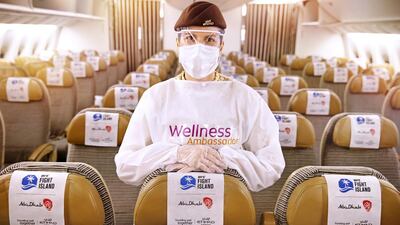
  • Etihad Wellness Ambassador prepares to welcome passengers on board an Etihad aircraft. Courtesy of Etihad Airways
    Etihad Wellness Ambassador prepares to welcome passengers on board an Etihad aircraft. Courtesy of Etihad Airways
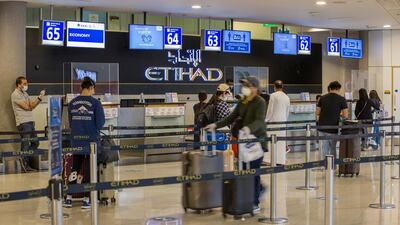
  • Stickers on the floor encouraging passengers to remain 2 metres apart while queueing. Courtesy of Etihad Airways.
    Stickers on the floor encouraging passengers to remain 2 metres apart while queueing. Courtesy of Etihad Airways.
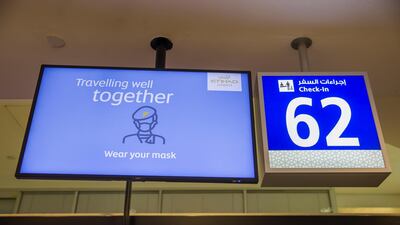
  • TV screen encouraging travellers to wear masks. Courtesy of Etihad Airways
    TV screen encouraging travellers to wear masks. Courtesy of Etihad Airways
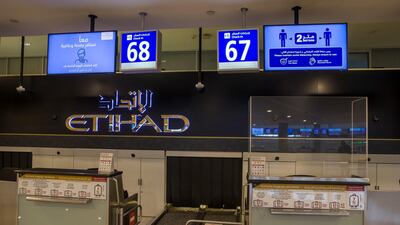
  • Plastic barriers around the check in area protecting both staff and passengers. Courtesy of Etihad Airways
    Plastic barriers around the check in area protecting both staff and passengers. Courtesy of Etihad Airways
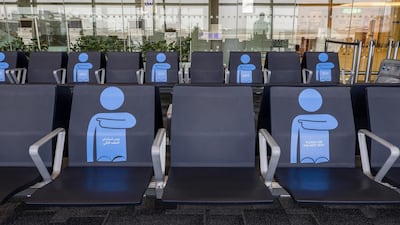
  • Signage encouraging social distancing on public seating in Abu Dhabi International Airport. Courtesy of Etihad Airways
    Signage encouraging social distancing on public seating in Abu Dhabi International Airport. Courtesy of Etihad Airways
  • Temperature scanning at a sanitisation booth. Courtesy of Etihad Airways.
    Temperature scanning at a sanitisation booth. Courtesy of Etihad Airways.
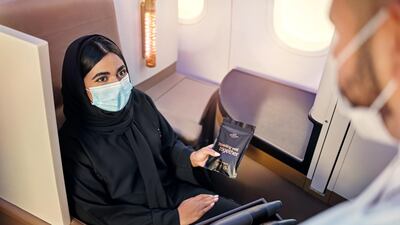
  • A passenger receiving an Etihad Wellness kit. Courtesy of Etihad Airways
    A passenger receiving an Etihad Wellness kit. Courtesy of Etihad Airways

Besides its 40 Dreamliners, Etihad will deploy its 12 Airbus A350s but not in 2021 or 2022, the chief executive said.

"It's one of those where you segment how you fight your way through 2021-2022 and we'd do that with the 787s predominantly," he said.

Of its 10 Airbus A380 superjumbos, Mr Douglas said: "We have now taken the strategic decision to park the A380s, I'm sure it's very likely that we won't see them operating with Etihad again."

Etihad has Boeing 777-9s on order, with the US manufacturer delaying the plane's debut to 2023. Mr Douglas said the date for Etihad deliveries is a question for Boeing.

"I'm not sure they know and it will probably be some time until they can answer it intelligently because of the Covid impact," he said.

Asked if Etihad is considering converting the 777X order for Dreamliners, he said: "When you're in a street fight with Covid, it's almost irrelevant, because the deliveries are way out in the future anyway. The trick to this one is to focus on 2021-2022 ... that journey is a 787 Dreamliner journey."

The aviation industry is among the worst-hit sectors during the Covid-19 crisis, forcing airlines to cut thousands of jobs, ground aircraft and seek government aid.

The airline’s total workforce shrank 33 per cent to a total of 13,587 employees by the end of 2020, compared to 20,369 in 2019.

Another wave of job cuts is in progress for 2021, but it will be "smaller significantly" than last year, he said, without providing an exact number.

The state-owned carrier plans to refinance existing debt that has been on its balance sheet since 2014 and maturing this year, Mr Douglas said. It will replace it with long-term debt and is open to a variety of financing instruments.

Asked if Etihad will seek government aid to bolster its finances during the Covid crisis, as other airlines have done, Mr Douglas said the carrier will continue to accelerate its transformation plan.

Airlines who got the biggest chunks of government bailouts such as Lufthansa, Cathay Pacific, Singapore Airlines and US carriers are the ones seeing recovery take longer because they've been given the funds to bolster their balance sheets, he said.

"The jury will always be out in my mind about that because on one hand you preserve a national asset but on the other hand, back to what transformation is all about, you don't make them as agile and resourceful," Mr Douglas said.

There is a silver lining for airlines who use the crisis as an accelerator to become more agile and who stay focused on sustainable flying, he said.

A focus on sustainability will separate long-term winners from those who "fall by the wayside", Mr Douglas said.

In 2020 alone, more than 40 commercial carriers stopped or suspended operations globally, according to Cirium.

Air cargo is another bright spot, with Etihad earning $1.2bn in revenue, a 66 per cent increase from 2019, driven by demand for medical supplies.

"There will be an end to this. 2021 will be the year of how this not only turns a corner but resets. Vaccine and testing will be key ingredients to this," he said. "Governments in a controlled way will connect travel flows on a bilateral basis from A to B and the winners will be the ones who develop ways to handle this from a wellness point of view."

More than 75 per cent of the airline's UAE-based workforce has been vaccinated, and Etihad is the first airline globally to have 100 per cent of its flight crew inoculated.

The push towards digital health passports will very quickly mature this year and more people will "adapt and adopt to the new norm" of vaccines and PCR testing, he said. "We will come out of this fine."

McLaren GT specs

Engine: 4-litre twin-turbo V8

Transmission: seven-speed

Power: 620bhp

Torque: 630Nm

Price: Dh875,000

On sale: now

EA Sports FC 26

Publisher: EA Sports

Consoles: PC, PlayStation 4/5, Xbox Series X/S

Rating: 3/5

ESSENTIALS

The flights

Emirates flies direct from Dubai to Rio de Janeiro from Dh7,000 return including taxes. Avianca fliles from Rio to Cusco via Lima from $399 (Dhxx) return including taxes. 

The trip

From US$1,830 per deluxe cabin, twin share, for the one-night Spirit of the Water itinerary and US$4,630 per deluxe cabin for the Peruvian Highlands itinerary, inclusive of meals, and beverages. Surcharges apply for some excursions.

Ten tax points to be aware of in 2026

1. Domestic VAT refund amendments: request your refund within five years

If a business does not apply for the refund on time, they lose their credit.

2. E-invoicing in the UAE

Businesses should continue preparing for the implementation of e-invoicing in the UAE, with 2026 a preparation and transition period ahead of phased mandatory adoption. 

3. More tax audits

Tax authorities are increasingly using data already available across multiple filings to identify audit risks. 

4. More beneficial VAT and excise tax penalty regime

Tax disputes are expected to become more frequent and more structured, with clearer administrative objection and appeal processes. The UAE has adopted a new penalty regime for VAT and excise disputes, which now mirrors the penalty regime for corporate tax.

5. Greater emphasis on statutory audit

There is a greater need for the accuracy of financial statements. The International Financial Reporting Standards standards need to be strictly adhered to and, as a result, the quality of the audits will need to increase.

6. Further transfer pricing enforcement

Transfer pricing enforcement, which refers to the practice of establishing prices for internal transactions between related entities, is expected to broaden in scope. The UAE will shortly open the possibility to negotiate advance pricing agreements, or essentially rulings for transfer pricing purposes. 

7. Limited time periods for audits

Recent amendments also introduce a default five-year limitation period for tax audits and assessments, subject to specific statutory exceptions. While the standard audit and assessment period is five years, this may be extended to up to 15 years in cases involving fraud or tax evasion. 

8. Pillar 2 implementation 

Many multinational groups will begin to feel the practical effect of the Domestic Minimum Top-Up Tax (DMTT), the UAE's implementation of the OECD’s global minimum tax under Pillar 2. While the rules apply for financial years starting on or after January 1, 2025, it is 2026 that marks the transition to an operational phase.

9. Reduced compliance obligations for imported goods and services

Businesses that apply the reverse-charge mechanism for VAT purposes in the UAE may benefit from reduced compliance obligations. 

10. Substance and CbC reporting focus

Tax authorities are expected to continue strengthening the enforcement of economic substance and Country-by-Country (CbC) reporting frameworks. In the UAE, these regimes are increasingly being used as risk-assessment tools, providing tax authorities with a comprehensive view of multinational groups’ global footprints and enabling them to assess whether profits are aligned with real economic activity. 

Contributed by Thomas Vanhee and Hend Rashwan, Aurifer

You may remember …

Robbie Keane (Atletico de Kolkata) The Irish striker is, along with his former Spurs teammate Dimitar Berbatov, the headline figure in this season’s ISL, having joined defending champions ATK. His grand entrance after arrival from Major League Soccer in the US will be delayed by three games, though, due to a knee injury.

Dimitar Berbatov (Kerala Blasters) Word has it that Rene Meulensteen, the Kerala manager, plans to deploy his Bulgarian star in central midfield. The idea of Berbatov as an all-action, box-to-box midfielder, might jar with Spurs and Manchester United supporters, who more likely recall an always-languid, often-lazy striker.

Wes Brown (Kerala Blasters) Revived his playing career last season to help out at Blackburn Rovers, where he was also a coach. Since then, the 23-cap England centre back, who is now 38, has been reunited with the former Manchester United assistant coach Meulensteen, after signing for Kerala.

Andre Bikey (Jamshedpur) The Cameroonian defender is onto the 17th club of a career has taken him to Spain, Portugal, Russia, the UK, Greece, and now India. He is still only 32, so there is plenty of time to add to that tally, too. Scored goals against Liverpool and Chelsea during his time with Reading in England.

Emiliano Alfaro (Pune City) The Uruguayan striker has played for Liverpool – the Montevideo one, rather than the better-known side in England – and Lazio in Italy. He was prolific for a season at Al Wasl in the Arabian Gulf League in 2012/13. He returned for one season with Fujairah, whom he left to join Pune.

What drives subscription retailing?

Once the domain of newspaper home deliveries, subscription model retailing has combined with e-commerce to permeate myriad products and services.

The concept has grown tremendously around the world and is forecast to thrive further, according to UnivDatos Market Insights’ report on recent and predicted trends in the sector.

The global subscription e-commerce market was valued at $13.2 billion (Dh48.5bn) in 2018. It is forecast to touch $478.2bn in 2025, and include the entertainment, fitness, food, cosmetics, baby care and fashion sectors.

The report says subscription-based services currently constitute “a small trend within e-commerce”. The US hosts almost 70 per cent of recurring plan firms, including leaders Dollar Shave Club, Hello Fresh and Netflix. Walmart and Sephora are among longer established retailers entering the space.

UnivDatos cites younger and affluent urbanites as prime subscription targets, with women currently the largest share of end-users.

That’s expected to remain unchanged until 2025, when women will represent a $246.6bn market share, owing to increasing numbers of start-ups targeting women.

Personal care and beauty occupy the largest chunk of the worldwide subscription e-commerce market, with changing lifestyles, work schedules, customisation and convenience among the chief future drivers.

Our family matters legal consultant

Name: Hassan Mohsen Elhais

Position: legal consultant with Al Rowaad Advocates and Legal Consultants.

Analysis

Members of Syria's Alawite minority community face threat in their heartland after one of the deadliest days in country’s recent history. Read more

Desert Warrior

Starring: Anthony Mackie, Aiysha Hart, Ben Kingsley

Director: Rupert Wyatt

Rating: 3/5