


The UK government has thrown its support behind the construction of a third runway at London’s Heathrow Airport.
In a speech on Wednesday, Chancellor Rachel Reeves set out its determination to drive growth in the economy, with expanded airports at the heart of the plan. Ms Reeves said the government “cannot duck the decision any longer” and that a third runway at Heathrow would “unlock further growth”.
“Now, the case is stronger than ever, because our reforms to the economy, like speeding up the planning system and our plans to modernise UK airspace, mean the delivery of this project is now set up for success,” she said.
She said a third runway at the airport was “badly needed”, that the previous government had taken no action on it and claimed no full-length runway has been built in Britain since the 1940s.
“By backing a third runway at Heathrow, we can make Britain the world’s best connected place to do business,” she said. She pointed out that the funding will have to come from private sources, not taxpayers' pockets.

The plan
- Ms Reeves said the government has “invited proposals for the third runway to come forward by the summer”.
- They will “ensure that the project is value for money” and also that “any associated service transport costs will be financed through private funding”.
- A third runway would be delivered in line with “legal, environmental and climate objectives”.
- Heathrow chief executive Thomas Woldbye said the airport would work with the government on planning reform
- Mayor of London Sadiq Khan said he remains “opposed” to Heathrow expansion because of its “severe impact”.
- The airport needs to approval for a development consent order to go ahead with the project.
Mr Woldbye enthusiastically greeted the government's support for the third runaway, saying that it would “create jobs and drive trade, tourism and inward investment to every part of the country” and would also give airlines and passengers the “competitive, resilient hub airport they expect while putting the UK back on the map at the heart of the global economy”.
Likewise, Kenton Jarvis, the chief executive of the low-cost carrier easyJet, welcomed Ms Reeves’s announcement on the third runway, adding that “expansion at Heathrow will provide consumer and economic benefits and represents a unique opportunity for easyJet to operate from the airport at scale for the first time and bring with it lower fares for consumers”.
But others were less enthusiastic. Doug Parr, UK policy director at Greenpeace, said Ms Reeves is “dead right that tackling climate change is the biggest industrial opportunity of the 21st century, but dead wrong to think airport expansion is the way to seize it”.
"A third runway at Heathrow is unlikely to boost the UK economy but will certainly boost noise, air pollution and climate emissions,” he said.
“It’s airlines and airport bosses who will reap the lion’s share of economic benefits, leaving taxpayers and holidaymakers to pay billions for new infrastructure and transport links.”
Nonetheless, Surinder Arora, the founder and executive chairman of Arora, a hotel and property conglomerate that includes the Hilton, Sofitel, Radisson Blu and Renaissance hotels at Heathrow, was “delighted” by Ms Reeves’s comments, but warned that the whole process of building a third runway at Heathrow will need significant supervision.
“They get our tick in the box, absolutely, as long as we make sure the regulatory side is brought up to date, so [Heathrow’s] shareholders cannot milk the system,” Mr Arora told The National.

Jobs surge
As the UK economy struggles with low economic growth and numbers that seem to constantly flirt with recession, expanding capacity at London’s airports must seem an easy win for the government.
By some measures, a third runway at Heathrow will create tens of thousands of jobs, bring in many tens of billions into the UK economy and even lower the price of airfares by 20 per cent.
In her speech, Ms Reeves said 100,000 jobs would be created. Giving Heathrow such a serious upgrade would put it back in a competitive position with its European rivals. After all, Paris's Charles de Gaulle and Frankfurt Airport both have four runways and Amsterdam's Schiphol has six.
The airport with the most runways in the world is Chicago's O'Hare, which has eight.
Heathrow is owned by Heathrow Airport Holdings, which is itself owned by FGP Topco, a consortium owned and led by a mixture of sovereign wealth funds and pension companies based in several countries. The largest shareholders are the French private equity company Ardian (22.61 per cent), the Qatar Investment Authority (20 per cent), Saudi Arabia’s Public Investment Fund (15 per cent), the Singapore sovereign wealth fund GIC (11.2 per cent), the Australian Retirement Trust (11.18 per cent) and China Investment Corporation (10 per cent).
The controversy over the third runway has, at least until now, meant politicians have mostly preferred to shelve the idea rather than support it. In fact, along with the Prime Minister himself, several members of Keir Starmer’s current cabinet voted against the third runway project six years ago, when they were opposition MPs.
They included current Environment Minister Steve Reed, Energy and Climate Change Minister Ed Miliband, Culture Minister Lisa Nandy and Northern Ireland Minister Hilary Benn. In total, 94 Labour MPs opposed expanding Heathrow in that showdown vote regarding the National Policy Statement on Airports. However, the motion passed by 415 votes to 119.
In 2018, Mr Khan said expansion at Heathrow was not the right answer and that he was “committed to opposing such a short-sighted decision”. In response to the Labour government’s enthusiasm now, Mr Khan − who is still Mayor of London − reiterated his opposition to the third runway. He cited “the negative impact on air quality, noise and London’s ability to reach net zero by 2030”.

Villages demolished
Heathrow’s proposed third runway is by far the largest and most controversial of all the expansion plans for London’s airports. A new terminal is planned for Luton, while Gatwick’s £2.2 billion plan would bring its second “standby” runway into full operational use.
By comparison, Heathrow’s third runway is a much bigger proposition. It could cost in excess of £60 billion − by many estimates − require the demolition of homes in the areas of Harmondsworth, Sipson and Harlington and the building of a new tunnel for the part of the London orbital M25 motorway that would run beneath the new runway.
Given all that and previous governments' reluctance to give the project anything more than lip service, Heathrow has until now not even applied for the required planning permission. But all that seems to have changed with Ms Reeves's invitation for proposals to be sent to the government by the summer.

Building capacity
Ten years ago, the Airports Commission looked into the economic case for expanding airport capacity in the UK. It was “crucial for the UK's long-term prosperity”, the commission, led by former NatWest chairman Howard Davies, said. It forecast an expansion of Heathrow − the cornerstone of which is the construction of a third runway − would allow for 40 new global destinations to link to the hub, create 70,000 jobs by 2050 and add around £147 billion to Britain’s economy.
Nonetheless, some are determined that a third runway would cost far too much, increase carbon emissions to the point where net-zero targets are dumped and in the long run actually threaten jobs and be a conduit for money out of the country.
A record 83.9 million passengers passed through last year, three million more than the previous record set in 2019. Heathrow operates at 98 per cent capacity − much higher than other airports in the UK.
The airport and its supporters argue that it needs a third runway to meet the demand in air travel that is expected to increase in the coming years. At the moment, flights to and from Heathrow are capped at 480,000 a year. With a third runway, that is predicted to rise to more than 720,000.

“With the industry developing and now operating single-aisle aircraft capable of flying up to eight hours, the opportunities for connecting Heathrow − and Gatwick − to new emergent markets is something that UK plc can’t continue to ignore,” John Grant, chief analyst for flight data company OAG, told The National.
“There is a constant queue of airlines seeking to gain access to Heathrow, and increasingly Gatwick, and as a country we have to service that demand.”
The cost of building the third runway at Heathrow, however, is more a matter of debate. When the Airports Commission decided 10 years ago that it was the best option for Heathrow, it gave an estimate of £14 billion.
By the time the Supreme Court ruled in 2020 that the project could legally proceed, the estimated cost had risen to more than £15 billion. Some say following another five years of rising inflation, the figure is now closer to £20 billion ($24.9 billion). But there's also speculation from various sources that the cost of the third runway is between £42 billion and £63 billion.
Aside from the cost, there are vastly differing views on how much the third runway would bring into the British economy.
Alex Chapman, senior economist at the New Economics Foundation (NEF) think tank, said the third runway at Heathrow and the proposals for airport expansion at Gatwick and Luton would not deliver the boon Ms Reeves believes they will. It will simply make it easier for more Britons to take holidays aboard, taking their spending with them, he claimed.
“The government’s plan suggests they haven’t done their homework, or they would know that more airport capacity will not bring us benefits either from more business travel or money from international tourists,” said Mr Chapman. “Business use of air travel has collapsed, and the UK is sending three times as many tourists out of the country as it is bringing in.”
The NEF, which promotes social, economic and environmental justice, claims that in 2023, £41 billion left the UK in the pockets of British holidaymakers heading abroad, which was more than the sum foreign tourists to the UK spent while visiting.
Nonetheless, business lobby groups insist the third runway will be a boost to the UK economy. Shevaun Haviland, director general of the British Chambers of Commerce, said expanding airport capacity is a “top priority for business”.
“At a time of increased costs for many businesses, speeding up infrastructure investment is crucial to boosting economic activity and unlocking growth,” she added.

One theory holds that with more capacity at Heathrow, the price of airline tickets will come down, simply because supply will rise to meet demand, once the third runway is completed.
But that could take 15 years, and some industry figures believe the very nature of aviation will have changed substantially by then.
Finlay Asher, an aerospace engineer with Safe Landings, a group that supports aviation workers, said projections for growing demand for air travel are incorrect.
The “cost of flying will be a lot higher”, owing to the expensive technology that will be necessary for aviation to hit carbon emission targets, and the “amount of flying that we’re going to be doing in ten to 15 years’ time isn’t what we’re predicting,” he told The National.
Several airlines are doubtful about the costs and funding of the third runway. It is thought Heathrow will seek to raise the money needed to build the third runway by increasing the landing fees it charges airlines, which then pass the cost on to customers.
'Front-loading' the cost of the third runway on to landing charges would exacerbate the already tension relationship between Heathrow and its airline clients.
Being the biggest airline at Heathrow by far, British Airways and its customers would shoulder a great deal of the cost of building the third runway, if the funding was to come through the landing fees system.
Willie Walsh, current director general of the International Air Transport Association, was very vocal with his opposition to the third runway when he was the boss of British Airways parent group IAG.
He accused the airport’s management of “being on a gravy train” and misleading the industry over costs.
“Advance costs are spiralling out of control and total expansion costs are being covered up,” he said back in 2019. At the time, Heathrow said Mr Walsh was using “misleading rhetoric”.
Cutting carbon
Aside from the arguments over the economic costs and benefits, Heathrow’s third runway has raised concerns about increased carbon emissions. It is calculated that up to nine million tonnes of extra carbon would be emitted as a result of building a third runway.
But Ed Miliband, the Energy Minister, has insisted any airport expansions − including a third Heathrow runway − that are inconsistent with meeting legally binding limits on UK emissions “won't go ahead”. But some observers have suggested the government is now more focused on economic growth and less so on hitting climate change targets.
“It’s not a ‘growth at all costs’ approach that will get us to a better economic future,” Greenpeace's Dr Parr said.
However, business groups support the notion that the planning and construction of the third runway would have to be consistent with the government’s net-zero policies and targets. “Any developments must be aligned to the government’s commitments on the environment,” said Ms Haviland. “That will require the airports, the aviation sector and ministers to work together.”
But Alethea Warrington of Possible climate charity, which campaigns for a zero-carbon society, says trying to balance the economic growth numbers with carbon emission figures within the third runway framework doesn’t work.
“The idea that you can bulldoze through climate commitments and invest in high-carbon infrastructure projects without there being any consequences, adverse impacts or knock-on harm caused to the economy is completely detached from any realistic assessment of where we are in economic and environmental terms in 2025, and where we’re going to be in 2040 if this ever actually gets built,” she told The National.
A noisy affair
Living under the flight paths serving Heathrow can be a noisy business, despite the airport's attempts to reduce the effect of planes taking off and landing so close to major population areas. But Heathrow argues a third runway would actually reduce the number of people within the “noise footprint” by around 300,000.
Based on CAA analysis, Heathrow said this would be down to advances in noise reducing technology on aircraft, steeper landing approaches and the location of the runway itself.
But Robert Barnstone, from the No 3rd Runway Coalition pressure group, said that more than two million people would be exposed to increases in noise pollution if a third runway was built. The added problem, he told The National, is that “it's difficult to highlight the precise impacts, given Heathrow has made no planning application”.
If the plans change from what was voted on by MPs in 2018, many people who thought they would not be part of the West London “noise envelope” may end up living under a flight path, said Mr Barnstone.
Even though Ms Reeves has announced the government support for the third runway at Heathrow, the likelihood of aircraft landing on it before the mid-2030s is slim.
It will probably just at least three years to acquire the necessary permissions and there are many groups who will fight the construction every step of the way. The project could become the UK's biggest focus of environmental protest.
But the government's support for Heathrow's third runway does act as a signal to international investors that Britain is open for business and serious about kick-starting economic growth. However, as Mr Grant from flight data company OAG told The National, there's plenty of “turbulence ahead on this one”.
-

Heathrow Airport in London, the UK's busiest, has been a travel hub for decades. Here The National takes a look back at Heathrow through the years. All photos: Getty Images -

An Airco De Havilland biplane of the British airline, Aircraft Transport and Travel Limited, about to leave on the company’s inaugural flight from Hounslow Heath Aerodrome, later known as Heathrow, to Le Bourget, Paris, in August 1919 -

Waterlogged runways at London Airport - Heathrow's original name - one week before it became Britain's main aerial gateway to the US in 1946 -
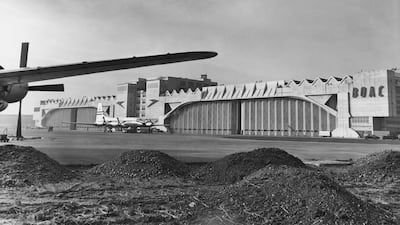
The new BOAC maintenance headquarters at London Airport circa 1955 -

The air traffic control room at the airport's new terminal in 1955 -

US film star Marilyn Monroe with her husband, playwright Arthur Miller, after arriving at the airport in July 1956 -
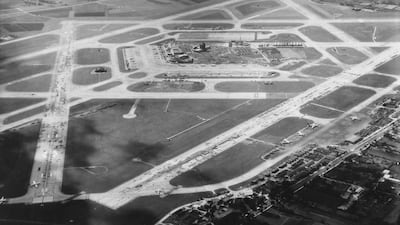
An aerial view showing the runways in 1958 -

The arrivals and departures board in 1960 -

A new airport gift shop, selling items by Chanel, Wedgwood and Pringle of Scotland, in 1961 -
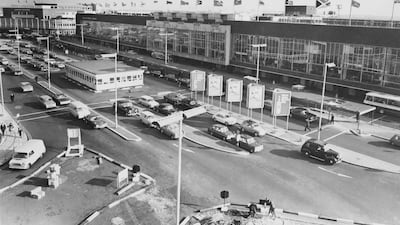
The Queen's Building and the No. 1 Building Europa at Heathrow in 1965 -
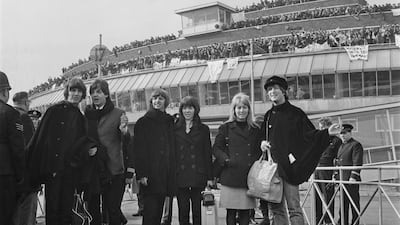
The Beatles leave Heathrow for Salzburg in Austria, to resume filming of the movie Help!, in 1965 -
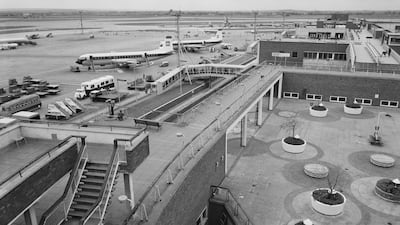
Passenger terminal gates at Heathrow in 1966 -
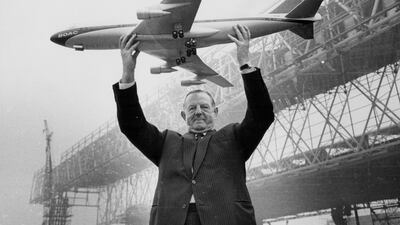
Keith Granville, managing director of BOAC, holding up a model of the Boeing 747 jet, with the new aircraft hangars under construction in the background, at Heathrow in 1969 -
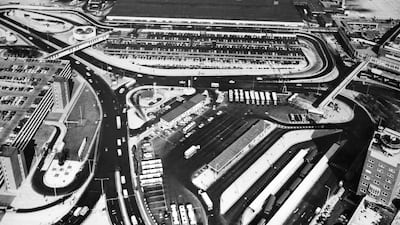
An aerial view of Heathrow in 1970 -
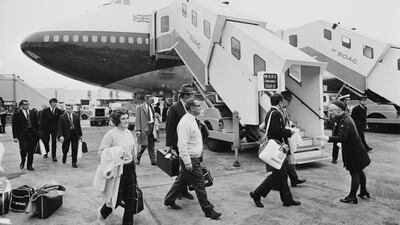
Passengers boarding the first BOAC Jumbo Jet 747 used for a commercial flight, from London Heathrow to New York, in 1971 -
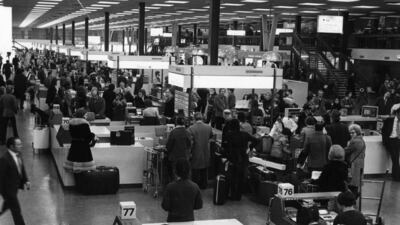
Passengers going through the departure lounge at Heathrow in 1973 -
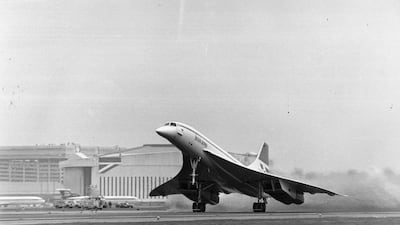
Concorde takes off from Heathrow on her first commercial flight for British Airways in 1976 -
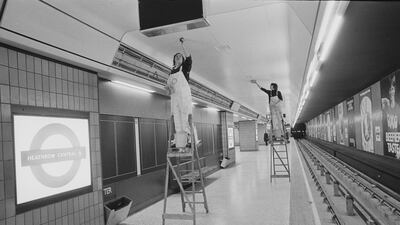
Men at work finalising the Heathrow Central underground station before its opening in 1977 -
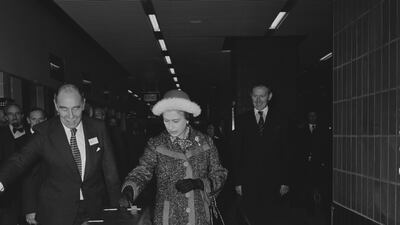
Queen Elizabeth II passing though the Tube gates at Heathrow Central station on its opening in 1977 -
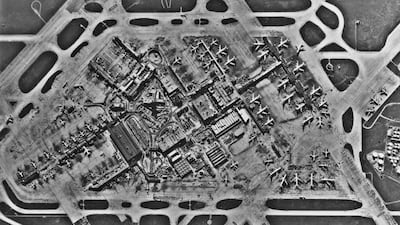
An aerial view of Heathrow in 1978 -

Passengers waiting near a departures board in 1979 -
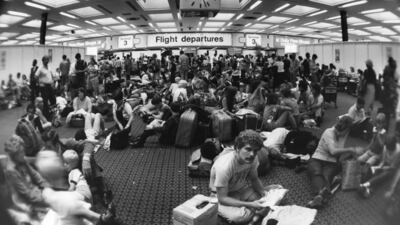
Holidaymakers waiting in the departure lounge at Terminal 3 of Heathrow in 1981 -
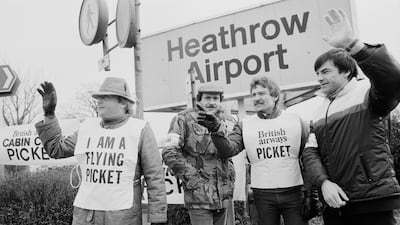
British Airways employees protesting at Heathrow in 1984 -
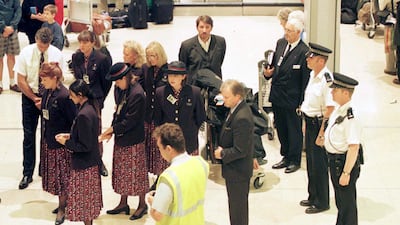
Passengers and staff observe a silence in Heathrow's Terminal One to mark the beginning of the funeral of Diana, Princess of Wales, in 1997 -
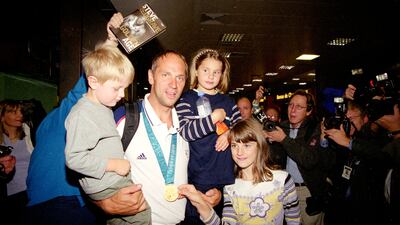
Rower Steve Redgrave at Heathrow with daughters Sophie and Natalie and son Zak after returning from the Sydney 2000 Olympic Games with his gold medal -
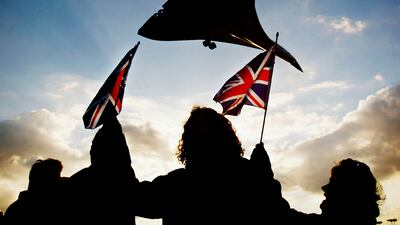
Spectators watch the last Concorde land at Heathrow in 2003 -
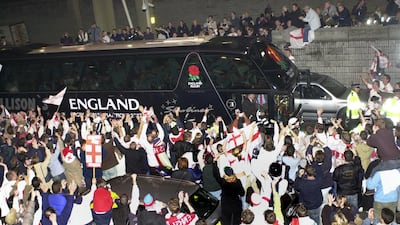
Fans surround the coach carrying the England rugby team at Heathrow, as they arrived from Sydney after winning the World Cup in 2003 -
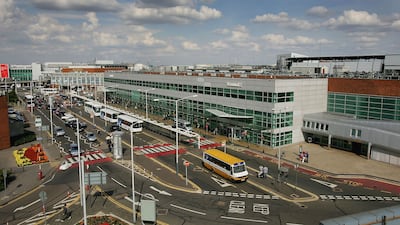
Heathrow's Terminal 2 in 2004 -
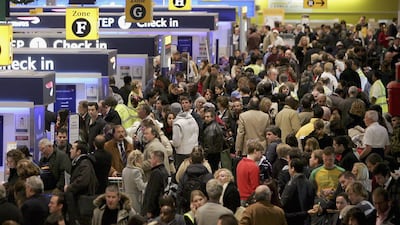
Passengers queue to check in at Terminal 1 of Heathrow Airport during the Christmas 2006 and New Year period -
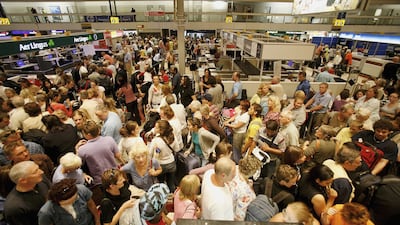
Passengers wait at Terminal 1 on August 10, 2006, after airport security was raised to critical when a terrorist plot to blow up planes in mid-flight from the UK to the US was disrupted by police -
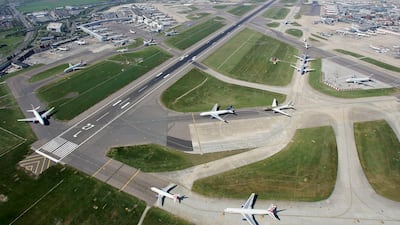
Planes queueing to take off at Heathrow in 2007 -
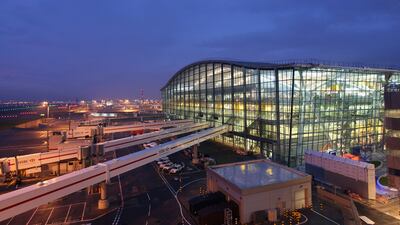
The new Terminal 5 at Heathrow in 2008 -
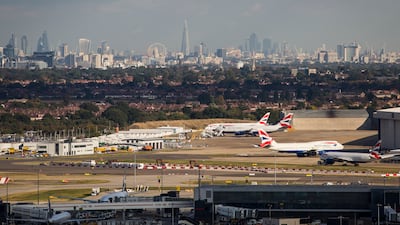
Aircraft at Heathrow Airport in front of the London skyline in 2016 -
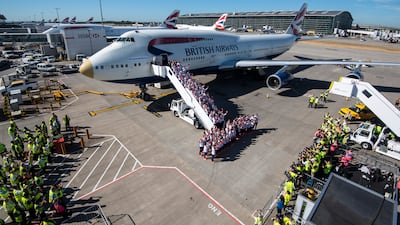
Members of Team GB arrive from Rio de Janeiro at Heathrow, after returning from the 2016 Olympics, which saw Great Britain's strongest performance at the Games in over a century -

A composite photo shows planes taking off from Heathrow in November 2016. Forty-two planes were captured between 10.17am and 11.17am and a montage was created from those single images -
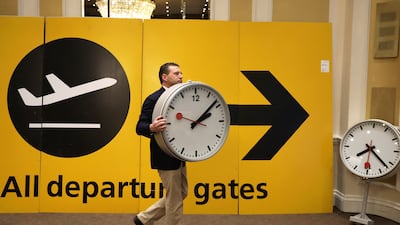
Items are arranged during an auction preview at Heathrow in 2018. The contents of Terminal 1, which closed in 2015, were being sold -
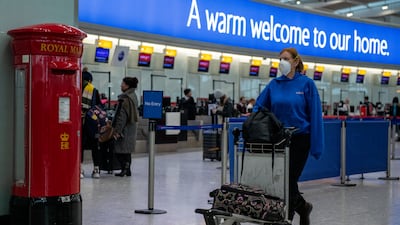
An airline passenger wearing a face mask pushes her bags through Heathrow's Terminal 5 during the coronavirus pandemic in 2020 -
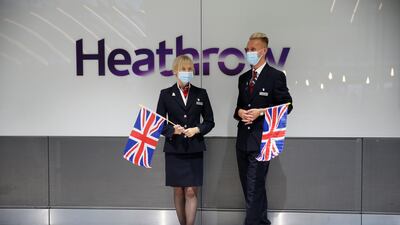
British Airways employees welcome Olympians returning from the Tokyo Olympics in 2021 -
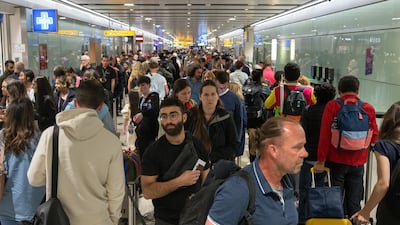
Travellers wait in a long queue to pass through the security check in 2022



