


Saudi Arabia's New Murabba, one of the giga projects in Riyadh, is on track for completion by December 2030, with the project's cubic centrepiece, the Mukaab, expected to attract at least 90 million visitors a year after it opens, according to its developer.
Work on the project, a planned 19-square-kilometre city district in north-west Riyadh, is "ahead of schedule in terms of our physical activity" and will be completed by December 31, 2030, Michael Dyke, chief executive of the New Murabba Development Company, told The National.
"We expect there to be, just in the Mukaab alone, more than 90 million visitations per annum. And those visitations are made of a combination of New Murabba residents, Riyadh city residents, kingdom of Saudi Arabia residents and international visitors," Mr Dyke said at the sidelines of the Future Hospitality Summit in Dubai. "Of these 90 million visitors, probably about 40 per cent will be international. But of course time will tell whether that number is an overestimate or an underestimate."
He added that the company works closely with multiple advisers on projections for population growth in Riyadh, the number of residents, as well as regional and international visitors. The hard data drives the project definition and investment strategies, he said.
Riyadh's population is estimated to reach 7.8 million in 2024, up 1.8 per cent from last year, and grow to 8.5 million by 2030, according to the World Population Review. The kingdom's overall population stands at 36.5 million, according to data from the World Census Bureau.
Saudi Arabia, under its Vision 2030 diversification strategy, aimed to reach 100 million visitors annually by 2030. But after surpassing that target in 2023, seven years ahead of schedule, the country revised its target to 150 million by the end of this decade, with planned investments of $800 billion to develop its tourism sector.
The Saudi capital is home to some of the biggest giga-projects being developed as part of the Vision 2030 plan to wean the economy off its dependence on oil. Along with New Murabba, these include the $500 billion Neom development, the historical district of Diriyah, and the sports and entertainment city of Qiddiya, among others.
-
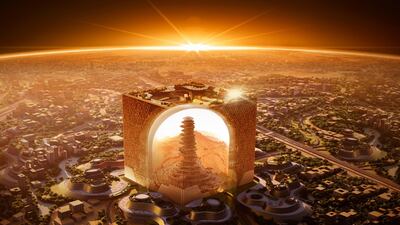
Saudi Arabia has announced a multi-billion dollar project in central Riyadh. All photos: SPA -
Crown Prince Mohammed bin Salman launched an entity, New Murabba Development Company, to carry out the development -
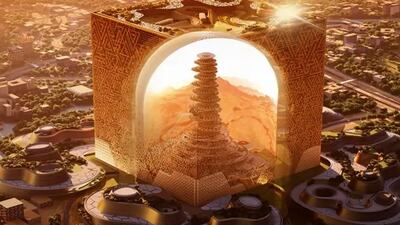
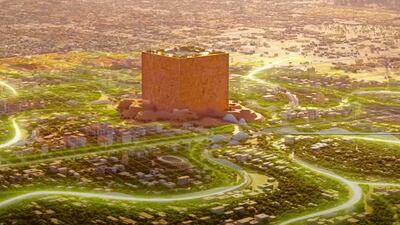
The project will cover 19 square kilometres, centred on a large cube-shaped structure known as the Mukaab -
A museum and technology and design university will form part of the development -
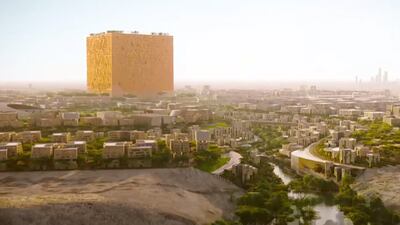
There will also be a multipurpose immersive theatre and more than 80 cultural and entertainment venues -
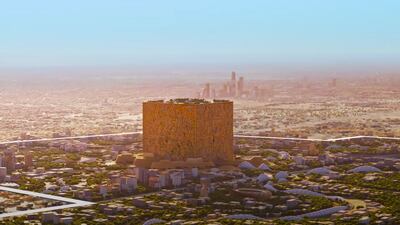
The project is part of the kingdom's plans to make its capital a global metropolis and diversify the economy -
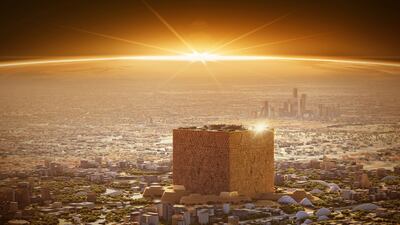
It is expected to be completed by 2030, in time for the global expo that year -
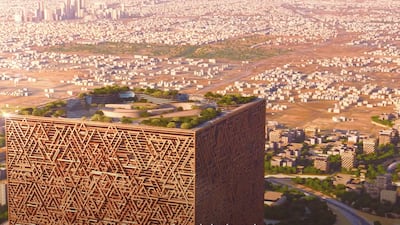
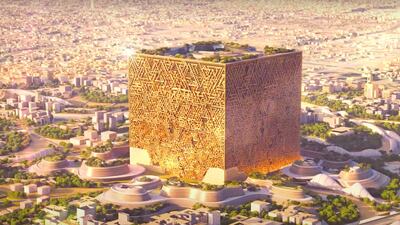
Built in a modern Najdi architectural style, the Mukaab is set to be the world’s first immersive destination offering virtual technology experiences -

Saudi Arabia’s Public Investment Fund will be the main source of funding for the project


'Full-throttle for 2030'
Saudi Arabia’s Finance Minister Mohammed Al Jadaan said in April that the kingdom would adapt to current economic and geopolitical challenges and “downscale” or “accelerate” some of the projects being carried out under its Vision 2030 programme.
Mr Dyke acknowledged that while projects are not immune to economic challenges, the New Murabba project remains on track for completion by the end of the decade.
"I don't think any enterprise within the kingdom, or for that matter in any environment, is immune from challenges in relation to capital rationing. New Murabba naturally has a level of stretch imposed on it by its board. Equally as a CEO, I impose stretch upon the organisation too," he said.
"New Murabba is very real, we're not immune, but at the same time nothing is changing in terms of our appetite."
Work is progressing on track and it will be open during the World Expo 2030, which Riyadh is hosting from October 2030 to March 2031, My Dyke said.
"2030 is less than 2,300 days away, or about 54,000 hours, and every second counts, just like every Halala [unit of Saudi currency] counts as well. So with that being the case, we are absolutely full-throttle for 2030," Mr Dyke said.
"What really galvanises New Murabba is that we're not a project that is either a concept or idea on paper which will be amazing when done but has a fluid timeline. We are part of the capital city. Expo is coming in 2030 and New Murabba is a fundamental part of Expo 2030 in terms of the provision and the offering. We're also driven by the fact that the demographics and the population forecast means that Riyadh needs more accommodation and more space."
New Murabba will be the downtown core that Riyadh currently lacks but that it "really deserves and needs and must have" for residents, he said.

'Gateway to another world'
The New Murabba is a planned mixed-use development in the north-west of the city, at the intersection of King Salman and King Khalid roads. As a “smart city”, it aims to offer residents amenities within a 15-minute walk, bike ride, or public transport journey from their homes.
Mr Dyke said the new downtown Riyadh project is drawing major interest from residents and real estate developers.
"The interest is enormous from a whole spectrum of people … there isn't enough stock and space in Riyadh today and the population is growing," Mr Dyke said.
The Mukaab at the centre of the project will be built in a modern Najdi architectural style and will feature more than 400,000 square metres of background immersion technology, which is “always on”.
Standing at 400 metres in height, width, and length, it will house premium hospitality, retail, cultural and entertainment attractions, including a museum, a technology and design university, and a multipurpose immersive theatre.
"There's massive pull from international visitors, particularly linked to the tech side of things, because what we're going to create inside the Mukaab is truly a gateway to another world," Mr Dyke said.
"You're inside the world's largest immersive experience, you cannot see any boundaries and you feel like you're in another world. You smell, touch, feel the smells of New York, or of being in the Serengetti or what it might feel like to be in Mars. The immersive background and the technology we're creating, which is a first of its kind, will transport visitors to another world," he added.
"I genuinely believe it’s a modern-day marvel. It is the most complex structure ever known to man, ever built,” Mr Dyke told the Future Hospitality Summit in Dubai.
Funding requirements
New Murabba Development Company, which is owned by Saudi Arabia's sovereign wealth fund, the Public Investment Fund, is seeking additional funding from investors and will be going to market in the next 18 months, according to its chief executive.
"We will be looking to raise finance and at the moment we're in early conversations with multiple different types of partners or investors," Mr Dyke said.
"We have the more classic real estate investments where we've had a really positive level of interest from the market whereby many organisations have come to us asking how they can play a part in providing investment into New Murabba."
The company is also in talks with industrial partners who are keen to not just participate in building the physical infrastructure, but also in providing finance, Mr Dyke said.
"There will be more classic investment packages over the next 18 months for both funding and infrastructure," he said.
Mr Dyke declined to provide the project's cost or the amount of funding the developer plans to raise.
Consultancy Knight Frank, in its 2024 report titled Saudi Arabia Giga Projects, valued New Murabba at $50 billion, but said that the total value of projects commissioned to date is only $100 million.
Work on the project is progressing, with excavation work under the Mukaab now 86 per cent complete, "which means we're well advanced with that", Mr Dyke said.
The piling works have commenced to create the foundations for the structure. "We're in the market for the next stage of the detailed design and we're also going to market very shortly on packages for structural steel and for the first foundations which sit above the pile," he said. "So there's a lot of packages that are coming to market very shortly."

