

The Farnborough International Airshow is mostly about the fast and the furious, as well as the big, beautiful and noisy.
The soaring combat aircraft such as the F-16s and Typhoons are always crowd pleasers, and in years gone by the sheer size of aircraft such as the Airbus A380 taking to skies have left audiences mesmerised.
But this year, there has been much excitement around the small, quieter and sustainable end of the industry, as makers of electric take-off and landing aircraft (eVTOLs) had their wares on display.
Often referred to as air taxis, these compact aircraft, usually capable of carrying no more than four passengers, are predicted to flock to many of the world's cities in the next decade.
In this fledgling industry, the overwhelming majority of eVTOLs are propeller driven, where rotas set on fixed wings can pivot, enabling the aircraft to take off and land like a helicopter and fly like a plane.

Because they are powered by electric batteries there are no emissions, but they are limited in terms of range and flying time.
However, this makes them perfect for what could be a wind of change that is blowing through urban flying, with predictions that one day passengers will be able to catch one for the same price as an Uber.
The sector has excited investors and air taxi makers at this year's Farnborough Airshow were not short of enthusiasm or deals.
Among those making announcements this week were Germany's Lilium, Crisalion of Spain and the UK's Vertical Aerospace.
Boeing-owned Wisk Aero has its full-size prototype on display, as did Joby, while Embraer was keen to show off its Eve prototype, which it displayed in Brazil this month.
-
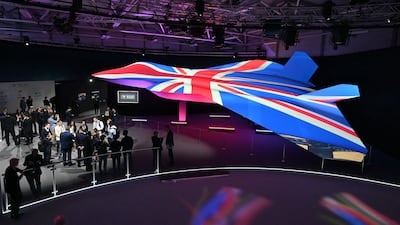
Delegates look at the Global Combat Air Programme sixth-generation fighter jet concept design, bathed in the colours of the British flag, on day two of the Farnborough International Airshow. AFP -
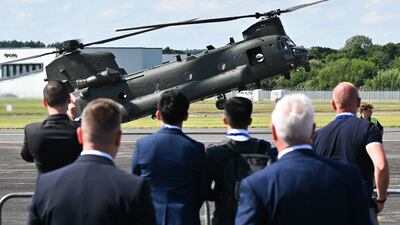
Visitors watch a Chinook helicopter land. AFP -
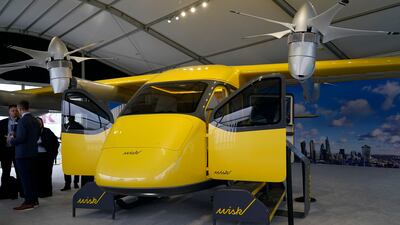
The Wisk pavilion showcasing its air taxi. AP -

The British Red Arrows aeronautics display team in action in the sky over Farnborough. Reuters -
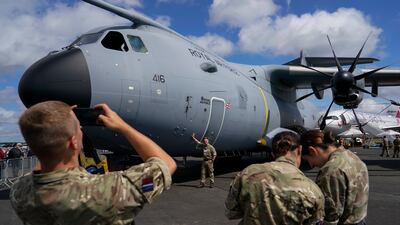
Members of the armed forces pose next to a Royal Air Force Embarer C-390. AP -
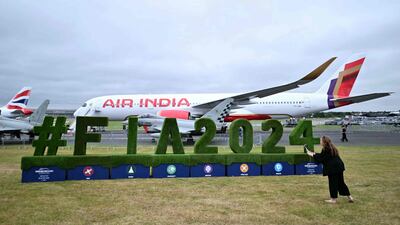
A visitor photographs the logo on the opening day. AFP -

British Prime Minister Keir Starmer, centre, speaks to Guillaume Faury, right, Airbus chief executive, as he arrives at the annual event. PA -
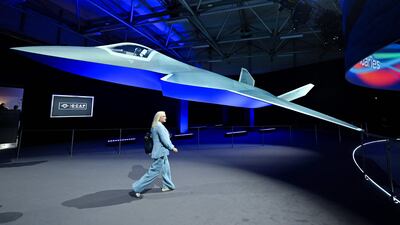
The Global Combat Air Programme sixth-generation fighter jet concept design. AFP -
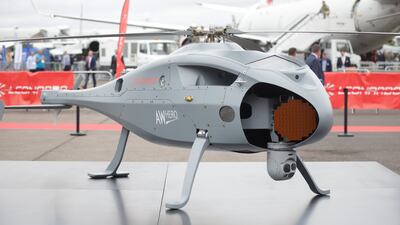
An AWHero drone displayed on the Leonardo SpA stand. Bloomberg -
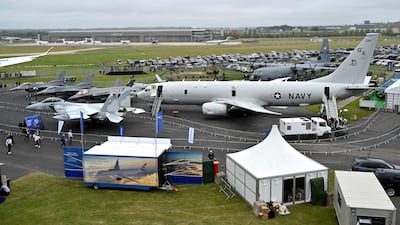
US military aircraft displayed on the opening day at Farnborough. AFP -

Falconworks unmanned aerial vehicles are displayed at the BAE Systems stand. AFP -
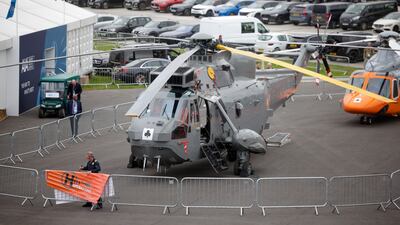
A Westland Sea King HU5 helicopter on display. Bloomberg -
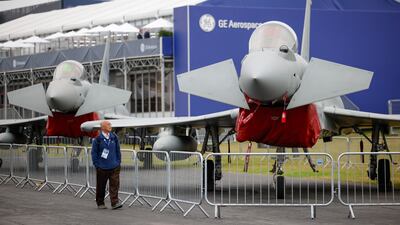
A Typhoon multirole combat aircraft on show. Bloomberg -
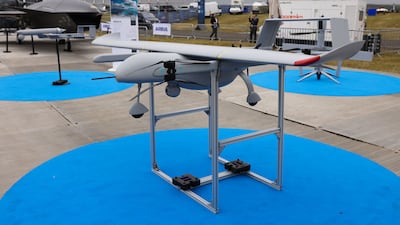
A drone made by Airbus on a stand at Farnborough. Bloomberg


On Thursday, Dubai-based operator Air Chateau announced it had pre-ordered 10 eVTOLs from Crisalion, which would support the development of air taxi services in the UAE.
The 10 orders for its Integrity aircraft brings Crisalion's order book to 125 in less than a year.
“Dubai is one of our core markets,” Oscar Lara, chief operating officer at Crisalion, told The National.
“We want to keep on expanding our presence in the region.
“In Dubai, it’s a very open city, a very open region – they are really willing to take on these new technologies.”

The eVTOL market is at an interesting juncture. Billions of dollars have been invested on a handful of prototypes to demonstrate that the technology is feasible and investable.
Vertical Aerospace's prototype, VX4, is undergoing tests at its base in the Cotswolds, in the UK.
“We are excited to be working towards piloted flight with this aircraft prototype, which would make us one of only a few eVTOL manufacturers in the world to achieve this feat," Michael Cervenka, the company's chief strategy officer and chief technology officer, told The National.
“And we are making good progress towards certification, which will ultimately lead to seeing the VX4 in UK skies as well as around the world.”
Eve, which is owned by the Brazilian aircraft maker Embraer, is hoping to have its prototype flying taxi tested and certified by the end of next year.
But Eve's chief executive, Johann Bordais, realises that the path to flight could be full of turbulence.
"Challenges exist," Mr Bordais said. "It's not something trivial.
"We are at the limits of technology and aeronautics, and this moment of testing is fundamental."

Likewise, Wisk's chief executive Brian Yutko said the company was testing its eVTOL and hoping to "fly around the end of this year".
Wisk is slightly different from its air taxi peers, though, in that its aircraft are designed for pilotless, autonomous flight.
Some industry watchers are more sceptical of this approach. The consultancy firm Bain contends that fully autonomous flight is at least about 15 years away and the margins could be tighter than for piloted aircraft.
"Maximising passenger occupancy and avoiding return trips with empty aircraft will be crucial for operator profitability," said Mattia Celli, a partner with Bain and Company in Rome.
Safety, certification and regulators
While ideas and designs for air taxis are plentiful, for those few eVTOL makers that have a working prototype, certification is the next step.
That involves convincing aviation authorities around the world that the aircraft is safe and robust – and regulators are, quite rightly, a tough bunch to please.
“We have 16 rotas. In a normal helicopter you just have one engine," Mr Lara told The National.
"So, there’s much more redundancy in case of a failure. This is important when you’re flying over a city. These things should not fall down.
“In addition, the noise that it makes is much lower than a helicopter and noise levels are one of the driving factors in letting helicopters fly over cities. There are cities that restrict helicopter flights due to the noise.”
Air taxi makers say eVTOLs are better, more efficient and cheaper to maintain than helicopters, and over the coming decades will replace them as the workhorses of the skies in urban areas.
Despite this, it is still too early to wave goodbye to the helicopter because they have ranges that can beat air taxis and their hovering ability is better, especially with heavier loads.
As such, they are likely to be used by militaries, emergency services and parts of the construction industry for many years to come.

Fan jets not props
Unique among the eVTOL makers is Lilium, a German company that, instead of employing a number of rotas with propellers, uses 30 turbofan jet engines in its design.
Lilium's chief executive, Klaus Roewe, told The National the aircraft is "much more silent" and "much more comfortable" than a commercial helicopter.
“It’s much safer – we have 30 engines. So, we can lose a couple of them due to things like bird-strike and so on. If you lose one helicopter blade, that’s it."
Like all the eVTOL makers at Farnborough Mr Roewe was quick to emphasise the safety aspects of the aircraft.
"We design for so-called 10 to the minus nine, which means we have to demonstrate that you’ll have fewer than one accident in one billion flight hours and that you’re not going to achieve that with a rota-driven aircraft," he told The National.
"So, it’s much safer than driving in a car. If you drive the same distance in a car as travelling in a Lilium aircraft your likelihood of dying in that car is between 100 and 1,000 times higher.”
However, Lilium is not looking to become a flying city taxi. It believes the best market its aircraft could serve, because it has a longer range than propeller-driven eVTOLs, is between regional cities.
"We want to connect cities and there are many, many places in the world where you can do that," Mr Roewe said.
"Florida, for example. When you want to go from Tampa to Orlando, it’s a desperate undertaking by car.
"It’s not far, but it’s a three-hour drive. With a Lilium jet you would do it in 30 minutes.”
-

The Joby Aviation aircraft will cut the journey from Dubai Airport to Palm Jumeirah from 45 minutes to 10 minutes. Dubai Media Office -
Vertiports will allow the aircraft to land in city locations. Dubai Media Office -

The initial network will include four vertiports located by Dubai International Airport, Palm Jumeirah, Downtown Dubai and Dubai Marina. Dubai Media Office -

Sheikh Mohammed bin Rashid, Vice President and Ruler of Dubai, inspects the Joby Aviation aircraft. Dubai Media Office -
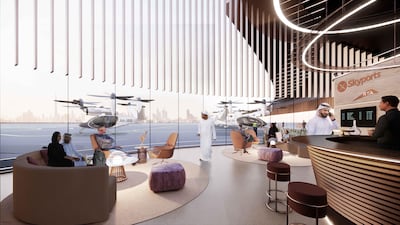
The vertiport certification and approval process has begun with the authorities in the UAE. Photo: Skyports -

Sheikh Hamdan bin Mohammed, Crown Prince of Dubai, inspects Joby Aviation's aircraft. Dubai Media Office -

Sheikh Mohammed witnesses the signing of the agreement between Dubai RTA and Joby Aviation. Dubai Media Office


Air taxis for the masses
Many of the air taxi makers' executives were keen to point out the eventual costs to passengers and that an air taxi trip will one day be similar to land taxis.
"Already, without needing lots of fancy new technology, the potential is for this aircraft to be about the same cost as hiring an Uber," Mr Cervenka said.
Given the early market supply challenges it would take some time before hailing an air taxi was as cheap and convenient as hailing an Uber.
But Mr Roewe said that once the market is fully established, prices have to come down.
“We are shooting for €2 per passenger kilometre," he said.
"This is a value proposition that many people can afford and will want to afford. In fact, it’s not much more than if you were to take an Uber.
"If you can reduce your travel time by 80 to 90 per cent for the same ticket price, plus the fun of flying, you will just go for it.”

Enthusiasm and doubt
Going for it certainly seems to be the industry's mantra at the moment.
A study by McKinsey last year showed 18,000 eVTOLs were on order, but with the added caveat that many of these are simply letters of intent or options to buy.
Nonetheless, Lilium was keen to promote its biggest deal so far, which it struck a week before the Farnborough Air Show, as Saudi airline Saudia agreed to buy up to 100 of its eVTOLs.
It also signed an agreement with Saudi certification authorities.
Lilium is also looking for a site to set up a factory in the US, which it hopes to have operational within five years.
The Farnborough Airshow was an opportunity for eVTOL makers to attract investors, who have swayed from enthusiasm to ambivalence to cynicism in recent years.
Potential profitability is weighed against regulatory requirements and the pace of development is measured against the time it takes to get passenger number one on board.
As such, shares in the eVTOLs that lack a big brother such as Embraer or Boeing are often volatile.
Lilium's shares have fallen 21.7 per cent this year, while its industry peers Archer Aviation and Joby Aviation are down 25.7 per cent and up 0.45 per cent, respectively.
While most air taxi makers spoke optimistically of the near future, others agreed the industry will at some point shake down and the many will become the few.
“I think we are going to see a few players in the end succeeding," Mr Lara said.
"Of course, the industry cannot sustain hundreds of players. It’s likely that we will see consolidation, but for us we’re are ready for the evolution of the industry wherever it goes."

For Mr Roewe, consolidation within the air taxi industry is a given, but he feels Lilium, with its fanjets, is somewhat unexposed to the coming market massacre.
“We are in a very good position because our value proposition is completely different, so we are much less affected by any kind of competition," he said.
"The others all look the same and they don’t really differentiate."
By the time the next Farnborough Airshow comes around in two years, the air taxi landscape could look very different.
Some will have been certified and a few may be starting to run embryonic services. Others may have gone to the wall having been abandoned by impatient investors.
But the signs of something new in city skies may just start to become apparent. Watch this space.

