


It was a peculiar feeling being airside at Heathrow's Terminal 2, poking into the hidden parts of a familiar travel experience and watching from the other side as passengers put laptops back in their bags.
Instead of being part of the flow from kerb to stand, I was an observer of the thousands of people bustling through the terminal to get to dozens of destinations.
I had just come through security, but not the one most people are familiar with as part of boarding a plane. Taken through a discreet, coded door on the landside area by my guide, I followed the procedure that many of Heathrow's 80,000 workforce go through every day.
They have their own security hall which is almost the same, albeit smaller, as the set-up passengers go through. It's a quicker process, because workers tend not to bring liquids from home and belts and wallets come off and out with speed.
All airside employees come through these worker screening areas to get airside – even the airport's chief executive, Thomas Woldbye. The only possible exception would be King Charles III: the royals and visiting dignitaries have their own facilities in another, secluded part of the airport.
Once through, I'm into the throng of visitors, holidaymakers, businesspeople and other travellers passing through the terminal, the passenger flow taking them past more than 30 shops vying to attract those final pounds of a holiday budget.
Several luxury brands, including Harrods, Rolex and Bulgari, sit on the banks as passengers stream towards the departure gates. Plus there's a Hamleys, should the returning businessperson require a gift for the kids.

Golden hour
The airport and its shop tenants don't want the passenger flow to go too fast at this point, which is where the concept of the “golden hour” comes into play.
Essentially, it's in Heathrow's interest for people to get checked in and through security quickly, which is why everything landside is geared towards speed while maintaining passenger comfort and safety.
But once through the queues and clatter of plastic trays in security, you're in the airport's shopping centre, where the longer you spend time, the more likely you'll spend.

As I watched the milling mass in Terminal 2, I noticed it was full of passengers who had got to the airport in plenty of time, a habit most travellers exhibit.
The term “golden hour” was coined by the airport expert Holly Buckner and describes the time period that starts when passengers clear security and finishes when they reach their departure gate.
Some analysts contend that it is why departure gate numbers are not displayed on screens until it's absolutely necessary: to keep passengers in the retail areas for as long as possible. In many airports, it's also the reason there are far fewer seats than passengers in retail areas.
Heathrow is also one of thousands of British businesses that have opposed the continued absence of tax-free shopping in the UK, where international travellers would be able to claim back VAT.
“Money that used to be spent in the UK and support jobs and businesses here is now going into tills in Paris, Milan and Madrid,” a Heathrow representative told The National. “We continue to urge the Chancellor to think again on this easy win for jobs and economic growth.”
The airport of tomorrow
One hundred years ago, the spot in Terminal 2 on which I am standing was part of a sleepy hamlet surrounded by farmland and orchards. The only things that flew over what was called Heath Row Farm at the time were starlings and sparrows.
Fast-forward a century, and 39,556 aircraft took off or landed from Heathrow Airport last month, and more than seven million passengers moved through its terminals.
But Heathrow is looking to seriously increase those numbers and has embarked on an ambitious multi-decade expansion plan that will add further terminal buildings and a third runway.
As such, the airport is in a constant state of flux and development, as the process of replacing the old with the new is kept separate from daily operations, as far as possible.
As a passenger, you could be forgiven for being oblivious to the areas of the airport that are building sites, where parts of the master plan are being built. That, indeed, is the challenge – how to ensure capacity is not reduced while adding more infrastructure to make sure it can be increased.
“It is a real logistical challenge – how do you squeeze your existing volumes and your demand into a space that you might have to cut capacity in for a period of time?” John Grant, a senior analyst with OAG, told The National.
“Every airport in the world is a building site, it’s just what degree of building.”

Heathrow has four terminals, currently named 2, 3, 4 and 5. Terminal 1, which was opened in 1969, is scheduled for demolition, but not yet, as its baggage system will remain in use until a shiny new AI-enabled one can be fired up in the rebuilt and refurbished Terminal 2.
When it is up and running, the new system will handle 31,000 bags a day, with an improved level of data analytics the airport hopes will deliver a far more reliable service for customers.
Turning on the new baggage system at Terminal 2 is the crucial next stage in Heathrow's ambitious revamp. That will allow for Terminal 1 to be torn down and for Terminal 2 to enlarge its footprint.
Eventually, Terminal 3 should be replaced and Terminal 4 revamped, but neither will happen until the flow of passengers can be diverted elsewhere.
A new terminal is planned to the west of the current Terminal 5. At the moment it is being called Terminal 5X, though others refer to it as Terminal 6.
“Just like home renovations, we’re improving Heathrow room-by-room as we continue to build the airport of tomorrow, without interrupting the passengers of today,” said Helen Elsby, chief solutions officer at Heathrow.
Much of the construction of the airport of tomorrow entails the building of “satellite terminals” rather than full, standalone new terminals.
For example, if you've ever been to Heathrow's Terminal 5, you'll have left from either A, B or C gates. A gate is in the main terminal building, and you will have had to catch an underground train to B or C gates. As such, B and C gates are essentially satellite terminals of Terminal 5, a design style known as a “toaster”.
But are the “passengers of today” being interrupted or inconvenienced by the expansion plans?

The airport potentially has a larger tempest on its radar – the problem of how to expand, maintain efficiency and build the elusive third runway.
Heathrow expansion plans, like most of the operations at the airport, are highly complex, with lots of moving parts in a relatively small space.

Queues and delays
Heathrow has lurched from one bad headline to another in recent years, often not of the airport's own making.
founder of Arora
A post-pandemic rush to alleviate the British public's overwhelming pent-up desire to travel, combined with a shortage of staff, led to delays and queues, while the cost-of-living crisis fired industrial action, and the airport was hit by a series of strikes.
Malfunctioning e-gates at UK border control caused crowding in the arrivals halls, and delays to the installation of modern scanning equipment mean passengers will have to place carry-on liquids in clear plastic bags for another year.
But experts say it would be unfair to blame Heathrow for all of these problems, given the complexity of the airport's operations.
Tomasz Pawliszyn, the chief executive of AirHelp, a company that assists passengers in receiving compensation, told The National “both airports and airlines can be at fault for flight delays and disruptions”.
“Airports are responsible for much of the passenger journey through the airport, so any circumstances affecting staff and operations across areas like security can impact [on] multiple flights, regardless of the airline passengers fly with.
“Airline disruptions are typically caused by staff shortages and strikes, or issues with arrivals which delay the transfer of staff and the preparation of aircraft.”
So, next time you're in a long check-in queue at Heathrow, perhaps its better to blame the airline.
If you've just arrived from Dubai and you're stuck in a severely crowded arrivals hall waiting to go through passport control, that's more likely to be the fault of the Home Office.
“All airports, because that’s the highly visible part of the process the traveller sees, sometimes carry the can or have to sort out a problem that is created by someone else,” Mr Grant told The National.
Pandemic recovery
In 2019, the year before the pandemic, which grounded aircraft across the world and saw airport-associated jobs evaporate, Heathrow had one of its best years: 80.9 million passengers passed through its terminals and it made a pre-tax profit of £819 million ($1.02 billion).
The future looked good back then – permission to build a third runway had been granted and plans for a major expansion were well under way.
But the pandemic lockdowns and travel restrictions then killed revenue for the entire industry for the next two years and just as it looked like a recovery was possible a new energy crisis, rising borrowing costs and inflation reared their heads off the back of Russia's invasion of Ukraine.
But while some of the expansion plans were put into a holding pattern, the travel industry and Heathrow did roar back to life in 2022 and 2023.
Last year, 79.15 million passengers made use of Heathrow, a 28 per cent improvement on 2022, and the airport is hoping 2024's passenger figures will challenge those of 2019.
But now that the stormy skies of Covid, rising interest rates and inflation are clearing, what next for Heathrow?
Property and parking
For the tens of thousands of people who pass through Heathrow every day, the airport is a transitory experience that needs to be navigated to reach an ultimate destination within the UK or a conduit to get to the correct aircraft to journey out of the country.
Most passengers see Heathrow (and in fairness all airports) as a necessary hurdle to be overcome in the quest to reach a final destination.
But in essence Heathrow is a highly complex operation that involves more than 400 companies that employ about 80,000 people in dozens of operational areas.

The company that owns and runs Heathrow, Heathrow Airport Limited (HAL), is part airport service provider, part property company, part hotel and retail landlord, part car parking firm and part railway operator.
If you arrive at Heathrow, your airline will have paid the airport movement, plane parking and passenger charges. Heathrow made £2.4 billion last year from these aeronautical charges.
The aeronautical charges make up about 69 per cent of Heathrow's total revenue. The rest comes from retail charges (£698 million in 2023), which includes concessions for retailers in the terminals, catering concessions and car parking services.
Added to this is the revenue Heathrow makes from its properties, including leases for hotels and car parks not run by the airport, as well as from the Heathrow Express railway.
All of which added up to total revenue in 2023 of £3.7 billion, which translated into an adjusted pre-tax profit of £38 million, Heathrow's first profit in four years.
The airport has also regained its title as Europe's busiest, having lost it to Istanbul in 2022.
Shareholders disembark
From its beginnings as an airfield called the Great West Aerodrome in 1929, through to its official opening as London Airport in 1946 and its renaming as Heathrow in 1966, the airport has always been at the centre of global aviation and is still the fourth-busiest in the world.
But while the post-pandemic travel boom has blown the wind back into its sock, Heathrow now faces a potentially cloudy future with plenty of possible turbulence.
At the end of November last year, one of HAL's shareholders, the Spanish firm Ferrovial, announced it was selling its 25 per cent holding for $3 billion to Ardian, a Paris-based private equity fund and the Public Investment Fund (PIF), the sovereign wealth fund of Saudi Arabia, to be split 15 per cent and 10 per cent, respectively.
The other 75 per cent of HAL is owned by sovereign wealth funds from Qatar, China and Singapore, pension funds from Canada and Australia and one of the UK's largest private pension funds, the Universities Superannuation Scheme.
But the sale may have stalled because of certain “tag-along rights”, which enable other shareholders in HAL's holding company to piggyback on Ferrovial's deal and sell their shares at the same price.
The trouble is, it's thought that the “tag-alongers” could represent up to 35 per cent more of the total shares, meaning that 60 per cent of HAL is in play, while the likes of Ardian and the PIF have not expressed an appetite for more shares.
“Completion of the transaction continues to be subject to the satisfaction of the tag-along condition,” Ferrovial said in January, adding there was “no certainty” the deal would be completed.

Third runway
But the big question mark is the third runway. Before 2019, it seemed it was all systems go – the government had granted permission and Heathrow had won out against, among others, a proposal to build a second runway at Gatwick.

“It’s the one and only way that they can significantly grow their revenue base,” Mr Grant told The National.
“There’s always a need for a bit more runway capacity space in the London system. Gatwick is ploughing on with its plans to use its taxiway as a second runway for certain periods of the day, but even that requires capital investment and expansion of terminals – none of it come free of charge, unfortunately.”

Mr Woldbye, Heathrow's chief executive, will have to work out how to bring the third runway out of a holding pattern and safely in to land.
The problem is that the situation on the ground has changed. A legal battle broke out over the alleged contradiction of the UK's climate change pledges under the Paris Agreement and the huge increase in flights a third runway would bring.
By December 2020, the legal tussle was over and the government's Airport National Policy Statement – which included Heathrow's expansion plans – was reinstated. Heathrow said the judgment made it clear that “up-to-date climate obligations will be considered as part of the robust planning process that would apply to any proposals for Heathrow expansion”.
At the moment, there is a cap of 480,000 flights a year at Heathrow but a third runway would add another 250,000.

Plus, there's also the cost. The last few years have brought a considerable increase in inflation and the calculations of how much money will be needed to build the third runway as well as the accompanying infrastructure, including new terminal buildings, will have to be revisited.
Heathrow's former boss, John Holland-Kaye, was adamant that expansion and a third runway were crucial for the airport and the UK economy as a whole, and that the pandemic was simply a blip on the road to achieving those goals.
Heathrow is the most connected airport in the world and to maintain that position as a leading hub, passenger numbers need to increase. Many analysts feel some of that increase can be achieved through greater efficiency, stronger passenger flow and tweaks to air traffic that will allow more planes into the system, but the real prize is a third runway and the terminal buildings and infrastructure that go with it.
However, a representative for Heathrow told The National that the airport continues “to review our plans for delivering long-term growth”, while at the same time investing £3.6 billion in shorter-term growth by “upgrading all security lanes, installing a replacement baggage system in Terminal 2 and upgrading facilities across the airport”.
For Heathrow, putting all its eggs into the third runway basket is not a sound strategy and much expansion of capacity can be achieved while the third runway remains a future goal. For example, it could switch to a “mixed mode”, allowing planes to take off and land on the same runway. It is thought an additional 60,000 aircraft movements a year could be added that way.
Nonetheless, groups opposed to the third runway also tend to take a dim view of such plans.
“Communities around the airport will rightly oppose any kind of expansion at Heathrow, which leads to a deterioration in their quality of life,” said Paul McGuinness, chairman of the No 3rd Runway Coalition. “So any expansion is problematic.
“And not just for those who will be adversely impacted by yet more air traffic overhead. But because, as the Department for Transport recognised when examining a third runway there, any growth at Heathrow will draw flights away from other airports, with particularly negative impacts for the UK’s regions.”

Some analysts say the situation is complicated by its sheer size and the ability of Heathrow to raise enough debt and equity to fund huge projects such as the third runaway, particularly now borrowing costs are higher than they were five years ago.
That has prompted airline bosses such as the Virgin Atlantic chief executive Shai Weiss to voice concerns that expansion plans should go ahead only if passengers are the focus of the benefits, “rather than excessive dividends for shareholders”.
For its part, Heathrow says it can fund its expansion plans but some worry that will happen in part by raising landing fees, despite these being controlled by the Civil Aviation Authority.
Competition questions
The issue of competition at Heathrow has emerged amid the failure to progress with the runway plans. Heathrow runs all the terminals, most of the car parks and the land on which the airport hotels stand. Over the years, several industry figures have postulated that opening areas of the airport up to more competition would improve service for passengers.
There is some precedent for this, particularly in the US, where competing companies and airlines can often run different terminals at the same airport.
The property, construction and hotel management conglomerate Arora is keen to build and operate a potential Terminal 6 and its founder and chairman, Surinder Arora, has been proposing the idea for the past eight years.
“Our dream was always to create competition at Heathrow Airport,” he told The National. “Our view is that the third runway is dead and buried, it'll never happen. We can make Heathrow efficient, we can make Heathrow the best.
“You need to force Heathrow to either sell off the terminals or lease them.”
Mr Arora said proposals by his group, which is the largest landowner in and around Heathrow, to work in conjunction with HAL have been rebuffed over the years.

New mayor in town
But while Heathrow takes a lot of misdirected flak for strikes, delays and queues and there's much criticism over its stalled progress on expansion, not to mention questions over the company's debt and sale of its shares, the future of the airport is crucial not only to the people who work there and the passengers, but also to the broader UK economy.
According to a report from the Centre for Economics and Business Research, more than 20 per cent of the UK's trade in goods passes through Heathrow, which in 2019 was worth £188 billion. By next year, the CEBR predicts that will have grown to £205 billion.
Mr Holland-Kaye would often compare his job to that of a town mayor overseeing a disparate and complex series of operations when he was in charge at Heathrow.
So Mr Woldbye has much on his plate, and while the £14 billion third runway is viewed as his biggest decision for the future, he also has the day-to-day operations of an airport to consider and how those can be made more efficient.
Running one of the world's largest airports might be considered akin to landing a plane in high crosswinds – get it right and everyone applauds but get it wrong and it is on everybody's lips.
-

Heathrow Airport in London, the UK's busiest, has been a travel hub for decades. Here The National takes a look back at Heathrow through the years. All photos: Getty Images -

An Airco De Havilland biplane of the British airline, Aircraft Transport and Travel Limited, about to leave on the company’s inaugural flight from Hounslow Heath Aerodrome, later known as Heathrow, to Le Bourget, Paris, in August 1919 -
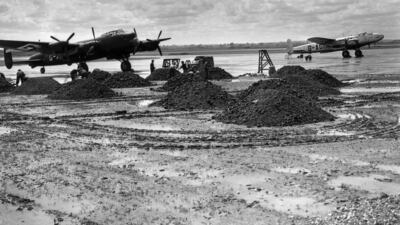
Waterlogged runways at London Airport - Heathrow's original name - one week before it became Britain's main aerial gateway to the US in 1946 -
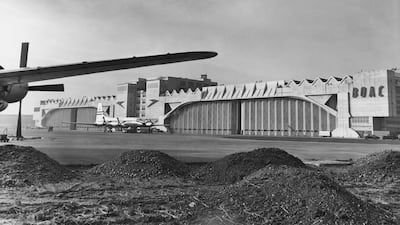
The new BOAC maintenance headquarters at London Airport circa 1955 -
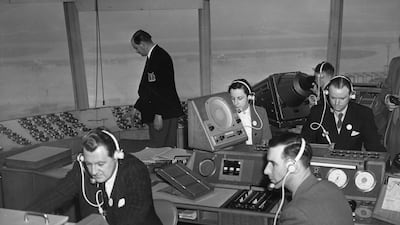
The air traffic control room at the airport's new terminal in 1955 -

US film star Marilyn Monroe with her husband, playwright Arthur Miller, after arriving at the airport in July 1956 -
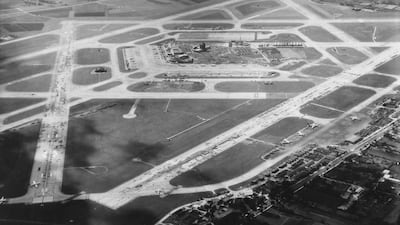
An aerial view showing the runways in 1958 -

The arrivals and departures board in 1960 -

A new airport gift shop, selling items by Chanel, Wedgwood and Pringle of Scotland, in 1961 -
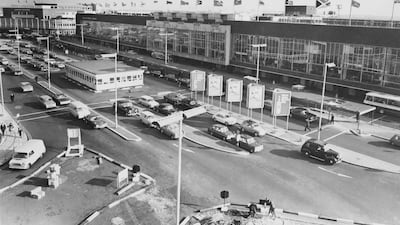
The Queen's Building and the No. 1 Building Europa at Heathrow in 1965 -
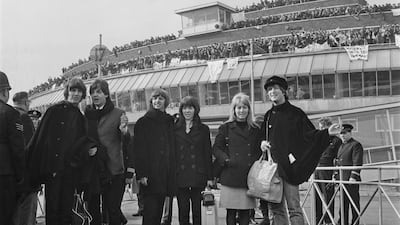
The Beatles leave Heathrow for Salzburg in Austria, to resume filming of the movie Help!, in 1965 -
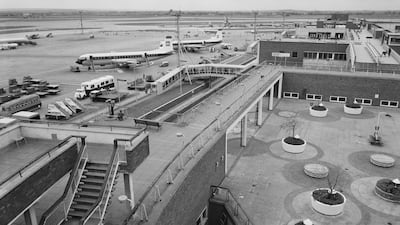
Passenger terminal gates at Heathrow in 1966 -
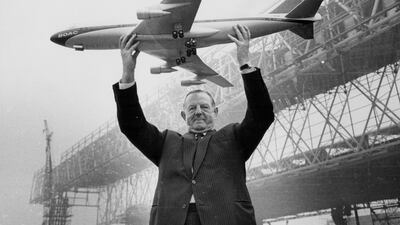
Keith Granville, managing director of BOAC, holding up a model of the Boeing 747 jet, with the new aircraft hangars under construction in the background, at Heathrow in 1969 -
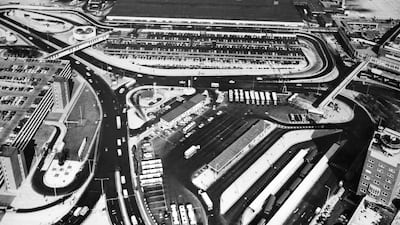
An aerial view of Heathrow in 1970 -
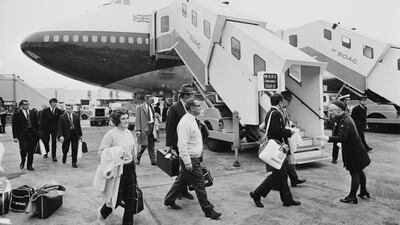
Passengers boarding the first BOAC Jumbo Jet 747 used for a commercial flight, from London Heathrow to New York, in 1971 -
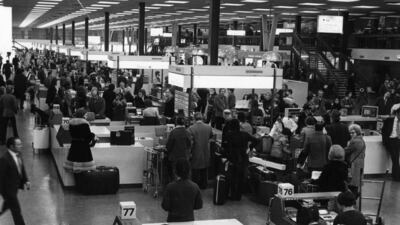
Passengers going through the departure lounge at Heathrow in 1973 -
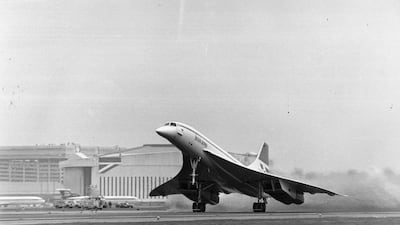
Concorde takes off from Heathrow on her first commercial flight for British Airways in 1976 -
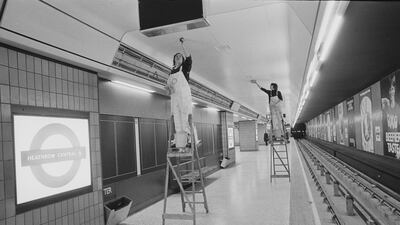
Men at work finalising the Heathrow Central underground station before its opening in 1977 -
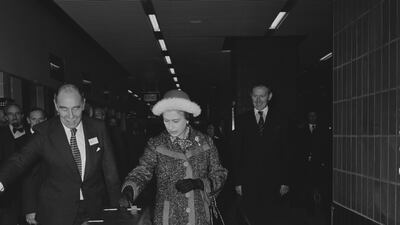
Queen Elizabeth II passing though the Tube gates at Heathrow Central station on its opening in 1977 -
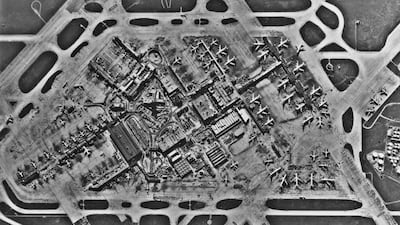
An aerial view of Heathrow in 1978 -

Passengers waiting near a departures board in 1979 -
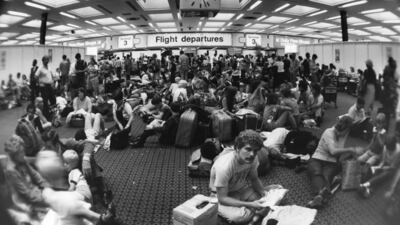
Holidaymakers waiting in the departure lounge at Terminal 3 of Heathrow in 1981 -
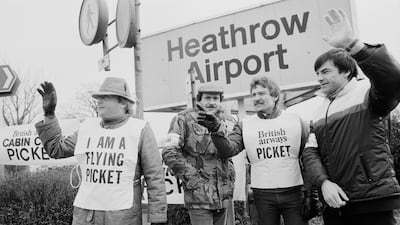
British Airways employees protesting at Heathrow in 1984 -
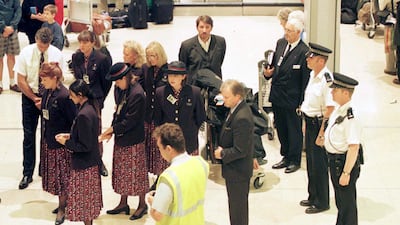
Passengers and staff observe a silence in Heathrow's Terminal One to mark the beginning of the funeral of Diana, Princess of Wales, in 1997 -
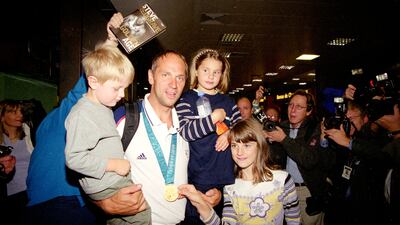
Rower Steve Redgrave at Heathrow with daughters Sophie and Natalie and son Zak after returning from the Sydney 2000 Olympic Games with his gold medal -
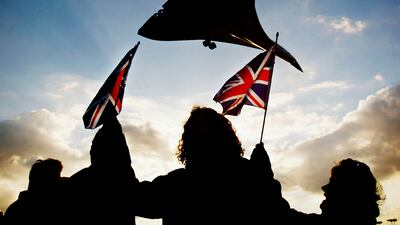
Spectators watch the last Concorde land at Heathrow in 2003 -
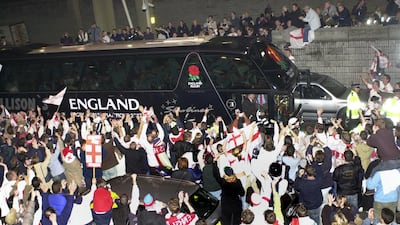
Fans surround the coach carrying the England rugby team at Heathrow, as they arrived from Sydney after winning the World Cup in 2003 -
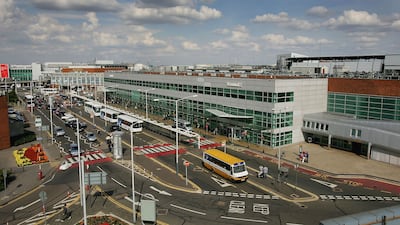
Heathrow's Terminal 2 in 2004 -
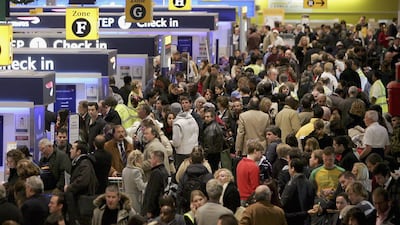
Passengers queue to check in at Terminal 1 of Heathrow Airport during the Christmas 2006 and New Year period -
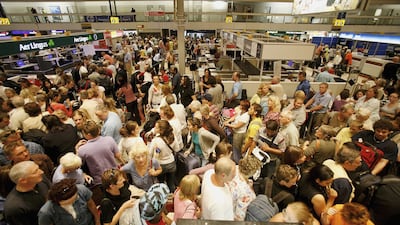
Passengers wait at Terminal 1 on August 10, 2006, after airport security was raised to critical when a terrorist plot to blow up planes in mid-flight from the UK to the US was disrupted by police -
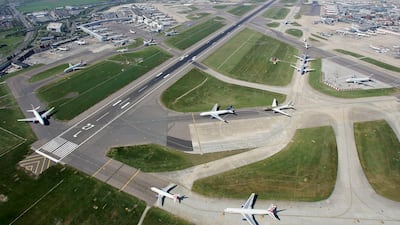
Planes queueing to take off at Heathrow in 2007 -
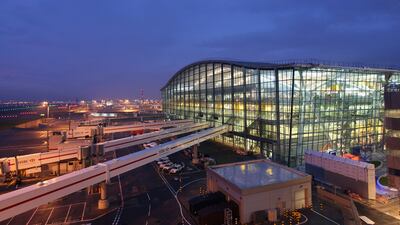
The new Terminal 5 at Heathrow in 2008 -
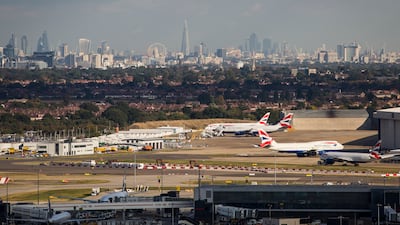
Aircraft at Heathrow Airport in front of the London skyline in 2016 -
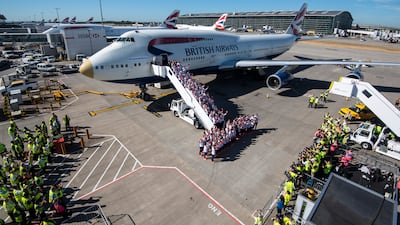
Members of Team GB arrive from Rio de Janeiro at Heathrow, after returning from the 2016 Olympics, which saw Great Britain's strongest performance at the Games in over a century -

A composite photo shows planes taking off from Heathrow in November 2016. Forty-two planes were captured between 10.17am and 11.17am and a montage was created from those single images -
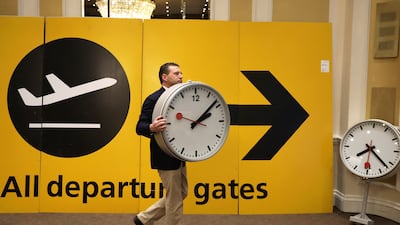
Items are arranged during an auction preview at Heathrow in 2018. The contents of Terminal 1, which closed in 2015, were being sold -
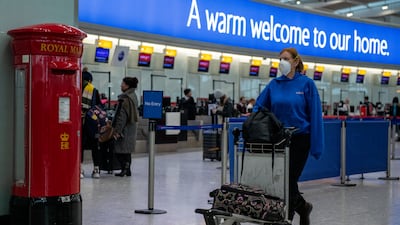
An airline passenger wearing a face mask pushes her bags through Heathrow's Terminal 5 during the coronavirus pandemic in 2020 -
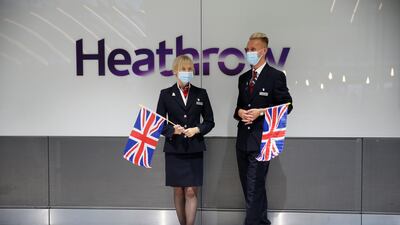
British Airways employees welcome Olympians returning from the Tokyo Olympics in 2021 -
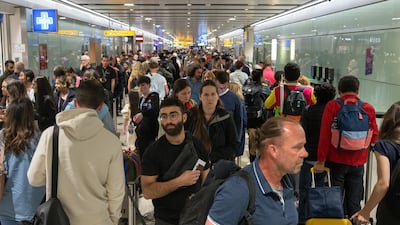
Travellers wait in a long queue to pass through the security check in 2022



