

After returning to New York from Oslo in late May, Harley Hendrix noticed her suitcase containing a cherished Alexander McQueen dress had been diverted to Copenhagen.
Also rotting in Denmark: packs of cheese that Ms Hendrix had stuffed into the suitcase to bring back home.
While she had not visited Copenhagen, Ms Hendrix knew the bag was there because, like many people these days, she had tucked an AirTag inside.
Delta Air Lines first told her it was at John F Kennedy International in New York, then Dallas, Texas. But the tracker was pinging from Denmark.
It took a week for Delta and its European partner KLM to find the suitcase and forward it to New York. By then, the cheese was spoilt, Ms Hendrix said.
The vintage black McQueen, still reeking of rotten Jarlsberg after several cleanings, had to be tossed – along with Chanel and Missoni dresses and cashmere sweaters.
“All trash. Some of these items I’ll never be able to exactly replace,” said Ms Hendrix, who curated her wardrobe over the years from sample sales and scouring second-hand sites.
“I didn’t actually love the Chanel dress but did love the Alexander McQueen.”
A year after air travel stormed back from pandemic lows, overwhelming the system with airport chaos and luggage pile-ups, airlines are still struggling to keep up.
Last month, bags stacked up from Newark Liberty to Los Angeles International after storms scrambled airline schedules in the north-east US.
At Amsterdam’s Schiphol airport, about 10,000 bags were lost in one day, which KLM chief executive Marjan Rintel blamed on the hub’s outdated systems.
Passengers are meanwhile arming themselves with Bluetooth devices in ever greater numbers, exposing a balky bag-handling system that’s often a step behind customers – and putting pressure on the industry to catch up.
Airlines and baggage-handling firms say they are better equipped than last year to keep customers’ goods from getting lost. The industry is also working on a plan to incorporate the trackers into existing systems and seeking assistance from technology firms.
One challenge is to create a standard for interoperability between airlines and device manufacturers – a starting point for eventual solutions.
“There is a huge benefit in complementing the airlines’ tracking data with the Bluetooth tracker information,” said Getnet Taye, senior manager of global baggage operations at the International Air Transport Association, the industry’s main lobbying group.
Current bag-handling tech is largely bar code based, logging items intermittently on their journey but not continuously.
The back-end systems of airlines, airports and ground-handling firms cannot always speak to each other, making them vulnerable to breakdowns.
Ms Hendrix used KLM to take her from Oslo to Amsterdam to connect with a Delta flight to the US. The Dutch airline said it regrets the incident that led to her ruined clothing, and that “every piece of misplaced luggage is one too many”.
KLM said it was closely monitoring technological advancements, though it does not use AirTag technology to track lost luggage because the data can only be shared with the owner of the tracker for privacy reasons.
Delta, which sold Ms Hendrix her tickets, also apologised. With its RFID-enabled systems, Delta misplaces bags less frequently than other large US global airlines, it said.
A bag can go astray for any number of reasons, from airport Wi-Fi signals to snafus on transfers between airlines. Schedule disruptions can lead to pile-ups, like during last summer’s disarray or the mass cancellations in December on Southwest Airlines.
-
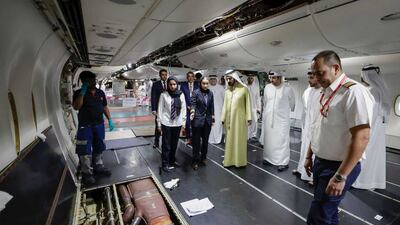
Sheikh Mohammed bin Rashid, Vice President and Ruler of Dubai, visits the Emirates Airlines Engineering Centre. All photos: Dubai Media Office -

Sheikh Mohammed bin Rashid, Vice President and Ruler of Dubai, reviewed the airline's ongoing 'retrofit' refurbishment programme for its A380 aircraft -
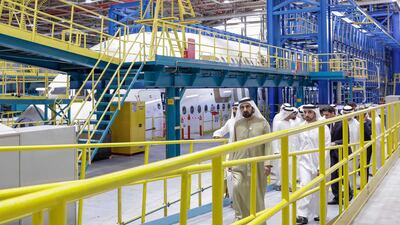
Sheikh Mohammed bin Rashid, Vice President and Ruler of Dubai, visits the 400,000-square-metre facility that is home to 12 hangars -

Sheikh Mohammed bin Rashid, Vice President and Ruler of Dubai, meets the Emirates engineering team that is made up of 60 per cent UAE citizens


For now, Bluetooth systems add to the pressure by providing users of Apple AirTags, Tile or Samsung SmartTags with frequent updates when in range of other enabled devices.
While passengers may know where their bags are sooner than airlines, customer-service desks cannot gain access to the same information.
Airlines’ responses have not always been reassuring. Deutsche Lufthansa AG initially tried to ban Bluetooth devices as a safety risk, but quickly reversed itself.
And each high-profile misstep drives passengers into the arms of manufacturers like Apple and Tile maker Life360.
“AirTag sales really began to ramp in the spring of ’22, which aligns with when the post-Covid travel surge began,” said Nate Harmon, director of research at YipitData.
It is too soon to know whether airlines have made a dent in the problems that erupted last summer, when lost baggage was a by-product of a spike in flight delays and cancellations.
Through April, US airlines misplaced about 0.62 per cent of bags checked by passengers on domestic flights this year, little changed from the first four months of 2022, according to statistics published by the Department of Transportation.
A big contributor to last year’s chaos was a labour shortage after the industry shed workers during the pandemic. Airlines, airports and baggage handlers say they have staffed up, have improved working conditions and are more focused on retention.
Still, pile-ups persist with unsettling regularity. Shortages of ground-handling staff and equipment were to blame for disruptions in Edinburgh this month, The Scotsman reported.
Workers in the UK, France, Switzerland and Belgium have snarled traffic this summer or threaten to with more strikes.
In Amsterdam, Schiphol said the late-June baggage chaos described by KLM’s Rintel affected transfer flights in particular. All of the misplaced luggage belonging to the Dutch airline’s customers has now been sent to its intended destination, the airport said in a statement.
One of those passengers was Shay Lawson, whose cold-weather clothing was waylaid in Amsterdam while she continued on a visit to the Arctic Circle. The suitcase was finally sent north, but only after Ms Lawson was already headed back to Atlanta.
It completed its circuitous journey four days after she did.
“The frustration here is that no one told me they had located my bag,’’ she said.
In the aftermath of last year’s failures, Swissport International, one of the largest providers of airport ground services, appointed a baggage “tsar” to look at pinch points and ways to improve. It is also working with customers to improve digital tracking, said Chris Rayner, chief people officer.
An AirTag investment would have value, but “has to be a combined effort”, he said.
Tech spending also suffered during the downturn, slowing progress on a 2018 initiative to ensure luggage is logged at least four times on a journey, and to encourage information sharing between participants, according to Iata.
“Right now the biggest challenge is how airlines and airports share information more transparently,” said Sumesh Patel, who heads the Asia-Pacific region of Sita, the industry-owned provider of widely used aviation technology.
“I don’t think there is any shortcoming in terms of technology or solutions, the only problem is collaboration.”
Sita offers a product that centralises tracing of lost baggage and extends some tools to passengers. There are also companies like Berkshire Hathaway offering travel insurance, and AirHelp, which provides assistance securing refunds and compensation.
Airlines also want tech firms to better explain to customers that Bluetooth trackers do not always give up-to-date information – adding to airline costs and creating customer-service headaches, according to Iata’s Mr Taye.
Apple and Life360 had no comment. Samsung said about 11 per cent of users have set their SmartTag devices to luggage-finding mode. The company had no further comment.
KLM offered Ms Hendrix $109 in compensation for the ruined items, according to a message from the Air France-KLM unit she showed to Bloomberg News.
The 54-year-old producer of executive events was not expecting much, as she bought the cheese for herself and for gifts with cash, and had long since done away with her receipt for the McQueen, purchased not long after the trailblazing designer died in 2010.
Still, she said she was disappointed.
“I could actually see exactly where my bag was and yet no one would listen or grab it,” Ms Hendrix said. “I have purchased four more AirTags after this.”

