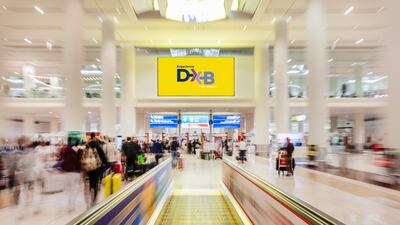
Dubai International Airport (DXB) retained the title of the world's busiest international hub for passengers in 2022 for the ninth year in a row, as long-haul travel demand surged, rankings by the Airports Council International (ACI) show.
London, Amsterdam, Paris and Istanbul followed Dubai as the top-five busiest hubs by international air traffic, the trade association for airports — representing nearly 2,000 airports worldwide — said on Wednesday.
DXB, which does not have a domestic market, more than doubled passenger traffic on the year to 66.1 million last year.
“While we continue to march forward cautiously amidst multiple headwinds that could impact the speed and magnitude of global air traffic recovery, the latest rankings represent an important milestone in reaching pre-pandemic levels,” ACI World's director general Luis Felipe de Oliveira said.
“The reopening of China, the second-largest aviation market after the US, is now expected to bring an overall gain, both domestically and for international travel.”
State-owned operator Dubai Airports projects the number of passengers that will pass through the international hub by the end of this year will reach 78 million, as the UAE prepares to host major international events such as the Dubai Airshow and the Cop28 climate summit.
A full recovery to pre-pandemic levels on a monthly basis could come by the end of this year, or the beginning of 2024, if monthly passenger figures reach 7.5 million, Paul Griffiths, chief executive of Dubai Airports, told The National in February.
Global airlines and airports, emerging from the two-year Covid-19 pandemic that shattered air travel demand, are now facing steep jet fuel bills and mounting pressure to reduce their carbon footprint as they ramp up operations to meet surging travel demand.
Preliminary figures by ACI indicate that with the return of international travel, 2022 global passenger traffic reached close to 7 billion, an increase of 53.5 per cent from 2021, and recovered to 73.8 per cent of 2019 levels.
Hartsfield-Jackson Atlanta International Airport once again topped the rankings by overall passenger traffic last year, returning to the list with a 23.8 per cent year-on-year increase to 93.7 million travellers, ACI data showed.
Dallas/Fort Worth International Airport, Denver International Airport, Chicago's O'Hare International Airport followed Atlanta International Airport and held their positions from 2021.
Of the top 10 airports globally, five are in the US, ACI data showed. The strong performance by US airports was due to a healthy recovery in domestic travel. All five airports in the country have significant domestic passenger traffic shares of between 75 per cent and 95 per cent, ACI said.
Dubai ranked fifth in the list of the world's top 10 busiest airports.
London Heathrow ranked eighth and recorded the biggest jump in the top-10 list. The airport improved its ranking from 54th position as borders reopened in March 2022 after two years of pandemic-induced closures.
Delhi International Airport featured in the top-10 list for the first time, jumping from 13th position in 2021 and 17th in 2019, boosted by India's fast-growing travel market and aviation ambitions.
The rankings were based on the preliminary compilation of 2022 global data from airports around the world and take into account both their domestic and international markets.
Skoda Superb Specs
Engine: 2-litre TSI petrol
Power: 190hp
Torque: 320Nm
Price: From Dh147,000
Available: Now
Match info
Uefa Nations League A Group 4
England 2 (Lingard 78', Kane 85')
Croatia 1 (Kramaric 57')
Man of the match: Harry Kane (England)
Ten tax points to be aware of in 2026
1. Domestic VAT refund amendments: request your refund within five years
If a business does not apply for the refund on time, they lose their credit.
2. E-invoicing in the UAE
Businesses should continue preparing for the implementation of e-invoicing in the UAE, with 2026 a preparation and transition period ahead of phased mandatory adoption.
3. More tax audits
Tax authorities are increasingly using data already available across multiple filings to identify audit risks.
4. More beneficial VAT and excise tax penalty regime
Tax disputes are expected to become more frequent and more structured, with clearer administrative objection and appeal processes. The UAE has adopted a new penalty regime for VAT and excise disputes, which now mirrors the penalty regime for corporate tax.
5. Greater emphasis on statutory audit
There is a greater need for the accuracy of financial statements. The International Financial Reporting Standards standards need to be strictly adhered to and, as a result, the quality of the audits will need to increase.
6. Further transfer pricing enforcement
Transfer pricing enforcement, which refers to the practice of establishing prices for internal transactions between related entities, is expected to broaden in scope. The UAE will shortly open the possibility to negotiate advance pricing agreements, or essentially rulings for transfer pricing purposes.
7. Limited time periods for audits
Recent amendments also introduce a default five-year limitation period for tax audits and assessments, subject to specific statutory exceptions. While the standard audit and assessment period is five years, this may be extended to up to 15 years in cases involving fraud or tax evasion.
8. Pillar 2 implementation
Many multinational groups will begin to feel the practical effect of the Domestic Minimum Top-Up Tax (DMTT), the UAE's implementation of the OECD’s global minimum tax under Pillar 2. While the rules apply for financial years starting on or after January 1, 2025, it is 2026 that marks the transition to an operational phase.
9. Reduced compliance obligations for imported goods and services
Businesses that apply the reverse-charge mechanism for VAT purposes in the UAE may benefit from reduced compliance obligations.
10. Substance and CbC reporting focus
Tax authorities are expected to continue strengthening the enforcement of economic substance and Country-by-Country (CbC) reporting frameworks. In the UAE, these regimes are increasingly being used as risk-assessment tools, providing tax authorities with a comprehensive view of multinational groups’ global footprints and enabling them to assess whether profits are aligned with real economic activity.
Contributed by Thomas Vanhee and Hend Rashwan, Aurifer
MATCH INFO
Chelsea 0
Liverpool 2 (Mane 50', 54')
Red card: Andreas Christensen (Chelsea)
Man of the match: Sadio Mane (Liverpool)
COMPANY%20PROFILE
%3Cp%3EFounder%3A%20Hani%20Abu%20Ghazaleh%3Cbr%3EBased%3A%20Abu%20Dhabi%2C%20with%20an%20office%20in%20Montreal%3Cbr%3EFounded%3A%202018%3Cbr%3ESector%3A%20Virtual%20Reality%3Cbr%3EInvestment%20raised%3A%20%241.2%20million%2C%20and%20nearing%20close%20of%20%245%20million%20new%20funding%20round%3Cbr%3ENumber%20of%20employees%3A%2012%3C%2Fp%3E%0A
%20Ramez%20Gab%20Min%20El%20Akher
%3Cp%3E%3Cstrong%3ECreator%3A%3C%2Fstrong%3E%20Ramez%20Galal%3C%2Fp%3E%0A%3Cp%3E%3Cstrong%3EStarring%3A%3C%2Fstrong%3E%20Ramez%20Galal%3C%2Fp%3E%0A%3Cp%3E%3Cstrong%3EStreaming%20on%3A%20%3C%2Fstrong%3EMBC%20Shahid%3C%2Fp%3E%0A%3Cp%3E%3Cstrong%3ERating%3A%20%3C%2Fstrong%3E2.5%2F5%3C%2Fp%3E%0A
Tips to avoid getting scammed
1) Beware of cheques presented late on Thursday
2) Visit an RTA centre to change registration only after receiving payment
3) Be aware of people asking to test drive the car alone
4) Try not to close the sale at night
5) Don't be rushed into a sale
6) Call 901 if you see any suspicious behaviour
COMPANY PROFILE
Name: Rain Management
Year started: 2017
Based: Bahrain
Employees: 100-120
Amount raised: $2.5m from BitMex Ventures and Blockwater. Another $6m raised from MEVP, Coinbase, Vision Ventures, CMT, Jimco and DIFC Fintech Fund
COMPANY PROFILE
Name: Kumulus Water
Started: 2021
Founders: Iheb Triki and Mohamed Ali Abid
Based: Tunisia
Sector: Water technology
Number of staff: 22
Investment raised: $4 million
Huroob Ezterari
Director: Ahmed Moussa
Starring: Ahmed El Sakka, Amir Karara, Ghada Adel and Moustafa Mohammed
Three stars
Mercer, the investment consulting arm of US services company Marsh & McLennan, expects its wealth division to at least double its assets under management (AUM) in the Middle East as wealth in the region continues to grow despite economic headwinds, a company official said.
Mercer Wealth, which globally has $160 billion in AUM, plans to boost its AUM in the region to $2-$3bn in the next 2-3 years from the present $1bn, said Yasir AbuShaban, a Dubai-based principal with Mercer Wealth.
“Within the next two to three years, we are looking at reaching $2 to $3 billion as a conservative estimate and we do see an opportunity to do so,” said Mr AbuShaban.
Mercer does not directly make investments, but allocates clients’ money they have discretion to, to professional asset managers. They also provide advice to clients.
“We have buying power. We can negotiate on their (client’s) behalf with asset managers to provide them lower fees than they otherwise would have to get on their own,” he added.
Mercer Wealth’s clients include sovereign wealth funds, family offices, and insurance companies among others.
From its office in Dubai, Mercer also looks after Africa, India and Turkey, where they also see opportunity for growth.
Wealth creation in Middle East and Africa (MEA) grew 8.5 per cent to $8.1 trillion last year from $7.5tn in 2015, higher than last year’s global average of 6 per cent and the second-highest growth in a region after Asia-Pacific which grew 9.9 per cent, according to consultancy Boston Consulting Group (BCG). In the region, where wealth grew just 1.9 per cent in 2015 compared with 2014, a pickup in oil prices has helped in wealth generation.
BCG is forecasting MEA wealth will rise to $12tn by 2021, growing at an annual average of 8 per cent.
Drivers of wealth generation in the region will be split evenly between new wealth creation and growth of performance of existing assets, according to BCG.
Another general trend in the region is clients’ looking for a comprehensive approach to investing, according to Mr AbuShaban.
“Institutional investors or some of the families are seeing a slowdown in the available capital they have to invest and in that sense they are looking at optimizing the way they manage their portfolios and making sure they are not investing haphazardly and different parts of their investment are working together,” said Mr AbuShaban.
Some clients also have a higher appetite for risk, given the low interest-rate environment that does not provide enough yield for some institutional investors. These clients are keen to invest in illiquid assets, such as private equity and infrastructure.
“What we have seen is a desire for higher returns in what has been a low-return environment specifically in various fixed income or bonds,” he said.
“In this environment, we have seen a de facto increase in the risk that clients are taking in things like illiquid investments, private equity investments, infrastructure and private debt, those kind of investments were higher illiquidity results in incrementally higher returns.”
The Abu Dhabi Investment Authority, one of the largest sovereign wealth funds, said in its 2016 report that has gradually increased its exposure in direct private equity and private credit transactions, mainly in Asian markets and especially in China and India. The authority’s private equity department focused on structured equities owing to “their defensive characteristics.”
Mobile phone packages comparison