


Emirates, the world's largest long-haul airline, reported a record profit in the first half of the current financial year on strong travel demand during the peak summer season as international borders reopened and coronavirus restrictions eased.
The airline posted a Dh4 billion ($1.1bn) profit in the April to September period, compared with a loss of Dh5.8bn in the same period last year, Emirates said on Thursday, citing its ability to increase capacity in response to the surge in travel demand.
Revenue more than doubled to Dh50.1bn from Dh21.7bn in the same period a year earlier, despite unfavourable currency exchange movements, as the airline carried 20 million passengers, up 228 per cent from the same period last year, it said.
The performance is the result of forward planning and agility, said Sheikh Ahmed bin Saeed, chairman and chief executive of Emirates airline and group.
“Across the group, our operations recovery accelerated as more countries eased and removed travel restrictions," he said.
"We were ready and amongst the first movers to serve the strong customer demand thanks to our robust business plans, the support of our industry partners, and our ongoing investments."
The Dubai-based airline benefitted from a strong rebound in passenger travel in the summer, which led to higher air fares across the global airline industry as capacity remained constricted, compared with pre-pandemic levels, and jet fuel costs increased.
Travel demand is strengthening after two years of Covid-19 lockdowns and restrictions, giving a much-needed boost to airlines that reported losses, rising debt and staff redundancies during the pandemic.
But global airlines also face a perfect storm of high fuel costs, currency fluctuations, a shortage of aviation workers, delays in aircraft deliveries, the Russia-Ukraine war, higher inflation and a gloomier economic outlook.
Emirates has been bullish about the recovery of travel, resuming flights that had been suspended during the pandemic.
It has also launched new routes, hired additional cabin crew, forged codeshare partnerships and invested more than $2bn to retrofit its aircraft.
"The airline’s strong turnaround performance is driven by strong passenger demand for international travel across markets and shows the airline’s ability to plan ahead to meet the demand, activate capacity and attract customers," Emirates said.
In terms of air freight, the volume of cargo lifted declined by 14 per cent year-on-year to 936,000 tonnes during the six-month period as the airline shifted capacity from its “mini-freighters” back to passenger operations, it said.
Emirates group, which includes global airport services company Dnata, reported a record profit of Dh4.2bn, after a net loss to Dh5.7bn in the April to September period last year.
Group revenue more than doubled to Dh56.3bn. The group's cash position reached Dh32.6bn on September 30, compared with Dh25.8bn as of March 31.
The group has been able to tap its own cash reserves to support business needs, including debt payments and pandemic-related commitments, Emirates said.
"The group expects to return to our track record of profitability at the close of our full financial year," Sheikh Ahmed said.
Dnata's cargo and ground handling, catering and retail, and travel services businesses recorded a "significant uptick" in operations due to an increase in passenger traffic across its markets.
Dnata posted a Dh236 million profit, compared with a profit of Dh85m last year. Its revenue doubled to Dh7.3bn during the first half of the year.
In August, Emirates airline introduced its full Premium Economy cabin to a "hugely positive, booked-out customer response" on its flights to London, Paris and Sydney, it said.
Emirates plans to introduce its Premium Economy cabin on five more routes before the end of the 2022-2023 fiscal year, as more aircraft are fitted with these seats under its retrofit programme.
In line with increased capacity and business activities, the Emirates group’s employee base grew 10 per cent to an overall count of 93,893 as of September 30, compared with March 31.
Travel outlook
Emirates said it expects travel demand to remain strong in the second half of its fiscal year as it remains focused on restoring its operations to pre-pandemic levels and growing its workforce.
Emirates plans to hire an additional 400 pilots and 5,000 to 6,000 cabin crew by the middle of next year, recruiting to the maximum capacity of its training facilities, Adel Al Redha, chief operations officer told The National on Wednesday. This will swell the airline's current workforce of 4,500 pilots and 17,500 cabin crew.
However, the airline is also monitoring macroeconomic challenges facing the aviation industry.
"The horizon is not without headwinds, and we are keeping a close watch on inflationary costs and other macro-challenges such as the strong US dollar and the fiscal policies of major markets," Sheikh Ahmed said.
Emirates airline through the years - in pictures
-

Emirates' first flights in October 1985 used leased aircraft. Photo: Emirates -
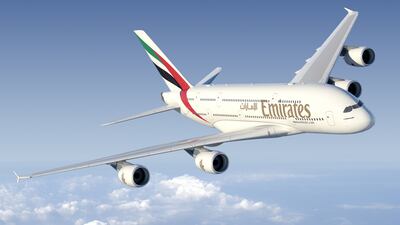
An Emirates A380 in flight. Photo: Emirates -

Emirates Premium Economy is the airline's newest cabin class. DXB Terminal 3, Dubai. Chris Whiteoak / The National -

Skydiver and stuntwoman Nicole Smith-Ludvik stars in Emirates' latest ad campaign at the top of the Burj Khalifa. Emirates -
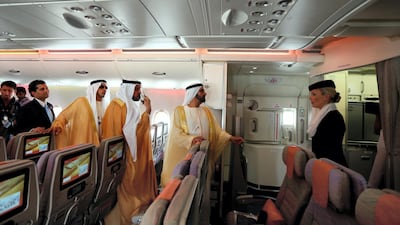
Sheikh Mohammed bin Rashid Al Maktoum, Vice President and Ruler of Dubai, takes a tour of the Emirates A380 airliner during the opening ceremony at Dubai Airshow in November 2013. AFP -
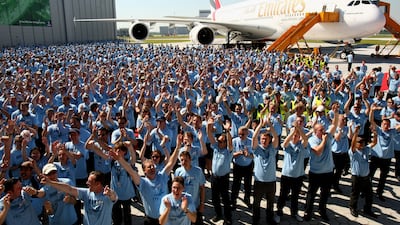
Airbus workers celebrate in front of the Airbus A380 on July 28, 2008 in Hamburg, Germany. The world's largest passenger liner was built for Emirates airline. Getty Images -
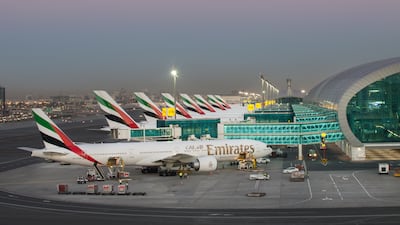
Terminal 3, the exclusive terminal for Emirates airline, was opened in 2008. Photo: Emirates -

Emirates chairman, Sheikh Ahmed bin Saeed Al Maktoum, in November 2001, with a model of the Airbus A3XX superjumbo jet (now known as the A380) at the Farnborough Air Show. Reuters



