The aviation industry needs to prepare for the future to address the expected higher levels of travel demand, climate change challenges and operational safety, Emirates airline president Tim Clark has said.
Industry investment in air navigation systems, new technology, skilled aviation workers and infrastructure are inadequate, he said in a keynote speech on Tuesday at the International Air Transport Association's Safety Conference in Dubai.
"These days a few things are keeping me awake and one of them is future readiness," Mr Clark said.
"Are we as an industry truly ready to tackle the next 20 to 30 years? I fear that what I’ve been seeing so far are signs of an industry failure to provide the right infrastructure for the future. And more worrying, a dearth of leadership."
"How can we operate safely if we are not investing in systems, in technologies, in people and in bricks-and-mortar infrastructure?"
The aviation veteran lambasted plane-makers over repeated delays of aircraft deliveries as the airline steps up its operations to meet a surge of travel demand after bouncing back from the Covid-19 pandemic.
"How can we be assured of safety when the biggest manufacturers in commercial aviation are failing to deliver aircraft programmes to the standards and timelines requested to replace ageing fleets? Where is the accountability and oversight from their senior managers?" Mr Clark said.
Emirates has previously criticised US aircraft manufacturer Boeing for years-long delays to its 777X programme, which the airline warned would hamper its complex fleet plans.
Supply chain issues have also left suppliers and manufacturers struggling to source everything from raw materials to parts to keep the production process moving.
Highlighting the industry's shortcomings in dealing with the massive resurgence of travel demand this summer, the Emirates boss also highlighted some airports' failure to foresee the recovery after the pandemic and the reopening of global business and tourism.
"Just look at the shambolic situations we found ourselves in at many airports this summer," Mr Clark said. "We can hardly cope with current demand, not to mention future growth. And how many countries are investing to improve and expand airport infrastructure, and modernise air navigation systems?"
European hubs such as London's Heathrow and Amsterdam's Schiphol had to impose passenger caps amid long queues, delays and baggage problems due to a staff shortage.
____________________________
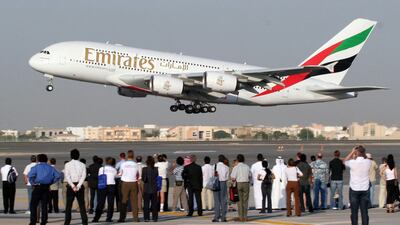
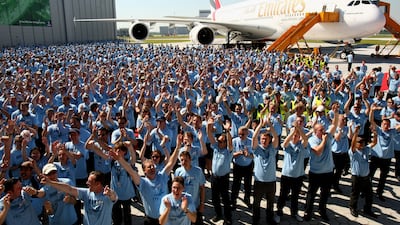
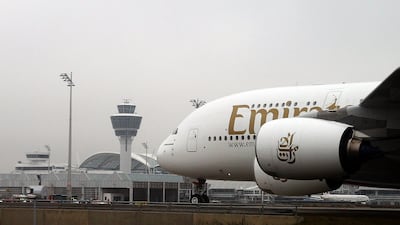
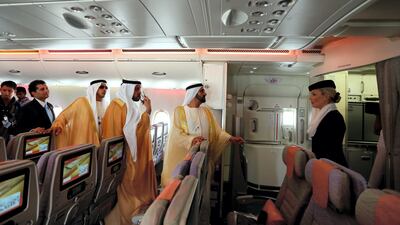
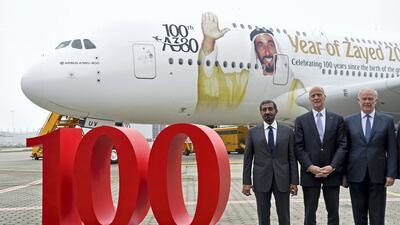
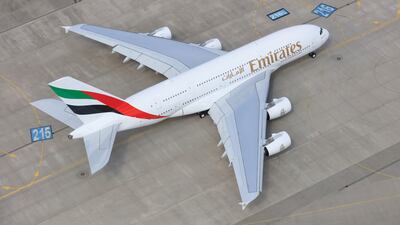
Emirates A380 - in pictures
____________________________
Earlier this year, major international airlines were caught off guard by safety concerns triggered by a major C-band fifth-generation (5G) wireless rollout in the US, sending them scrambling to alter flight plans or cancel them altogether.
"How did we end up in shambles at the 11th hour ... with the roll-out of 5G telecoms in the United States?" Mr Clark said.
"What kind of systems do we have that, in this day and age, pilots with fake licences are found operating aircraft with hundreds of human lives on board? Has there been sufficient investment in support programmes to build a pool of skilled aviation workers?"
Government agencies, regulators, airlines, airports, ground handlers, air navigation services, manufacturers and supply chain players must all play their part to address these industry issues, Mr Clark said.
Other challenges to operational safety include providing more mental health support to aviation workers, addressing the shortage in skilled staff, flying sustainably, addressing cyber-security threats and designing a safety framework for eVTOLs (Electric vertical take off and landing vehicles), speakers at the Iata Safety Conference said.
With the kind of growth and innovation that the industry continues to register in areas such as advanced air mobility and the number of retirements hastened by the pandemic, the industry needs to develop highly skilled talent, Billy Nolen, acting administrator of the US Federal Aviation Administration, told the conference.
"This industry needs new people, including those with new skills and new abilities," he said.
"Government and industry must continue to work together and find more creative ways to build a future workforce and help them develop the advanced skill sets they all need to match [these] advancements."

North Pole stats
Distance covered: 160km
Temperature: -40°C
Weight of equipment: 45kg
Altitude (metres above sea level): 0
Terrain: Ice rock
South Pole stats
Distance covered: 130km
Temperature: -50°C
Weight of equipment: 50kg
Altitude (metres above sea level): 3,300
Terrain: Flat ice
Indoor cricket in a nutshell
Indoor Cricket World Cup - Sept 16-20, Insportz, Dubai
16 Indoor cricket matches are 16 overs per side
8 There are eight players per team
9 There have been nine Indoor Cricket World Cups for men. Australia have won every one.
5 Five runs are deducted from the score when a wickets falls
4 Batsmen bat in pairs, facing four overs per partnership
Scoring In indoor cricket, runs are scored by way of both physical and bonus runs. Physical runs are scored by both batsmen completing a run from one crease to the other. Bonus runs are scored when the ball hits a net in different zones, but only when at least one physical run is score.
Zones
A Front net, behind the striker and wicketkeeper: 0 runs
B Side nets, between the striker and halfway down the pitch: 1 run
C Side nets between halfway and the bowlers end: 2 runs
D Back net: 4 runs on the bounce, 6 runs on the full
Mercer, the investment consulting arm of US services company Marsh & McLennan, expects its wealth division to at least double its assets under management (AUM) in the Middle East as wealth in the region continues to grow despite economic headwinds, a company official said.
Mercer Wealth, which globally has $160 billion in AUM, plans to boost its AUM in the region to $2-$3bn in the next 2-3 years from the present $1bn, said Yasir AbuShaban, a Dubai-based principal with Mercer Wealth.
“Within the next two to three years, we are looking at reaching $2 to $3 billion as a conservative estimate and we do see an opportunity to do so,” said Mr AbuShaban.
Mercer does not directly make investments, but allocates clients’ money they have discretion to, to professional asset managers. They also provide advice to clients.
“We have buying power. We can negotiate on their (client’s) behalf with asset managers to provide them lower fees than they otherwise would have to get on their own,” he added.
Mercer Wealth’s clients include sovereign wealth funds, family offices, and insurance companies among others.
From its office in Dubai, Mercer also looks after Africa, India and Turkey, where they also see opportunity for growth.
Wealth creation in Middle East and Africa (MEA) grew 8.5 per cent to $8.1 trillion last year from $7.5tn in 2015, higher than last year’s global average of 6 per cent and the second-highest growth in a region after Asia-Pacific which grew 9.9 per cent, according to consultancy Boston Consulting Group (BCG). In the region, where wealth grew just 1.9 per cent in 2015 compared with 2014, a pickup in oil prices has helped in wealth generation.
BCG is forecasting MEA wealth will rise to $12tn by 2021, growing at an annual average of 8 per cent.
Drivers of wealth generation in the region will be split evenly between new wealth creation and growth of performance of existing assets, according to BCG.
Another general trend in the region is clients’ looking for a comprehensive approach to investing, according to Mr AbuShaban.
“Institutional investors or some of the families are seeing a slowdown in the available capital they have to invest and in that sense they are looking at optimizing the way they manage their portfolios and making sure they are not investing haphazardly and different parts of their investment are working together,” said Mr AbuShaban.
Some clients also have a higher appetite for risk, given the low interest-rate environment that does not provide enough yield for some institutional investors. These clients are keen to invest in illiquid assets, such as private equity and infrastructure.
“What we have seen is a desire for higher returns in what has been a low-return environment specifically in various fixed income or bonds,” he said.
“In this environment, we have seen a de facto increase in the risk that clients are taking in things like illiquid investments, private equity investments, infrastructure and private debt, those kind of investments were higher illiquidity results in incrementally higher returns.”
The Abu Dhabi Investment Authority, one of the largest sovereign wealth funds, said in its 2016 report that has gradually increased its exposure in direct private equity and private credit transactions, mainly in Asian markets and especially in China and India. The authority’s private equity department focused on structured equities owing to “their defensive characteristics.”
Packages which the US Secret Service said contained possible explosive devices were sent to:
- Former first lady Hillary Clinton
- Former US president Barack Obama
- Philanthropist and businessman George Soros
- Former CIA director John Brennan at CNN's New York bureau
- Former Attorney General Eric Holder (delivered to former DNC chair Debbie Wasserman Schultz)
- California Congresswoman Maxine Waters (two devices)
FFP EXPLAINED
What is Financial Fair Play?
Introduced in 2011 by Uefa, European football’s governing body, it demands that clubs live within their means. Chiefly, spend within their income and not make substantial losses.
What the rules dictate?
The second phase of its implementation limits losses to €30 million (Dh136m) over three seasons. Extra expenditure is permitted for investment in sustainable areas (youth academies, stadium development, etc). Money provided by owners is not viewed as income. Revenue from “related parties” to those owners is assessed by Uefa's “financial control body” to be sure it is a fair value, or in line with market prices.
What are the penalties?
There are a number of punishments, including fines, a loss of prize money or having to reduce squad size for European competition – as happened to PSG in 2014. There is even the threat of a competition ban, which could in theory lead to PSG’s suspension from the Uefa Champions League.
AWARDS
%3Cp%3E%3Cstrong%3EBest%20Male%20black%20belt%3A%20%3C%2Fstrong%3ELucas%20Protasio%20(BRA)%3Cbr%3E%3Cstrong%3EBest%20female%20black%20belt%3A%20%3C%2Fstrong%3EJulia%20Alves%20(BRA)%3Cbr%3E%3Cstrong%3EBest%20Masters%20black%20belt%3A%3C%2Fstrong%3E%20Igor%20Silva%20(BRA)%3Cbr%3E%3Cstrong%3EBest%20Asian%20Jiu-Jitsu%20Federation%3A%3C%2Fstrong%3E%20Kazakhstan%3Cbr%3E%3Cstrong%3EBest%20Academy%20in%20UAE%3A%20%3C%2Fstrong%3ECommando%20Group%2C%20Abu%20Dhabi%3Cbr%3E%3Cstrong%3EBest%20International%20Academy%3A%3C%2Fstrong%3E%20Commando%20Group%2C%20Abu%20Dhabi%3Cbr%3E%3Cstrong%3EAfrican%20Player%20of%20the%20Year%3A%20%3C%2Fstrong%3EKatiuscia%20Yasmira%20Dias%20(GNB)%3Cbr%3E%3Cstrong%3EOceanian%20Player%20of%20the%20Year%3A%20%3C%2Fstrong%3EAnton%20Minenko%20(AUS)%3Cbr%3E%3Cstrong%3EEuropean%20Player%20of%20the%20Year%3A%3C%2Fstrong%3E%20Rose%20El%20Sharouni%20(NED)%3Cbr%3E%3Cstrong%3ENorth%20and%20Central%20American%20Player%20of%20the%20Year%3A%20%3C%2Fstrong%3EAlexa%20Yanes%20(USA)%3Cbr%3E%3Cstrong%3EAsian%20Player%20of%20the%20Year%3A%20%3C%2Fstrong%3EZayed%20Al%20Katheeri%20(UAE)%3Cbr%3E%3Cstrong%3ERookie%20of%20the%20Year%3A%3C%2Fstrong%3E%20Rui%20Neto%20(BRA)Rui%20Neto%20(BRA)%3C%2Fp%3E%0A
Specs
Engine: Dual-motor all-wheel-drive electric
Range: Up to 610km
Power: 905hp
Torque: 985Nm
Price: From Dh439,000
Available: Now
Gulf Under 19s final
Dubai College A 50-12 Dubai College B
My Country: A Syrian Memoir
Kassem Eid, Bloomsbury
The specs
Engine: 1.5-litre turbo
Power: 181hp
Torque: 230Nm
Transmission: 6-speed automatic
Starting price: Dh79,000
On sale: Now
Ten tax points to be aware of in 2026
1. Domestic VAT refund amendments: request your refund within five years
If a business does not apply for the refund on time, they lose their credit.
2. E-invoicing in the UAE
Businesses should continue preparing for the implementation of e-invoicing in the UAE, with 2026 a preparation and transition period ahead of phased mandatory adoption.
3. More tax audits
Tax authorities are increasingly using data already available across multiple filings to identify audit risks.
4. More beneficial VAT and excise tax penalty regime
Tax disputes are expected to become more frequent and more structured, with clearer administrative objection and appeal processes. The UAE has adopted a new penalty regime for VAT and excise disputes, which now mirrors the penalty regime for corporate tax.
5. Greater emphasis on statutory audit
There is a greater need for the accuracy of financial statements. The International Financial Reporting Standards standards need to be strictly adhered to and, as a result, the quality of the audits will need to increase.
6. Further transfer pricing enforcement
Transfer pricing enforcement, which refers to the practice of establishing prices for internal transactions between related entities, is expected to broaden in scope. The UAE will shortly open the possibility to negotiate advance pricing agreements, or essentially rulings for transfer pricing purposes.
7. Limited time periods for audits
Recent amendments also introduce a default five-year limitation period for tax audits and assessments, subject to specific statutory exceptions. While the standard audit and assessment period is five years, this may be extended to up to 15 years in cases involving fraud or tax evasion.
8. Pillar 2 implementation
Many multinational groups will begin to feel the practical effect of the Domestic Minimum Top-Up Tax (DMTT), the UAE's implementation of the OECD’s global minimum tax under Pillar 2. While the rules apply for financial years starting on or after January 1, 2025, it is 2026 that marks the transition to an operational phase.
9. Reduced compliance obligations for imported goods and services
Businesses that apply the reverse-charge mechanism for VAT purposes in the UAE may benefit from reduced compliance obligations.
10. Substance and CbC reporting focus
Tax authorities are expected to continue strengthening the enforcement of economic substance and Country-by-Country (CbC) reporting frameworks. In the UAE, these regimes are increasingly being used as risk-assessment tools, providing tax authorities with a comprehensive view of multinational groups’ global footprints and enabling them to assess whether profits are aligned with real economic activity.
Contributed by Thomas Vanhee and Hend Rashwan, Aurifer
The biog
Name: Marie Byrne
Nationality: Irish
Favourite film: The Shawshank Redemption
Book: Seagull by Jonathan Livingston
Life lesson: A person is not old until regret takes the place of their dreams
Disturbing%20facts%20and%20figures
%3Cp%3E%3Cstrong%3E51%25%3C%2Fstrong%3E%20of%20parents%20in%20the%20UAE%20feel%20like%20they%20are%20failing%20within%20the%20first%20year%20of%20parenthood%3C%2Fp%3E%0A%3Cp%3E%3Cstrong%3E57%25%20vs%2043%25%3C%2Fstrong%3E%20is%20the%20number%20of%20mothers%20versus%20the%20number%20of%20fathers%20who%20feel%20they%E2%80%99re%20failing%3C%2Fp%3E%0A%3Cp%3E%3Cstrong%3E28%25%3C%2Fstrong%3E%20of%20parents%20believe%20social%20media%20adds%20to%20the%20pressure%20they%20feel%20to%20be%20perfect%3C%2Fp%3E%0A%3Cp%3E%3Cstrong%3E55%25%3C%2Fstrong%3E%20of%20parents%20cannot%20relate%20to%20parenting%20images%20on%20social%20media%3C%2Fp%3E%0A%3Cp%3E%3Cstrong%3E67%25%3C%2Fstrong%3E%20of%20parents%20wish%20there%20were%20more%20honest%20representations%20of%20parenting%20on%20social%20media%3C%2Fp%3E%0A%3Cp%3E%3Cstrong%3E53%25%3C%2Fstrong%3E%20of%20parents%20admit%20they%20put%20on%20a%20brave%20face%20rather%20than%20being%20honest%20due%20to%20fear%20of%20judgment%3C%2Fp%3E%0A%3Cp%3E%3Cspan%20style%3D%22font-size%3A%2014px%3B%22%3ESource%3A%20YouGov%3C%2Fspan%3E%3C%2Fp%3E%0A