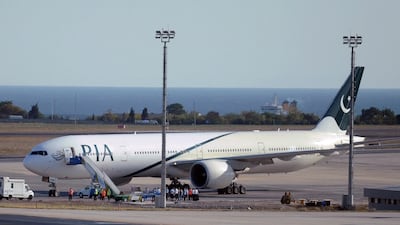
The UAE's civil aviation regulator has asked authorities in Pakistan for verification of licences and qualifications of its pilots after the government said almost a third of pilots had obtained their qualifications fraudulently. AP Photo
The UAE's civil aviation regulator has asked authorities in Pakistan for verification of licences and qualifications of its pilots after the government said almost a third of pilots had obtained their

UAE civil aviation authorities ask Pakistan for proof of pilots' credentials amid fake licence scandal


Ramola Talwar Badam
  • English
  • Arabic

The UAE's aviation authority has asked Pakistan for detailed information about the qualifications of its pilots to ensure the safety of flights.

The request comes a week after Pakistan's aviation minister said close to a third of the country's pilots had obtained flying licences fraudulently.

The General Civil Aviation Authority said it asked for clarifications as it was keen to implement the highest aviation safety standards required for operations in the country.

The UAE regulator has requested from Pakistan “clarifications pertaining to the authenticity of Pakistani issued licences and verifications of the qualifications of their pilots who are holding Pakistani licences,” according to a statement.

The GCAA has also reviewed all its records of licences issued by Pakistan to ensure “no suspicious licenses issued by the Pakistan Civil Aviation Authority has entered its system.”

The authority is in discussions with the International Civil Aviation Organisation and has asked for more information to take further safety measures if required.

On Thursday, Etihad said it has worked closely with the GCAA to verify the qualifications and licenses of Pakistani pilots employed by the airline.

“While we can confirm the authenticity of these pilots, we are however carrying out further precautionary due diligence with an additional audit,” a spokeswoman said

The airline said it operates stringent safety, security and professional background checks on all pilots and engineers joining its workforce.

“The safety of our passengers and crew remains our paramount priority,” she said.

Emirates declined to comment while Flydubai said it was governed by GCAA in the matter.

On Monday, the GCAA suspended passenger flights from Pakistan entering the country.

Pakistan’s aviation minister Ghulam Sarwar Khan last week said 262 pilots in the country had not taken exams themselves but paid someone to sit the papers on their behalf.

Earlier this week, the European Union banned Pakistan International Airlines from flying into Europe for six months.

The European Union Aviation Safety Agency said it was “concerned about the validity of the Pakistani pilot licences and that Pakistan, as the state of operator, is currently not capable to certify and oversee its operators and aircraft in accordance with applicable international standards.”

Pakistan International Airlines has grounded 150 pilots for cheating.

An inquiry into the May 22 PIA crash that killed 97 people near Karachi led to the revelation that 260 of 860 pilots in Pakistan had cheated on their exams.

The report said the pilots were discussing the impact of the coronavirus before the plane crashed into a row of houses as it approached Karachi airport.

Mr Khan told parliament the pilot and the controller did not follow standard rules.

The government has since fired four officials of the regulatory agency.

Moon Music

Artist: Coldplay

Label: Parlophone/Atlantic

Number of tracks: 10

Rating: 3/5

'Panga'

Directed by Ashwiny Iyer Tiwari

Starring Kangana Ranaut, Richa Chadha, Jassie Gill, Yagya Bhasin, Neena Gupta

Rating: 3.5/5

MATCH INFO

Uefa Champions League semi-final, first leg

Tottenham v Ajax, Tuesday, 11pm (UAE).

Second leg

Ajax v Tottenham, Wednesday, May 8, 11pm

Games on BeIN Sports

Notable salonnières of the Middle East through history

Al Khasan (Okaz, Saudi Arabia)

Tamadir bint Amr Al Harith, known simply as Al Khasan, was a poet from Najd famed for elegies, earning great renown for the eulogy of her brothers Mu’awiyah and Sakhr, both killed in tribal wars. Although not a salonnière, this prestigious 7th century poet fostered a culture of literary criticism and could be found standing in the souq of Okaz and reciting her poetry, publicly pronouncing her views and inviting others to join in the debate on scholarship. She later converted to Islam.


Maryana Marrash (Aleppo)

A poet and writer, Marrash helped revive the tradition of the salon and was an active part of the Nadha movement, or Arab Renaissance. Born to an established family in Aleppo in Ottoman Syria in 1848, Marrash was educated at missionary schools in Aleppo and Beirut at a time when many women did not receive an education. After touring Europe, she began to host salons where writers played chess and cards, competed in the art of poetry, and discussed literature and politics. An accomplished singer and canon player, music and dancing were a part of these evenings.


Princess Nazil Fadil (Cairo)

Princess Nazil Fadil gathered religious, literary and political elite together at her Cairo palace, although she stopped short of inviting women. The princess, a niece of Khedive Ismail, believed that Egypt’s situation could only be solved through education and she donated her own property to help fund the first modern Egyptian University in Cairo.


Mayy Ziyadah (Cairo)

Ziyadah was the first to entertain both men and women at her Cairo salon, founded in 1913. The writer, poet, public speaker and critic, her writing explored language, religious identity, language, nationalism and hierarchy. Born in Nazareth, Palestine, to a Lebanese father and Palestinian mother, her salon was open to different social classes and earned comparisons with souq of where Al Khansa herself once recited.
