


Emirates airline received the last manufactured Airbus A380 on Thursday, the 123rd aircraft that completed its superjumbo fleet.
The delivery capped a historic run for the wide-body A380, the first new aircraft of the 21st century. There were 249 of the double-decker delivered to 14 customers, including Abu Dhabi's Etihad Airways. Emirates operates about half of the A380s in service globally.
"The A380 is a truly special aircraft in so many ways. For Emirates, it gave us the opportunity to redefine the travel experience, efficiently serve demand at slot-constrained airports, and bolster our network growth. The A380 will remain Emirates’ flagship product for the coming years, and a vital pillar of our network plans," Tim Clark, president of Emirates airline, said in a statement.
The superjumbo delivered to Emirates on Thursday features the latest cabin products, including premium economy. "Compare it to our very first A380 delivered back in 2008 and you’ll see the myriad of enhancements and upgrades invested in ensuring that the Emirates A380 experience is unparalleled," Mr Clark added.
president of Emirates airline
The A380's status, however, was not a consideration for the Covid-19 pandemic, which hit the aviation industry hard and forced several A380 operators to ground the aircraft or remove them from their operations altogether.
Germany's Lufthansa, which retired six of the superjumbos in 2019, scrapped all its A380 operations in September because of the pandemic.

Singapore Airlines, the A380's launch customer, grounded its 17 A380 during Covid-19, and in November 2020 announced plans to trim its fleet to 12. Last month, a Qantas A380 returned to Australia after spending almost 600 days in the Californian desert.
While production of the A380 comes to an end, Toulouse-based Airbus said it will continue to service the aircraft.
"As production comes to a close, the A380 will keep flying for decades to come, and Airbus is continuing to fully support A380 operators and their fleets," Airbus said on its website.
In February 2019, Airbus announced it will scrap production of the A380. Emirates agreed at the time to receive 14 more of the superjumbos from 2019 to the end of 2021 and ordered 70 smaller A330 and A350 jets.
The A380, the largest civil aircraft in history, set new standards in aviation. Its wider cabin allows for wider seats – up to 48 centimetres in economy class – and has room for 545 passengers, although theoretically it can carry a maximum of 853.
Its cabin enables airlines to accommodate 232 more seats, or 75 per cent more than Boeing's 747-400, and 199 more seats, or 60 per cent more, than the 747-8 in a four-class layout configuration.
"The A380 has touched the lives of so many passengers by setting new standards in terms of flying and travel experience. I'm confident that it will continue to do so for decades to come with Emirates, which has continuously introduced new services and products allowing passengers around the world to experience the unique features of their A380s," said Guillaume Faury, chief executive of Airbus.
The aeroplane also needs runways that are about 300 metres shorter to take off and land compared with other aircraft in its class.
Conceived in the early 1990s, the A380 was unveiled in December 2000 and entered commercial service on October 25, 2007, with Singapore Airlines.
Emirates and the A380 highlights - in pictures
-
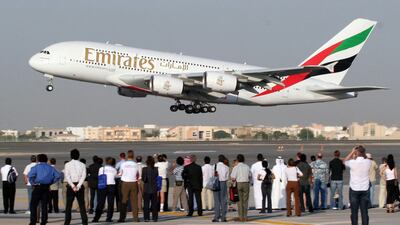
Visitors watch an Airbus A380, sporting the colors of air carrier Emirates, take off during the Dubai Air Show on November 22, 2005. AFP -
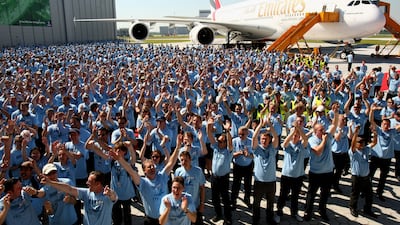
Workers of Airbus celebrate in front of the Airbus A380 on July 28, 2008 in Hamburg, Germany. The world's largest passenger liner, built by the European aircraft manufacturer Airbus, is delivered to the Emirates airline. Getty Images -
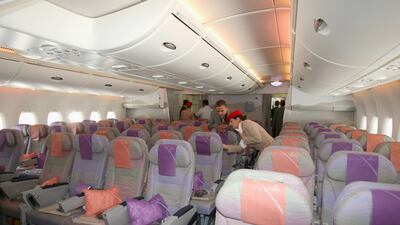
A general view of the economy class on board of the Airbus A380 on July 28, 2008 in Hamburg, Germany. Getty Images -
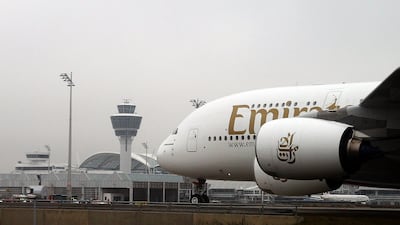
Emirates Airlines has launched a new daily A380 service from Dubai to Munich with its first flight at Munich Airport Franz Joseph Strauss on November 25, 2011 in Munich, Germany. Getty Images -

Emirates chairman Sheikh Ahmed bin Saeed Al Maktoum holds a model of the Airbus Industrie's new A3XX superjumbo jet at the Farnborough Air Show, July 24, 2000. Emirates airline is buying 10 of the jets from Airbus Industrie in a deal worth more than $1.5 billion. PA Images via Reuters -
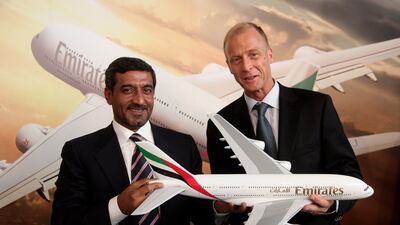
Sheikh Ahmed bin Saeed Al Maktoum and Thomas Enders, CEO of Airbus, pose for photographers after announcing that Emirates is to purchase more Airbus A380 aircraft at the ILA Berlin Air Show on June 8, 2010 in Berlin, Germany. Emirates will buy an additional 32 A380 aircraft, bringing its total A380 fleet to 90 aircraft. Getty Images -
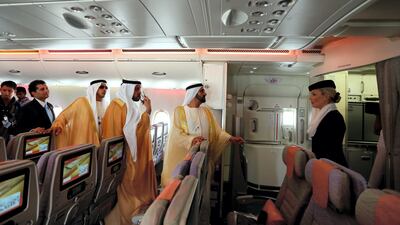
Ruler of Dubai Sheikh Mohammed bin Rashid takes a tour of the Emirates A380 airliner during the opening ceremony of the Dubai Airshow on November 17, 2013. AFP -
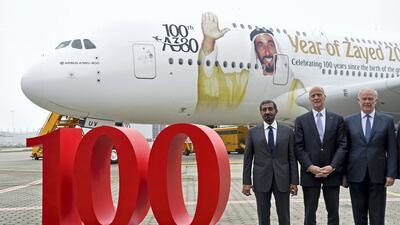
Tom Enders, Sheikh Ahmed bin Saeed Al Maktoum and Tim Clark, President of Emirates, pose for media during a delivery ceremony of Emirates' 100th Airbus A380 at the German headquarters of aircraft company Airbus in Hamburg-Finkenwerder, November 3, 2017. Reuters -
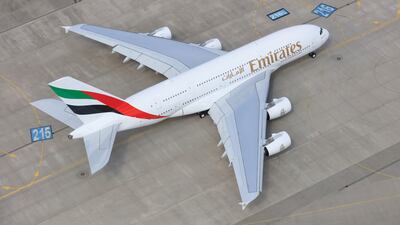
Emirates receives last A380 in November 2021. Courtesy Emirates -
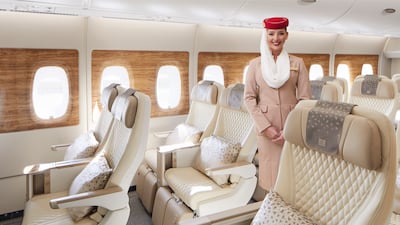
Emirates A380 Premium Economy. Courtesy Emirates -
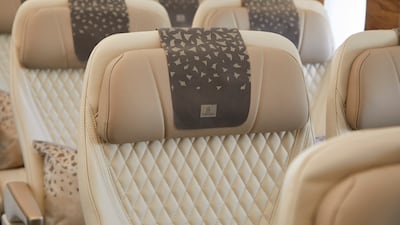
Emirates A380 Premium Economy. Courtesy Emirates -
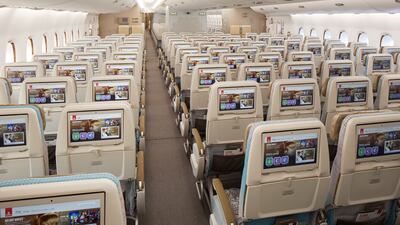
Emirates A380 Economy Refreshed. Courtesy Emirates -
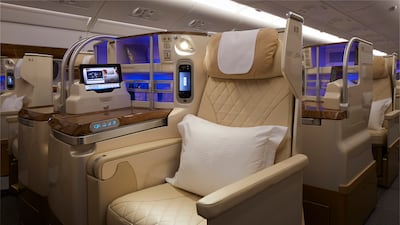
Emirates A380 Business Class Refreshed. Courtesy Emirates -
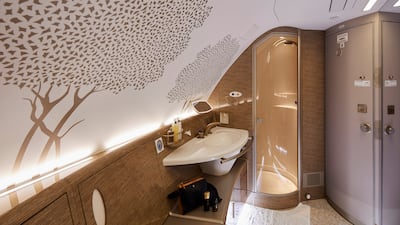
Emirates A380 Shower Spa First Class. Courtesy Emirates



