The organisation, headed by serious vice president Abdulaziz Al Gudaimi will begin operation on September 13, 2020..​​​​ EPA

Aramco's Q1 net profit slides 25% on lower oil prices and Covid-19


Jennifer Gnana
  • English
  • Arabic

Saudi Aramco, the world's largest oil-exporting company, reported a 25 per cent decline in first quarter net profit because of lower crude prices as well as declining refining and chemicals margins and inventory re-measurement losses.

Net profit for the three months ending March 31 fell to 62.5 billion Saudi riyals (Dh61.2bn/$16.7bn) from the year-earlier period, the company said in a statement on the Tadawul exchange where its shares trade. Aramco's sales for the quarter fell 16.2 per cent to 225.6bn riyals.

The company paid $13.4bn in dividends in the first quarter for the last three months of 2019. It will pay $18.7bn in dividends in the second quarter for the first three months of 2020.

"Not surprisingly, our financial performance in the first three months of 2020 was impacted by the ongoing effects of the Covid-19 global pandemic as well as lower oil prices," Saudi Aramco president and chief executive Amin Nasser said.

"During the first quarter, we took steps to optimise our planned 2020 capital spending while working to identify opportunities to further improve operational productivity," he added.

"Going forward, we retain significant flexibility to further adjust expenditures in response to the disruption caused by the coronavirus on both economic activity and energy demand."

The slide in net profit was "partially offset by a decrease in production royalties, mainly resulting from lower crude prices, and a decrease in crude royalty rates from 20 per cent to 15 per cent, in addition to higher revenue relating to the price equalisation income on gas products," the company said.

Aramco brought a record level of production of 12.3 million barrels per day to the market in April after talks between members of the Opec+ alliance collapsed.

The company has since reversed policy and is cutting back more than a quarter of its production to comply with the Opec+ - G20 output restriction agreement to counter the slump in oil prices from the coronavirus pandemic.

The Opec+ alliance, which Saudi Arabia heads alongside Russia, is cutting back 9.7 million bpd from the markets in May and June, with tapered cuts set to hold until 2022.

Saudi Arabia on Monday pledged to tighten its production restrictions by a million bpd, bringing its output to the lowest in 18 years.

Total production cut would average 4.8m bpd, bringing its total output for June to 7.492m bpd. Crude producers are looking to roll back record production amid a demand crunch from the Covid-19 pandemic, which has forced most countries into lockdowns. Both Riyadh and Moscow will cut from a level of 11m bpd, unlike other producers who will trim output from October levels.

Saudi Aramco's capital expenditure for the fiscal year 2020 is expected to average between $25bn and $30bn, the company said.

"Aramco's results are not as daunting when compared to the other oil majors," said Vijay Valecha, chief investment officer at Century Financial in Dubai.

Royal Dutch shell reported a 46 per cent drop in net profit for the first quarter, while BP’s profit tumbled two thirds and Exxon Mobil posted its first loss in a decade.

Aramco now faces similar challenges to its peers when it comes to striking the "right balance between capex, dividends and debt load," Mr Valecha said.

Spending on upstream activities declined by 2.1 per cent to 20.5bn riyals, the producer said citing optimisation of its drilling programme.

Upstream spending worldwide has taken a hit from the decline in oil prices, which have fallen by 57 per cent in value from the most recent peak in January. US rig counts, for instance, last week fell to their lowest levels since September 2009, according to Baker Hughes data.

Meanwhile, Aramco's capex for its downstream programme, which includes refining and petrochemicals, rose 26.6 per cent to 6.9bn riyals. The company cited continued project development and upgrades at various facilities for the increased spending. Producers in the Gulf are prioritising downstream development to diversify and generate higher-value products since the crash in oil prices in 2014-16.

Aramco, which jointly began producing in the Neutral Zone it shares with Kuwait in February, said it discovered two fields with significant oil and gas reservoirs in the northwest and central parts of the kingdom.

Meanwhile, the Fadhili gas plant reached 2 billion cubic feet per day of gas capacity in the first quarter of 2020, from 1.5 bcfd, and is on track to reach 2.5 bcfd capacity this year.

___________

Coronavirus in Saudi Arabia - in pictures

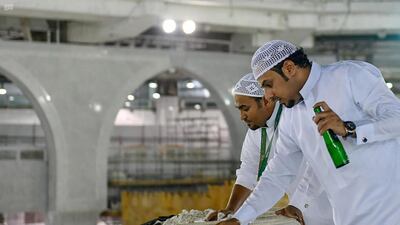
  • Workers clean and sterilise the roof of Kaaba at the Grand Mosque in Makkah, Saudi Arabia, amid the coronavirus pandemic on April 21, 2020. Saudi Press Agency via Reuters
    Workers clean and sterilise the roof of Kaaba at the Grand Mosque in Makkah, Saudi Arabia, amid the coronavirus pandemic on April 21, 2020. Saudi Press Agency via Reuters
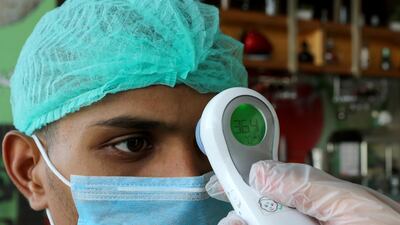
  • A manager wearing protective gloves checks the temprature of a worker amid the coronavirus pandemic at a restaurant, in Riyadh, Saudi Arabia, on April 26, 2020. Reuters
    A manager wearing protective gloves checks the temprature of a worker amid the coronavirus pandemic at a restaurant, in Riyadh, Saudi Arabia, on April 26, 2020. Reuters
  • Restaurant workers wearing protective suits walk to disinfect the restaurant's cars to prepare them for food delivery during the month of Ramadan on April 19, 2020. Reuters
    Restaurant workers wearing protective suits walk to disinfect the restaurant's cars to prepare them for food delivery during the month of Ramadan on April 19, 2020. Reuters
  • Workers clean and sterilise the roof of Kaaba at the Grand Mosque in Makkah during the month of Ramadan on April 21, 2020. Saudi Press Agency handout via Reuters
    Workers clean and sterilise the roof of Kaaba at the Grand Mosque in Makkah during the month of Ramadan on April 21, 2020. Saudi Press Agency handout via Reuters
  • A worker cleans and sterilises the roof of Kaaba at the Grand Mosque in Saudi city of Makkah amid the outbreak of the coronavirus on April 21, 2020. Saudi Press Agency handout via Reuters
    A worker cleans and sterilises the roof of Kaaba at the Grand Mosque in Saudi city of Makkah amid the outbreak of the coronavirus on April 21, 2020. Saudi Press Agency handout via Reuters
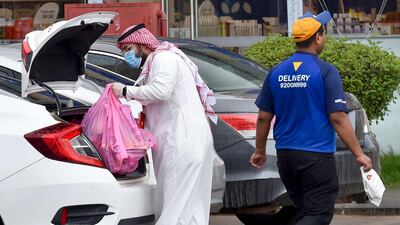
  • A man loads grocery bags on to his vehicle amid a nationwide curfew to stem the spread of Covid-19 in the Saudi capital Riyadh on April 13, 2020. AFP
    A man loads grocery bags on to his vehicle amid a nationwide curfew to stem the spread of Covid-19 in the Saudi capital Riyadh on April 13, 2020. AFP
  • Customers queue outside a supermarket while maintaining social distancing during a nationwide curfew to stem the spread of Covid-19 in the Saudi capital Riyadh on April 13, 2020, ahead of the month of Ramadan. AFP
    Customers queue outside a supermarket while maintaining social distancing during a nationwide curfew to stem the spread of Covid-19 in the Saudi capital Riyadh on April 13, 2020, ahead of the month of Ramadan. AFP
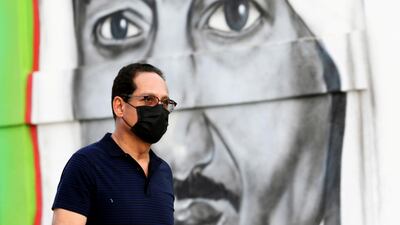
  • A Saudi man walks past a poster depicting Saudi King Salman, after a curfew was imposed to prevent the spread of the coronavirus in Riyadh, Saudi Arabia on March 25, 2020. Reuters
    A Saudi man walks past a poster depicting Saudi King Salman, after a curfew was imposed to prevent the spread of the coronavirus in Riyadh, Saudi Arabia on March 25, 2020. Reuters
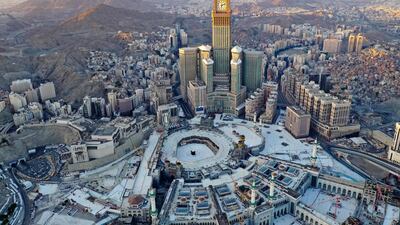
  • An aerial view shows the Grand Mosque and the Makkah Tower, deserted on the first day of Ramadan, in the Saudi city of Makkah, on April 24, 2020, amid the novel coronavirus crisis AFP
    An aerial view shows the Grand Mosque and the Makkah Tower, deserted on the first day of Ramadan, in the Saudi city of Makkah, on April 24, 2020, amid the novel coronavirus crisis AFP
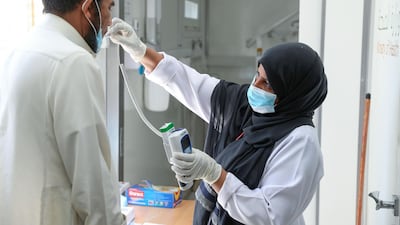
  • A Saudi nurse checks a patient's temperature at a mobile clinic in Ajyad Almasafi district of Makkah on April 7, 2020 amid the Covid-19. pandemic. AFP
    A Saudi nurse checks a patient's temperature at a mobile clinic in Ajyad Almasafi district of Makkah on April 7, 2020 amid the Covid-19. pandemic. AFP
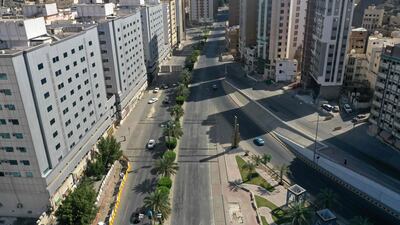
  • An aerial view shows deserted streets in the Saudi holy city of Makkah. AFP
    An aerial view shows deserted streets in the Saudi holy city of Makkah. AFP
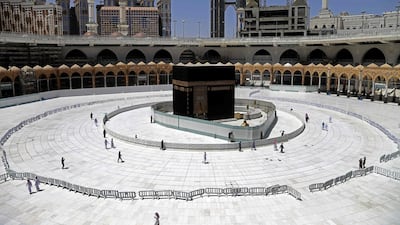
  • Worshippers circumambulate the Kaaba at the Grand Mosque in Makkah on April 3, 2020. AFP
    Worshippers circumambulate the Kaaba at the Grand Mosque in Makkah on April 3, 2020. AFP
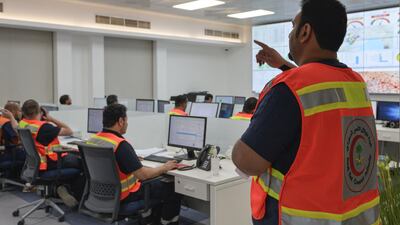
  • Employees of the Covid-19 coronavirus disease operations room of the Saudi Red Crescent. AFP
    Employees of the Covid-19 coronavirus disease operations room of the Saudi Red Crescent. AFP
Brief scores:

Toss: Rajputs, elected to field first

Sindhis 94-6 (10 ov)

Watson 42; Munaf 3-20

Rajputs 96-0 (4 ov)

Shahzad 74 not out

The smuggler

Eldarir had arrived at JFK in January 2020 with three suitcases, containing goods he valued at $300, when he was directed to a search area.
Officers found 41 gold artefacts among the bags, including amulets from a funerary set which prepared the deceased for the afterlife.
Also found was a cartouche of a Ptolemaic king on a relief that was originally part of a royal building or temple. 
The largest single group of items found in Eldarir’s cases were 400 shabtis, or figurines.

Khouli conviction

Khouli smuggled items into the US by making false declarations to customs about the country of origin and value of the items.
According to Immigration and Customs Enforcement, he provided “false provenances which stated that [two] Egyptian antiquities were part of a collection assembled by Khouli's father in Israel in the 1960s” when in fact “Khouli acquired the Egyptian antiquities from other dealers”.
He was sentenced to one year of probation, six months of home confinement and 200 hours of community service in 2012 after admitting buying and smuggling Egyptian antiquities, including coffins, funerary boats and limestone figures.

For sale

A number of other items said to come from the collection of Ezeldeen Taha Eldarir are currently or recently for sale.
Their provenance is described in near identical terms as the British Museum shabti: bought from Salahaddin Sirmali, "authenticated and appraised" by Hossen Rashed, then imported to the US in 1948.

- An Egyptian Mummy mask dating from 700BC-30BC, is on offer for £11,807 ($15,275) online by a seller in Mexico

- A coffin lid dating back to 664BC-332BC was offered for sale by a Colorado-based art dealer, with a starting price of $65,000

- A shabti that was on sale through a Chicago-based coin dealer, dating from 1567BC-1085BC, is up for $1,950

In numbers

1,000 tonnes of waste collected daily:

  • 800 tonnes converted into alternative fuel
  • 150 tonnes to landfill
  • 50 tonnes sold as scrap metal

800 tonnes of RDF replaces 500 tonnes of coal

Two conveyor lines treat more than 350,000 tonnes of waste per year

25 staff on site


White hydrogen: Naturally occurring hydrogenChromite: Hard, metallic mineral containing iron oxide and chromium oxideUltramafic rocks: Dark-coloured rocks rich in magnesium or iron with very low silica contentOphiolite: A section of the earth’s crust, which is oceanic in nature that has since been uplifted and exposed on landOlivine: A commonly occurring magnesium iron silicate mineral that derives its name for its olive-green yellow-green colour

CHATGPT%20ENTERPRISE%20FEATURES
%3Cp%3E%E2%80%A2%20Enterprise-grade%20security%20and%20privacy%3C%2Fp%3E%0A%3Cp%3E%E2%80%A2%20Unlimited%20higher-speed%20GPT-4%20access%20with%20no%20caps%3C%2Fp%3E%0A%3Cp%3E%E2%80%A2%20Longer%20context%20windows%20for%20processing%20longer%20inputs%3C%2Fp%3E%0A%3Cp%3E%E2%80%A2%20Advanced%20data%20analysis%20capabilities%3C%2Fp%3E%0A%3Cp%3E%E2%80%A2%20Customisation%20options%3C%2Fp%3E%0A%3Cp%3E%E2%80%A2%20Shareable%20chat%20templates%20that%20companies%20can%20use%20to%20collaborate%20and%20build%20common%20workflows%3C%2Fp%3E%0A%3Cp%3E%E2%80%A2%20Analytics%20dashboard%20for%20usage%20insights%3C%2Fp%3E%0A%3Cp%3E%E2%80%A2%20Free%20credits%20to%20use%20OpenAI%20APIs%20to%20extend%20OpenAI%20into%20a%20fully-custom%20solution%20for%20enterprises%3C%2Fp%3E%0A
Types of bank fraud

1) Phishing

Fraudsters send an unsolicited email that appears to be from a financial institution or online retailer. The hoax email requests that you provide sensitive information, often by clicking on to a link leading to a fake website.

2) Smishing

The SMS equivalent of phishing. Fraudsters falsify the telephone number through “text spoofing,” so that it appears to be a genuine text from the bank.

3) Vishing

The telephone equivalent of phishing and smishing. Fraudsters may pose as bank staff, police or government officials. They may persuade the consumer to transfer money or divulge personal information.

4) SIM swap

Fraudsters duplicate the SIM of your mobile number without your knowledge or authorisation, allowing them to conduct financial transactions with your bank.

5) Identity theft

Someone illegally obtains your confidential information, through various ways, such as theft of your wallet, bank and utility bill statements, computer intrusion and social networks.

6) Prize scams

Fraudsters claiming to be authorised representatives from well-known organisations (such as Etisalat, du, Dubai Shopping Festival, Expo2020, Lulu Hypermarket etc) contact victims to tell them they have won a cash prize and request them to share confidential banking details to transfer the prize money.

OTHER IPL BOWLING RECORDS

Best bowling figures: 6-14 – Sohail Tanvir (for Rajasthan Royals against Chennai Super Kings in 2008)

Best average: 16.36 – Andrew Tye

Best economy rate: 6.53 – Sunil Narine

Best strike-rate: 12.83 – Andrew Tye

Best strike-rate in an innings: 1.50 – Suresh Raina (for Chennai Super Kings against Rajasthan Royals in 2011)

Most runs conceded in an innings: 70 – Basil Thampi (for Sunrisers Hyderabad against Royal Challengers Bangalore in 2018)

Most hat-tricks: 3 – Amit Mishra

Most dot-balls: 1,128 – Harbhajan Singh

Most maiden overs bowled: 14 – Praveen Kumar

Most four-wicket hauls: 6 – Sunil Narine


Wonka
%3Cp%3E%3Cstrong%3EDirector%3A%3C%2Fstrong%3E%C2%A0Paul%20King%3C%2Fp%3E%0A%3Cp%3E%3Cstrong%3EStarring%3A%C2%A0%3C%2Fstrong%3ETimothee%20Chalamet%2C%20Olivia%20Colman%2C%20Hugh%20Grant%3C%2Fp%3E%0A%3Cp%3E%3Cstrong%3ERating%3A%3C%2Fstrong%3E%202%2F5%3C%2Fp%3E%0A
Classification of skills

A worker is categorised as skilled by the MOHRE based on nine levels given in the International Standard Classification of Occupations (ISCO) issued by the International Labour Organisation. 

A skilled worker would be someone at a professional level (levels 1 – 5) which includes managers, professionals, technicians and associate professionals, clerical support workers, and service and sales workers.

The worker must also have an attested educational certificate higher than secondary or an equivalent certification, and earn a monthly salary of at least Dh4,000. 

Skoda Superb Specs

Engine: 2-litre TSI petrol

Power: 190hp

Torque: 320Nm

Price: From Dh147,000

Available: Now

The National Archives, Abu Dhabi

Founded over 50 years ago, the National Archives collects valuable historical material relating to the UAE, and is the oldest and richest archive relating to the Arabian Gulf.

Much of the material can be viewed on line at the Arabian Gulf Digital Archive - https://www.agda.ae/en

A Cat, A Man, and Two Women
Junichiro
Tamizaki
Translated by Paul McCarthy
Daunt Books 

The language of diplomacy in 1853

Treaty of Peace in Perpetuity Agreed Upon by the Chiefs of the Arabian Coast on Behalf of Themselves, Their Heirs and Successors Under the Mediation of the Resident of the Persian Gulf, 1853
(This treaty gave the region the name “Trucial States”.)


We, whose seals are hereunto affixed, Sheikh Sultan bin Suggar, Chief of Rassool-Kheimah, Sheikh Saeed bin Tahnoon, Chief of Aboo Dhebbee, Sheikh Saeed bin Buyte, Chief of Debay, Sheikh Hamid bin Rashed, Chief of Ejman, Sheikh Abdoola bin Rashed, Chief of Umm-ool-Keiweyn, having experienced for a series of years the benefits and advantages resulting from a maritime truce contracted amongst ourselves under the mediation of the Resident in the Persian Gulf and renewed from time to time up to the present period, and being fully impressed, therefore, with a sense of evil consequence formerly arising, from the prosecution of our feuds at sea, whereby our subjects and dependants were prevented from carrying on the pearl fishery in security, and were exposed to interruption and molestation when passing on their lawful occasions, accordingly, we, as aforesaid have determined, for ourselves, our heirs and successors, to conclude together a lasting and inviolable peace from this time forth in perpetuity.

Taken from Britain and Saudi Arabia, 1925-1939: the Imperial Oasis, by Clive Leatherdale

NYBL PROFILE

Company name: Nybl 

Date started: November 2018

Founder: Noor Alnahhas, Michael LeTan, Hafsa Yazdni, Sufyaan Abdul Haseeb, Waleed Rifaat, Mohammed Shono

Based: Dubai, UAE

Sector: Software Technology / Artificial Intelligence

Initial investment: $500,000

Funding round: Series B (raising $5m)

Partners/Incubators: Dubai Future Accelerators Cohort 4, Dubai Future Accelerators Cohort 6, AI Venture Labs Cohort 1, Microsoft Scale-up