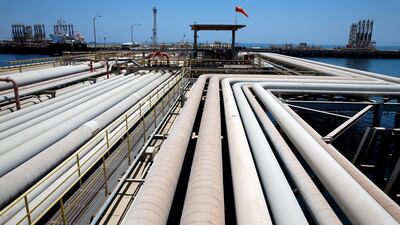

Saudi Aramco, the world's largest oil-producing company, reported a 25 per cent annual rise in first-quarter net profit, with the East-West pipeline offsetting war-related capacity disruption.
Net profit for the three months to the end of March rose to 120 billion Saudi riyals ($32 billion), up from 95.68 billion riyals that the company reported in the same period a year earlier, it said in a filing on Sunday to the Tadawul stock exchange, where its shares are traded.
The annual increase was “mainly driven by higher revenue and other income related to sales, partially offset by higher operating costs and an increase in income taxes and zakat”, it said.

Adjusted net income rose to 125.97 billion riyals during the quarter, up 26 per cent year-on-year, it said. This relates mainly to replacement cost adjustment, fair value remeasurement of certain commodity derivatives and adjusting items related to finance costs.
Total revenue for the first quarter reached 433.10 billion riyals, up from 405.65 billion riyals in the same period last year, mainly due to higher prices and volumes sold of both crude oil and refined and chemical products, the company said.
“Aramco’s first-quarter performance reflects strong resilience and operational flexibility in a complex geopolitical environment,” said Aramco president and chief executive Amin Nasser.
Following the effective closure of the Strait of Hormuz by Iran after the start of the war on February 28, Saudi Arabia shifted exports to its west coast.
The East-West pipeline has reached its maximum capacity of 7 million barrels of oil per day, Mr Nasser said. It has “proven itself to be a critical supply artery, helping to mitigate the impact of a global energy shock and providing relief to customers affected by shipping constraints in the Strait of Hormuz”, he said.
“Despite these headwinds, Aramco remains focused on its strategic priorities and is leveraging both its domestic infrastructure and its global network to navigate disruption.”
The company said capital expenditure of $12.1 billion in the first quarter supported its growth objectives, and that its domestic and international storage capacity provide additional optionality. “Strategic investment in critical infrastructure and robust contingency planning supported operational continuity and helped mitigate disruption,” Aramco said.
The company's board confirmed a base dividend of $21.9 billion for the first quarter, up 3.5 per cent year-on-year, to be paid in the second quarter.
Iran war impact
Saudi Arabia, along with other Gulf states, faced a number of Iranian attacks on energy infrastructure, with heavy damage reported.
The kingdom last month confirmed numerous sites had been struck, including pumping stations on the East–West Pipeline, the Manifa and Khurais production plants, and refineries at Jubail, Ras Tanura, Yanbu and Riyadh.
Among the most significant sites hit was Satorp in Jubail, a joint venture between Saudi Aramco and TotalEnergies processing 465,000 bpd and one of the world's largest export refining platforms. Also hit was Ras Tanura, Saudi Arabia's largest refinery at 550,000 bpd capacity, which was attacked early in the war and closed for 16 days before resuming production.
The Samref in Yanbu, a 400,000 bpd Aramco-ExxonMobil joint venture, was hit by a drone on March 19. Processing plants at Juaymah in Eastern Province were also targeted, disrupting liquefied petroleum and natural gas liquid exports. One person was killed and seven injured in the attacks.
Oil price moves
Oil prices have risen sharply since the start of the Iran war, although they have dropped from a wartime peak of nearly $120 per barrel in March.
US President Donald Trump said at the end of last week that the ceasefire is holding and Washington and Tehran remain engaged in negotiations.
Brent, the benchmark for two thirds of the world's seaborne oil, settled 1.23 per cent higher at $101.29 a barrel last week. West Texas Intermediate, the gauge that tracks US crude, gained 0.64 per cent to $95.42 a barrel.
Saudi Aramco said its average crude oil realised price from January to March was $76.9 per barrel, up from $76.30 in the first quarter of 2025 and from $64.10 in the previous quarter.

