


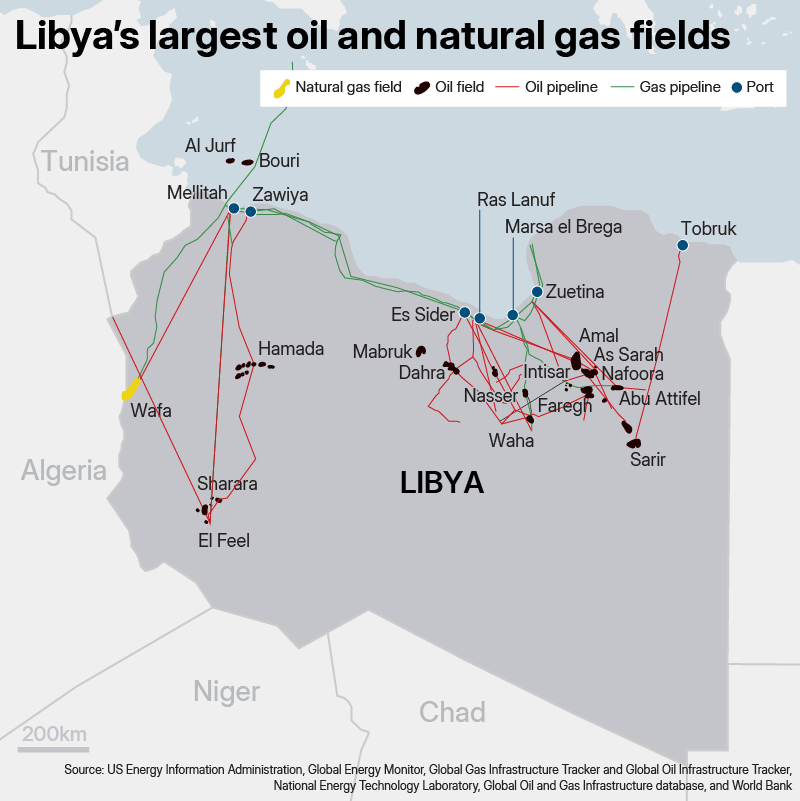
France's TotalEnergies has restarted production at the Mabruk oilfield in Libya after more than a decade, as the North African country seeks to revive its hydrocarbons sector.
The Mabruk field, in which TotalEnergies holds a 37.5 per cent interest, is onshore in Concession C17, around 130km south of Sirte. The field is operated by Mabruk Oil Operations, a joint venture between Libya’s National Oil Corporation (NOC) and international partners.
Production from the field was stopped in 2015.

Construction of a production unit with a capacity of 25,000 barrels per day was launched in May 2024. The facility started operating on February 28 this year, the French energy company said in a statement on Thursday.
“This project, which follows TotalEnergies' recent announcements regarding the extension of the Waha concessions, brings low-cost, low-emissions oil production in line with the company's strategy, and contributes to our objective of 3 per cent annual production growth per year until 2030,” said Julien Pouget, Middle East and North Africa director for TotalEnergies' exploration and production business.

International energy companies have been looking to return to Libya in recent months, with the country having Africa’s largest proven crude reserves. It produces some of North Africa’s cheapest, largely sweet oil, much of which has remained offline since the 2011 civil war that overthrew Muammar Qaddafi's government. Oil output has also been repeatedly disrupted by blockades and political disputes between rival administrations in eastern and western Libya in recent years.
Production has rebounded to about 1.4 million bpd, its highest level in more than a decade. Tripoli is targeting a crude output of 1.6 million bpd by the end of 2026.
In January, Libya signed a 25-year oil development agreement worth more than $20 billion with TotalEnergies and US's ConocoPhillips.
The deal will be funded through external financing, allowing Libya to add 850,000 bpd of additional capacity, with expected net revenue at about $376 billion, Libyan Prime Minister Abdul Hamid Dbeibah said at the time.
In February, Libya also awarded oil and gas exploration blocks to foreign energy companies including Chevron, Eni, QatarEnergy and Repsol in its first licensing round in nearly two decades.
TotalEnergies has been present in Libya since 1956 and last year, its production in the country averaged 113,000 bpd of oil equivalent from the offshore Al Jurf field (in which it has a 37.5 per cent interest), the onshore areas of El Sharara and the onshore Waha concessions.
The Waha concessions are held by the state-owned NOC (59.16 per cent), TotalEnergies (20.42 per cent) and ConocoPhillips (20.42 per cent) and are operated by Waha Oil Company, which is fully owned by NOC.
Libyan crude is increasingly important to Europe as it looks to diversify its energy supplies, with countries such as Italy and Spain among the main importers.
The North African country also plans to increase gas production to nearly 1 billion standard cubic feet a day over the next five years and have supply available for export to Europe by 2030.

