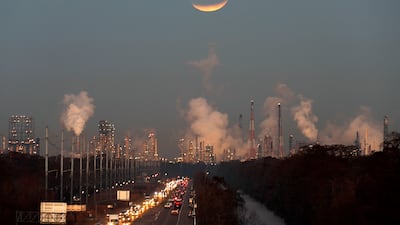
The Shell Norco Manufaturing Complex, at sunrise in St. Charles Parish, La. Last year, Congress pledged $3.5 billion to carbon capture and sequestration projects around the US, which has been called the largest federal investment ever by advocates for the technology. AP
The Shell Norco Manufaturing Complex, at sunrise in St. Charles Parish, La. Last year, Congress pledged $3.5 billion to carbon capture and sequestration projects around the US, which has been called t


Carbon capture is becoming big business, here is how


  • English
  • Arabic

July 15, 2024

ExxonMobil says carbon capture, use and storage (CCUS) will be a $4 trillion market by 2050. Most reputable climate analysts find CCUS is essential to meeting our climate targets. Environmental groups, with a few honourable exceptions, loathe it. But perhaps the most important question is – can it make money, and how much?

CCUS covers a range of technologies that trap carbon dioxide from industrial facilities, power plants and other emitting sites, usually from burning oil, gas, coal, waste and biomass, or manufacturing cement. This carbon dioxide is then used to make valuable products such as fizzy drinks, fuels or plastics, or reacted to produce solid minerals. Or, it is injected deep into the ground, either to liberate additional oil, or to be stored permanently and safely.

Environmental groups dislike CCUS because of its association with the oil and gas industry, and its competition with renewables – which is apparent rather than real. They reserve more vitriol for it than for real climate problems such as burning coal. Even usually objective media such as the Financial Times and Bloomberg are all but unable to mention it without including lists of its alleged problems.

But carbon capture will address different challenges from renewables. It will meet about 16 per cent of the required reductions in greenhouse gas emissions by 2050, primarily applied to heavy industry such as iron and steel, cement, ammonia and “blue” hydrogen. Gas or coal plants with CCUS can help alongside batteries to balance out renewable-heavy electricity systems.

Costs for CCUS vary widely depending on the application. Most of the costs are used for capturing the carbon dioxide; the transport to a suitable point were storage is relatively cheap. Perhaps $20 per tonne for the cheapest options, where carbon dioxide is already separated as part of processes such as hydrogen or ammonia manufacture or natural gas processing, rise to $120 or more for challenging operations such as cement.

Of course, when no one was willing to pay for CCUS, no one did it, an obvious statement that somehow escapes many critics. Now, carbon prices are coming into force and rising in a growing number of countries.

The estimated CCUS costs compare to $85 per tonne offered in tax credits by the US, about $76 per tonne currently under the EU’s emissions trading system, and an intended US $125 per tonne by 2030 for Canada’s carbon tax. So, many carbon capture approaches should now be entering economic viability. The GCC has no carbon price yet, but industries that export to the EU will increasingly be exposed to its carbon border tariffs.

Articles on CCUS often confuse it with a related but different approach, direct air capture (DAC). This takes carbon dioxide directly from the atmosphere. This offsets residual emissions elsewhere that are very hard or expensive to capture or avoid and draws down our vast atmospheric liability of past pollution.

The technological means for doing this operate today, but only on a small scale, and are costly, at $500 per tonne or more. Biological, geochemical and other approaches may be cheaper, but have to be proven technically, or are limited in the amount they could capture.

CCUS is a crucial part of GCC climate plans. The Gulf’s large emitting sources are close to well-understood, big and high-quality underground storage sites. The major Gulf oil and gas companies have significant expertise: Adnoc started its first large operation eight years ago, and it, Saudi Aramco and QatarEnergy plan in total to capture more than 25 million tonnes annually by 2030.

Worldwide, current capture capacity is about 40 million tonnes per year. The International Energy Agency believes that needs to rise to more than 7.6 billion tonnes annually by 2050, with 980 million tonnes of DAC. Other estimates put DAC up to 5 billion tonnes and growing further after 2050.

Vicki Hollub, the chief executive of Occidental, has talked of a $3-5 trillion global industry, and says it could generate as much earnings as the company’s oil and gas business does today. ExxonMobil compared the anticipated $4 trillion CCUS market to the $6.5 trillion it expects for the midcentury petroleum market.

Assuming ExxonMobil is using a similar figure for volumes to the IEA’s, that implies a value of more than $500 per tonne captured through CCUS, which seems excessive. Perhaps $120 for CCUS and $200 for DAC is more realistic, which would make the overall market about $1.1 trillion by 2050 – still very large, more than five times the size of the current liquefied natural gas business.

There are essentially six ways to make money from CCUS. First is to be paid by others to decarbonise the domestic economy, which helps on meeting national climate goals but doesn’t generate external value.

Second is to use the captured carbon dioxide for something. Applications are currently somewhat limited in size and value. The main one, injecting into oilfields to enhance recovery, is hated by anti-fossil fuel campaigners – but the combination of DAC with enhanced oil recovery can yield net-zero carbon oil for essential future uses in areas such as aviation and petrochemicals.

Third is to import carbon dioxide from others who do not have suitable storage opportunities themselves, and who are willing to pay to clean up – Japan and South Korea being obvious candidates.

Fourth is to do direct air capture at home and sell the carbon removal service to others. Microsoft, Stripe and other companies have already made major commitments to decarbonise their operations in this way. Big airlines are another obvious candidate – indeed, it may be the only way for them to keep flying as they do today.

Fifth is to establish low-carbon versions of polluting industries, using CCUS to make them near-zero carbon, and export the products – such as steel, cement, “blue” hydrogen and ammonia. GCC countries are already moving into this opportunity.

Sixth is to provide the technology and equipment. GCC countries could be more proactive investors and researchers. There are still challenges to overcome: reducing costs and energy use, standardising systems, ensuring maximum levels of capture and avoiding any leakage from underground. With a little capital and good pilot opportunities to prove themselves, exciting innovations in CCUS and DAC can become reality. The Gulf should be a pioneer, not just North America, Europe, China and Australia.

Even if it does not quite reach the size of petroleum today, carbon capture is going to be a big and profitable business. To succeed in the climate struggle, we need CCUS to grow much faster, with bold and capital-rich supporters. Balancing its future oil and gas outlook, the GCC should seize a larger share of the carbon capture cake.

Robin M. Mills is CEO of Qamar Energy, and author of The Myth of the Oil Crisis

The five pillars of Islam
AIDA%20RETURNS
%3Cp%3E%3Cstrong%3EDirector%3A%20%3C%2Fstrong%3ECarol%20Mansour%3C%2Fp%3E%0A%3Cp%3E%3Cstrong%3EStarring%3A%20%3C%2Fstrong%3EAida%20Abboud%2C%20Carol%20Mansour%3C%2Fp%3E%0A%3Cp%3E%3Cstrong%3ERating%3A%3C%2Fstrong%3E%203.5.%2F5%3C%2Fp%3E%0A
Company%C2%A0profile
%3Cp%3E%3Cstrong%3EDate%20started%3A%20%3C%2Fstrong%3EMay%202022%3Cbr%3E%3Cstrong%3EFounder%3A%20%3C%2Fstrong%3EHusam%20Aboul%20Hosn%3Cbr%3E%3Cstrong%3EBased%3A%20%3C%2Fstrong%3EDIFC%3Cbr%3E%3Cstrong%3ESector%3A%20%3C%2Fstrong%3EFinTech%20%E2%80%94%20Innovation%20Hub%3Cbr%3E%3Cstrong%3EEmployees%3A%20%3C%2Fstrong%3Eeight%3Cbr%3E%3Cstrong%3EStage%3A%20%3C%2Fstrong%3Epre-seed%3Cbr%3E%3Cstrong%3EInvestors%3A%20%3C%2Fstrong%3Epre-seed%20funding%20raised%20from%20family%20and%20friends%20earlier%20this%20year%3C%2Fp%3E%0A
The specs

Engine: 3.9-litre twin-turbo V8
Power: 620hp from 5,750-7,500rpm
Torque: 760Nm from 3,000-5,750rpm
Transmission: Eight-speed dual-clutch auto
On sale: Now
Price: From Dh1.05 million ($286,000)

The specs

Engine: 2.9-litre twin-turbo V6

Power: 540hp at 6,500rpm

Torque: 600Nm at 2,500rpm

Transmission: Eight-speed auto

Kerb weight: 1580kg

Price: From Dh750k

On sale: via special order

Match info

Uefa Champions League Group B

Barcelona v Tottenham Hotspur, midnight

Global state-owned investor ranking by size

1.

United States

2.

China

3.

UAE

4.

Japan

5

Norway

6.

Canada

7.

Singapore

8.

Australia

9.

Saudi Arabia

10.

South Korea

Take Me Apart

Kelela

(Warp)

PAKISTAN SQUAD

Abid Ali, Fakhar Zaman, Imam-ul-Haq, Shan Masood, Azhar Ali (test captain), Babar Azam (T20 captain), Asad Shafiq, Fawad Alam, Haider Ali, Iftikhar Ahmad, Khushdil Shah, Mohammad Hafeez, Shoaib Malik, Mohammad Rizwan (wicketkeeper), Sarfaraz Ahmed (wicketkeeper), Faheem Ashraf, Haris Rauf, Imran Khan, Mohammad Abbas, Mohammad Hasnain, Naseem Shah, Shaheen Afridi, Sohail Khan, Usman Shinwari, Wahab Riaz, Imad Wasim, Kashif Bhatti, Shadab Khan and Yasir Shah. 

Tamkeen's offering
  • Option 1: 70% in year 1, 50% in year 2, 30% in year 3
  • Option 2: 50% across three years
  • Option 3: 30% across five years 

Various Artists 
Habibi Funk: An Eclectic Selection Of Music From The Arab World (Habibi Funk)
​​​​​​​

ULTRA PROCESSED FOODS

- Carbonated drinks, sweet or savoury packaged snacks, confectionery, mass-produced packaged breads and buns 

- margarines and spreads; cookies, biscuits, pastries, cakes, and cake mixes, breakfast cereals, cereal and energy bars;

- energy drinks, milk drinks, fruit yoghurts and fruit drinks, cocoa drinks, meat and chicken extracts and instant sauces

- infant formulas and follow-on milks, health and slimming products such as powdered or fortified meal and dish substitutes,

- many ready-to-heat products including pre-prepared pies and pasta and pizza dishes, poultry and fish nuggets and sticks, sausages, burgers, hot dogs, and other reconstituted meat products, powdered and packaged instant soups, noodles and desserts.

Know before you go
  • Jebel Akhdar is a two-hour drive from Muscat airport or a six-hour drive from Dubai. It’s impossible to visit by car unless you have a 4x4. Phone ahead to the hotel to arrange a transfer.
  • If you’re driving, make sure your insurance covers Oman.
  • By air: Budget airlines Air Arabia, Flydubai and SalamAir offer direct routes to Muscat from the UAE.
  • Tourists from the Emirates (UAE nationals not included) must apply for an Omani visa online before arrival at evisa.rop.gov.om. The process typically takes several days.
  • Flash floods are probable due to the terrain and a lack of drainage. Always check the weather before venturing into any canyons or other remote areas and identify a plan of escape that includes high ground, shelter and parking where your car won’t be overtaken by sudden downpours.


Scoreline

Al Wasl 1 (Caio Canedo 90 1')

Al Ain 2 (Ismail Ahmed 3', Marcus Berg 50')

Red cards: Ismail Ahmed (Al Ain) 77'

IF YOU GO
 
The flights: FlyDubai offers direct flights to Catania Airport from Dubai International Terminal 2 daily with return fares starting from Dh1,895.
 
The details: Access to the 2,900-metre elevation point at Mount Etna by cable car and 4x4 transport vehicle cost around €57.50 (Dh248) per adult. Entry into Teatro Greco costs €10 (Dh43). For more go to www.visitsicily.info

 Where to stay: Hilton Giardini Naxos offers beachfront access and accessible to Taormina and Mount Etna. Rooms start from around €130 (Dh561) per night, including taxes.

Why your domicile status is important

Your UK residence status is assessed using the statutory residence test. While your residence status – ie where you live - is assessed every year, your domicile status is assessed over your lifetime.

Your domicile of origin generally comes from your parents and if your parents were not married, then it is decided by your father. Your domicile is generally the country your father considered his permanent home when you were born. 

UK residents who have their permanent home ("domicile") outside the UK may not have to pay UK tax on foreign income. For example, they do not pay tax on foreign income or gains if they are less than £2,000 in the tax year and do not transfer that gain to a UK bank account.

A UK-domiciled person, however, is liable for UK tax on their worldwide income and gains when they are resident in the UK.

The specs
 
Engine: 3.0-litre six-cylinder turbo
Power: 398hp from 5,250rpm
Torque: 580Nm at 1,900-4,800rpm
Transmission: Eight-speed auto
Fuel economy, combined: 6.5L/100km
On sale: December
Price: From Dh330,000 (estimate)
UAE currency: the story behind the money in your pockets
About Housecall

Date started: July 2020

Founders: Omar and Humaid Alzaabi

Based: Abu Dhabi

Sector: HealthTech

# of staff: 10

Funding to date: Self-funded

The low down

Producers: Uniglobe Entertainment & Vision Films

Director: Namrata Singh Gujral

Cast: Rajkummar Rao, Nargis Fakhri, Bo Derek, Candy Clark

Rating: 2/5

About RuPay

A homegrown card payment scheme launched by the National Payments Corporation of India and backed by the Reserve Bank of India, the country’s central bank

RuPay process payments between banks and merchants for purchases made with credit or debit cards

It has grown rapidly in India and competes with global payment network firms like MasterCard and Visa.

In India, it can be used at ATMs, for online payments and variations of the card can be used to pay for bus, metro charges, road toll payments

The name blends two words rupee and payment

Some advantages of the network include lower processing fees and transaction costs

Updated: November 21, 2024, 12:24 PM
