


The “fifth fuel” is nothing like French film director Luc Besson’s stylish 1997 cult sci-fi movie The Fifth Element, starring Bruce Willis.
Instead, the fifth fuel delivers negawatts — the megawatt of electricity not consumed. What is this mysterious substance? In the humble pursuit of energy efficiency worldwide, consumers and governments are bizarrely ignoring it.
The first four fuels are coal, hydrocarbons (oil and gas), nuclear and renewables. Each of these has its problems. In the current twin crises of energy insecurity and climate change, efficiency is the only option that combines being affordable, non-polluting, reliable, available everywhere, quick to market and socially acceptable.
As Russian gas supplies are gradually throttled, Europe faces a winter crisis. High petrol prices threaten US President Joe Biden’s political fortunes and defy government action.
India and China struggle with shortages of coal and electricity that force shutdowns of industry and air conditioning.
Even Japan, the developed countries’ most energy-frugal member, narrowly avoided power shortages during the country's heatwave last month.
High energy prices drive much of worldwide inflation and feed into the costs of making many other materials, including those required for renewable systems, batteries and electric vehicles. Using energy more wisely is the only way to alleviate these problems significantly over the next year or two.
Of course, all government policies and analysts’ forecasts pay lip service to improving energy efficiency.
For instance, the International Energy Agency’s scenario for reaching net-zero carbon emissions by 2050 has an annual 4 per cent reduction in energy intensity — the amount of energy required to produce one unit of gross domestic product. The EU’s proposed energy efficiency directive would cut energy use 1.5 per cent each year up to 2030.
But the actions of most governments, companies and individuals show they do not take efficiency seriously.
First, the more aggressive projections required for net-zero carbon look like fantasy — requiring the global energy economy to change more radically than anything seen historically.
In the past 55 years, the best ever annual improvement in intensity was less than 3 per cent. The yearly average since the oil crises of the 1970s was 1.07 per cent.
Even more remarkably, the amount of electricity to create a unit of GDP has not budged in the last 36 years.
The tremendous growth of megawatts of inherently less profligate renewables and electric vehicles will help to cut primary energy use, but it is not being matched by more intelligent use of electricity to save negawatts.
Climate change around the world — in pictures
-

Engineers carry solar panels on to the roof of a property in Barcelona in September 2022. Spain and other Mediterranean countries have generated record amounts of power from wind and solar farms. Bloomberg -
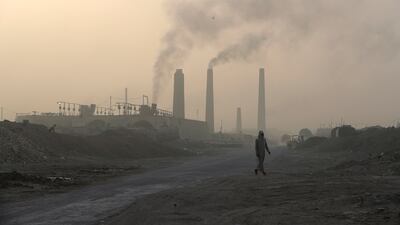
Smoke rises from brick factory stacks in Nahrawan, Baghdad. Tackling emissions from heavy industry is crucial to tackling global warming. Reuters -

A boy stands near a flock of sheep as a sandstorm approaches in the Syrian countryside of Tabqa. Syria is among the countries most vulnerable and poorly prepared for climate change, which is expected to worsen. AFP -

Mountains of smouldering rubbish at the Bhalswa landfill in New Delhi, India. Reuters -

Greenpeace activists take part in a climate change protest in front of the Brandenburg Gate in Berlin in May. AP -
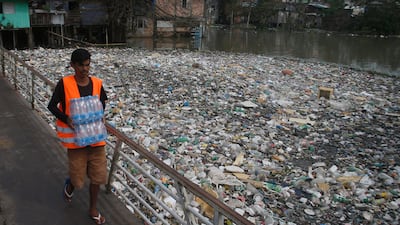
A man carries water bottles across the heavily polluted Negro River in Manaus, Brazil. About 35 tonnes of rubbish are removed daily from the river. AP -
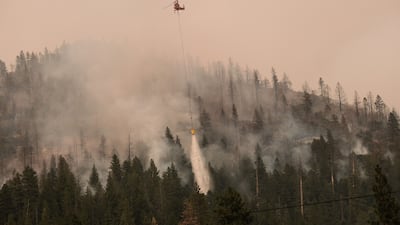
A helicopter drops water on a brush fire in California. Bloomberg -
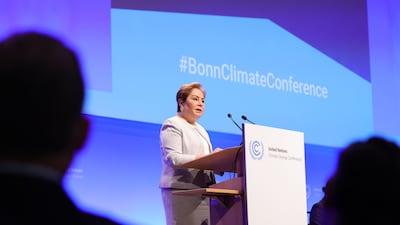
UN climate chief Patricia Espinosa speaks on the opening day of the Bonn climate change conference in Germany. Getty -

Activists take part in a demonstration to raise awareness of global warming, during an event to mark World Environment Day in Kolkata. AFP -
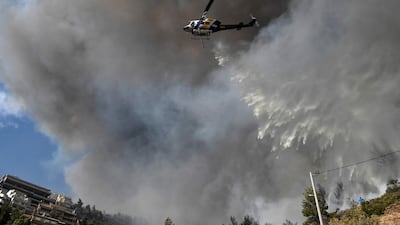
A helicopter drops water on a bushfire near a residential district in Athens. The fire forced residents to flee. AFP -
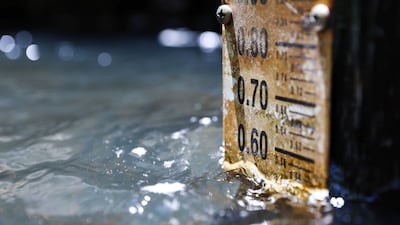
A gauge measures water levels in the Rio Nambe river, in New Mexico. Ninety per cent of the state is experiencing extreme drought. Getty -

Afghan refugees search for recyclable material from heaps of rubbish in Karachi, Pakistan. AP -

A climate activist ties herself to the net during the semi-final tennis match between Croatia's Marin Cilic and Norway's Casper Ruud at the French Open in Roland Garros in Paris. AP -
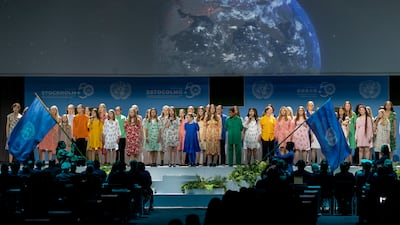
A dance group performs at a climate summit in Stockholm, Sweden. Getty -

US climate envoy John Kerry talks to a delegate at the Stockholm 50 climate summit. Getty -
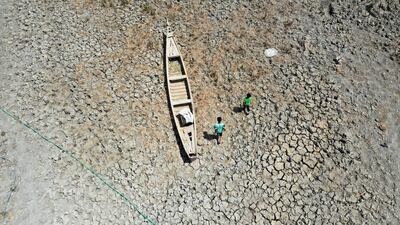
A boat is stranded during low tide at the Chebayesh marsh in Dhi Qar province, Iraq. Reuters -
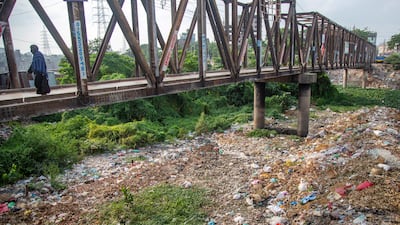
A woman crosses a polluted river in Dhaka, Bangladesh. EPA -
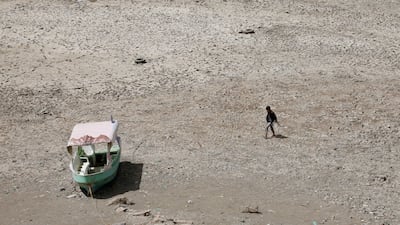
A man walks past an abandoned boat in the bed of a drought-affected reservoir on the outskirts of Sana'a, Yemen. EPA


And even if achieved, such dramatic improvements would drive down prices, undoing the incentives for further gains in efficiency, unless offset by high taxes or other stringent measures. Such factors make it unfeasible to quadruple efficiency gains every year over three decades.
Second, exceptionally expensive energy should drive efficiency on its own. But governments are doing their best to shelter consumers from price signals.
The US administration has floated the idea of a temporary holiday on petrol taxes, France and Germany are offering consumers handouts and Italy will spend nearly €40 billion ($41.7bn) subsidising energy bills.
Spain and Portugal are capping the price of gas for electricity generation, the UK government is giving every household a £400 ($483.95) discount on their electricity bill and India has imposed an export tax on fuel to keep domestic prices lower.
Third, boosting energy efficiency is steady, unglamorous work. The electricians, builders and technicians who install LED lights, insulation, heat pumps and seal air-gaps in windows and doors are in short supply in developed countries.
Politicians appear at the unveiling of a big new solar or wind power plant and can talk of their green credentials and the major contracts going to their constituents and donors. Only a few have their names on a low-energy light bulb.
Performance varies enormously between countries.
Europe’s most urgent need, given the shortage of gas, is heating for buildings. In chilly and environmentally aware Norway, an average home loses only 0.9ºC of temperature after five hours of freezing weather.
In the UK, with its Victorian housing stock, the figure is 3ºC. The UK government gave up on incentives for home insulation in 2013, a decision which has cost the country at least £2.5bn.
The IEA advocates replacing gas boilers with heat pumps, accelerating efficiency improvement, and turning down the thermostat for heating by 1ºC. Together, these simple steps would, within a year, save about a tenth of the gas that Europe buys from Russia.
chief executive of Qamar Energy
The Gulf’s need is the opposite: about 60 per cent to 70 per cent of buildings’ electricity use is for cooling. As the globe warms up and people become wealthier, air-conditioning units worldwide are expected to reach 5.6 billion by 2050, up from 1.6 billion today.
Air-conditioning units need to be upgraded, have filters cleaned and set to the correct temperature. A refit of the American University in Ras Al Khaimah, for instance, will save 21 per cent of electricity and 15 per cent of water.
Beyond this, Dubai-based Empower says its district cooling technology saves 50 per cent of energy versus having units for individual buildings.
Mubadala’s aerospace unit Strata has teamed up with two German companies to build a residential air-conditioning system that it says will be 10 times more efficient than standard units today.
Businesses and residents need to think about changing their behaviour, avoiding energy waste and investing sensibly to upgrade buildings.
Governments need to resist the temptation to subsidise: instead, they should protect vulnerable members of society, while ensuring prices otherwise properly reflect the financial and environmental cost of energy use. They must create sensible efficiency regulations and incentives.
Above all, governments, corporations and climate leaders should show they really care about energy efficiency.
Instead of the “fifth fuel”, it should be the priority. As Fatih Birol, secretary-general of the IEA, declared on Friday: “At the IEA, we say efficiency is the first fuel.”
Robin M Mills is chief executive of Qamar Energy and author of The Myth of the Oil Crisis

