


Egypt is looking to maximise the potential of the Qualified Industrial Zones (QIZ) agreement signed with Israel and the US more than 17 years ago to unlock $5 billion in exports.
Last year, the Arab world’s most populous country and third-largest economy reached $1.2bn in exports under the 2004 deal, which allows Egyptian products duty-free entry into the US, provided they include 10.5 per cent Israeli content.
“That leaves a tremendous amount of room for business opportunities and growth as we move forward,” said Ashraf Naguib, chief executive of Cairo-based think tank Global Trade Matters, which organised a QIZ conference on Wednesday with business and government representatives from the three countries.
“We want to take away all of this clutter that is around it — that includes regional issues, that includes current global issues and the global uncertainty that we have — and really move all of these things aside,” he said.
The conference took place on the sidelines of the QIZ’s Joint Committee quarterly review meeting in Cairo this week. Usually alternating between Egypt and Israel, the meeting had been conducted virtually over the past two years due to the Covid-19 pandemic.
Reaching $100bn in exports
The urgency of enhancing the QIZ agreement has been amplified as Egypt aims to more than triple its non-petroleum exports revenue from $32bn last year to $60bn by 2025 and reach $100bn, potentially by the end of the decade.
But it faces an economic crisis as the Russia-Ukraine war has put a tremendous strain on the country’s food supplies, tourism inflows and foreign investments. In March, Egypt imposed a three-month ban on the export of several essential food items, including wheat.
High fuel and food prices have hit vulnerable populations in low-income countries hardest, the International Monetary Fund said in its World Economic Outlook last month. Global growth is projected to slow to 3.6 per cent in 2022 from an estimated 6.1 per cent in 2021.
Egypt has lowered its economic growth forecast to 4.5 per cent from 5.5 per cent for the fiscal year that begins on July 1.
Last week, the country’s central bank raised its key interest rates by 200 basis points in the government’s latest attempt to contain double-digit inflation fuelled by high import costs and the March devaluation of the Egyptian pound against the US dollar.
-

On Monday, Egypt devalued the currency from 15.7 pounds to the dollar, where it had remained mostly steady since November 2020. AP Photo -
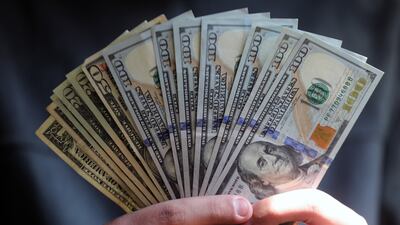
The Egyptian pound slid to about 18.50 to the US dollar on Tuesday from 18.27, a day after the country devalued its currency by 14 per cent, Refinitiv data showed. EPA -

The latest depreciation brings the total devaluation since Monday morning to slightly more than 15 per cent, close to the amount by which at least some analysts had estimated it was overvalued. EPA -

Egypt plans to restructure its public budget for fiscal year 2022/23 to cope with the global crisis resulting from the war in Ukraine, a cabinet statement said. Reuters -

The Egyptian Prime Minister Moustafa Madbouly said: 'Prices increased in an unprecedented way. We saw how fuel and food prices have significantly increased which put a huge pressure on our resources because now, we need to secure as much resources as we can to provide needed goods.' Reuters -
!['Prices are still the same over the past 10 days or two weeks. There are goods now sold at somehow reduced prices in government-owned shops in order to beat [traders] who raise prices, who use this opportunity [currency devaluation] to raise prices. This is a good step by the government to support citizens,' said one Egyptian citizen. Reuters](https://www.thenationalnews.com/resizer/v2/6FR37B5P2FDHRMIUE5FEQWVGIA.JPG?smart=true&auth=d7d5cc1adc349847e83833f41bc5cbb1dbdfcedd80a2890f417d4d0617bf5958&width=400&height=225)
'Prices are still the same over the past 10 days or two weeks. There are goods now sold at somehow reduced prices in government-owned shops in order to beat [traders] who raise prices, who use this opportunity [currency devaluation] to raise prices. This is a good step by the government to support citizens,' said one Egyptian citizen. Reuters -

The central bank raised its overnight lending and borrowing rates by one percentage point, state banks began selling one-year certificates of deposit to the public with a yield of 18 per cent and the government announced an economic relief package. Reuters


!['Prices are still the same over the past 10 days or two weeks. There are goods now sold at somehow reduced prices in government-owned shops in order to beat [traders] who raise prices, who use this opportunity [currency devaluation] to raise prices. This is a good step by the government to support citizens,' said one Egyptian citizen. Reuters](https://www.thenationalnews.com/resizer/v2/6FR37B5P2FDHRMIUE5FEQWVGIA.JPG?smart=true&auth=d7d5cc1adc349847e83833f41bc5cbb1dbdfcedd80a2890f417d4d0617bf5958&width=800&height=450)

Increasing export revenue to $100bn in such a challenging environment “is close to landing a man on the moon … but it is not impossible”, Mr Naguib said.
That is why it is important to take advantage of the multitude of trade agreements Egypt has signed with other countries, including the QIZ, he said.
History of the QIZ
The US introduced the QIZ concept in 1996 with the aim of developing regional economic partnerships that would benefit both Arab countries and Israel.
Jordan, which had signed a peace treaty with Israel in 1994, became the first country to join the QIZ protocol.
Although Egypt was the first Arab state to sign a peace treaty with Israel, in 1979, it did not sign a QIZ agreement until December 2004.
At the time, Egypt feared its textiles industry would be threatened by global competition from China and India, as the World Trade Organisation phased out quantitative quotas on the textiles trade.
About 95 per cent of Egypt’s exports through the QIZ come from the textiles sector, mainly to take advantage of the exemption from high customs, said Ashraf Rabiey, head of the QIZ unit at the Egyptian Ministry of Trade and Industry.
“The average for duties in the US is only 1.5 per cent but for textiles it can be as high as 32 per cent,” he said.
The Israeli content requirement under the QIZ started at 11.7 per cent but was negotiated down to 10.5 per cent in October 2007.
Egypt should also capitalise on declining Chinese exports to the US, which fell to $31bn last year from $40bn in 2020, Mr Rabiey said.
Total imports of ready-made textiles to the US reached $121bn last year.
Mr Rabiey advocated expanding the geographical areas covered by the QIZ. Currently there are more than 1,200 QIZ companies in Alexandria, Greater Cairo, the Middle Delta, the Suez Canal area and Upper Egypt.
Last month, Egypt’s Minister of Trade and Industry Nevine Gamea and Minister of Planning and Economic Development Hala El Said met Israel’s Minister of Economy and Industry Orna Barbivai to discuss strengthening trade relations.
Together they signed a letter asking the US to expand the QIZ to include more governorates, such as Fayoum, Assiut and Sohag, Mr Rabiye said.
Yaniv Tessel, director of the North and Latin America department at the Israeli Ministry of Economy and Industry, said such meetings are a sign of warming relations between Israel and Egypt in the context of recent regional developments.
In 2020, the UAE, Bahrain, Sudan and Morocco agreed to normalise relations with Israel.
The UAE and Israel also concluded negotiations last month for a free-trade agreement, which should be signed next week, Mr Tessel said.
“Our standing point in the regional economic landscape has completely changed from what it was in early 2020, and I’m sure it will affect the Israeli economy and the economic relationship between Egypt and Israel,” he said.
Israel exported $143bn worth of goods and services in 2021, with its largest recipient the US.
Bilateral trade between Egypt and Israel hit $330 million last year, an increase of 63 per cent compared to 2020, said Amira Oron, Israeli ambassador to Egypt.
Christopher Leslie, economic officer at the US embassy in Cairo, said the relationships between the US, Egypt and Israel are “of critical strategic importance to the United States, not just for us, but for regional stability and economic integration”.

