G-III Apparel Group aims to heavily market the Karl Lagerfeld brand in new regions. Reuters

Fashion brand Karl Lagerfeld to be fully acquired by G-III Apparel Group in $210m deal


Alvin R Cabral
  • English
  • Arabic

Karl Lagerfeld will be fully acquired by G-III Apparel Group, a US clothing company that counts Levi Strauss & Co and Tommy Hilfiger in its portfolio, as part of efforts to boost the fashion brand's presence.

G-III Apparel Group, which currently owns 19 per cent of Karl Lagerfeld, will buy the remaining stake from a group of private and public investors for €200 million ($210 million), the New York-based company said on Monday.

The all-cash deal is expected to add about $200m in initial annual sales, generate combined revenues of "approximately $1 billion or in excess of $2bn in sales to end consumers", and will expand G-III’s global presence.

“This transaction marks yet another significant milestone for G-III. Fully owning this visionary brand is a continuation of our successful partnership with the Karl Lagerfeld management team," Morris Goldfarb, chairman and chief executive of G-III, said.

"The addition of this iconic fashion brand to the G-III portfolio advances several of our key priorities, namely an increase in the direct ownership of brands and their licensing opportunities and further diversification of our global presence.”

Fashion remains one of the biggest shopping categories, particularly in the online segment.

Revenue from the overall apparel market is projected to surpass $1.7 trillion in 2022 and grow to over $1.95tn by 2026, according to data from online retail platform Oberlo, which is owned by Canada's Shopify.

Global revenue for the apparel segment this year would increase 10.59 per cent year-on-year, a slight dip from the 10.85 per cent increase last year, it said. The growth in 2021 came after an 11.8 per cent drop in 2020 during the height of the Covid-19 pandemic, the largest annual decrease expected between 2013 and 2026, Oberlo said.

G-III's acquisition of Karl Lagerfeld, founded by the German designer, is subject to certain adjustments and customary closing conditions, the statement said.

The deal will make the company the brand's sole owner, and will include Karl Lagerfeld’s existing 10 per cent stake in its established joint venture in China.

It will allow G-III to expand the fashion brand's presence in a number of geographic regions through partner-operated channels spanning digital, retail and licensing opportunities, G-III said.

It will also explore business opportunities in various industries, including hospitality, residential real estate and broader lifestyle projects.

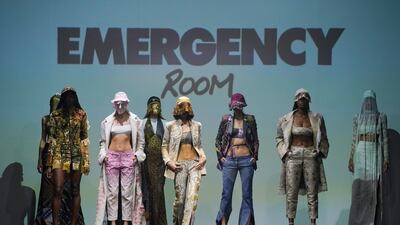
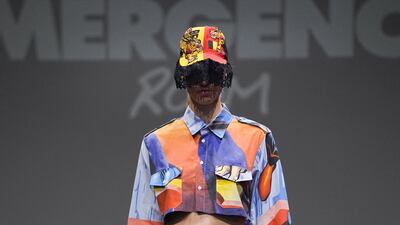
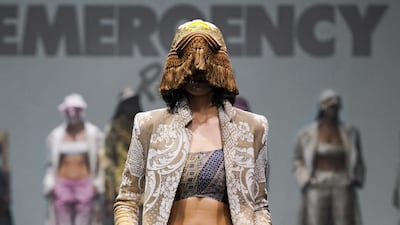
  • The Emergency Room show finale at Arab Fashion Week. All photos: AFW
    The Emergency Room show finale at Arab Fashion Week. All photos: AFW
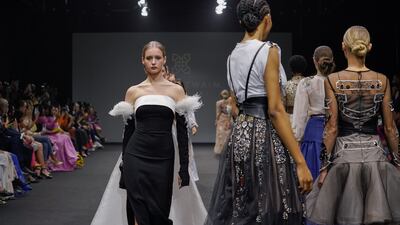
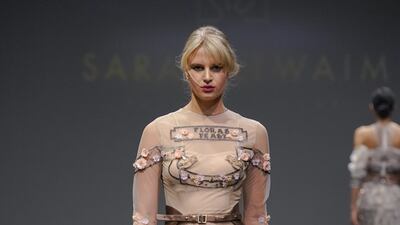
  • Sara Altwaim embroidered gowns with intricate images at Arab Fashion Week.
    Sara Altwaim embroidered gowns with intricate images at Arab Fashion Week.
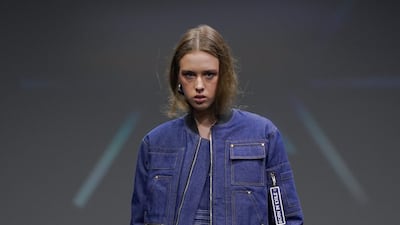
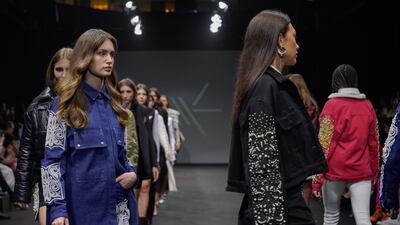
  • An all-denim look by Born in Exile at Arab Fashion Week.
    An all-denim look by Born in Exile at Arab Fashion Week.
  • The Sara Altwaim finale at Arab Fashion Week.
    The Sara Altwaim finale at Arab Fashion Week.
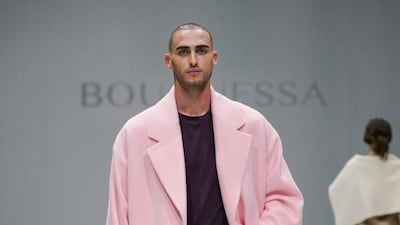
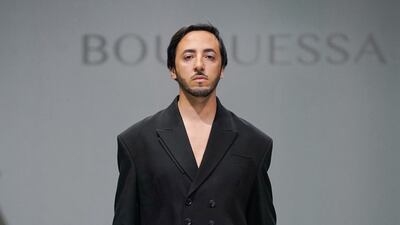
  • An all-pink menswear look at Bouguessa at Arab Fashion Week.
    An all-pink menswear look at Bouguessa at Arab Fashion Week.
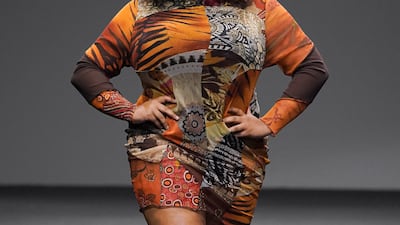
  • Emergency Room uses only discarded materials for its collections.
    Emergency Room uses only discarded materials for its collections.
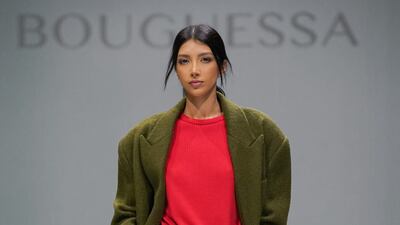
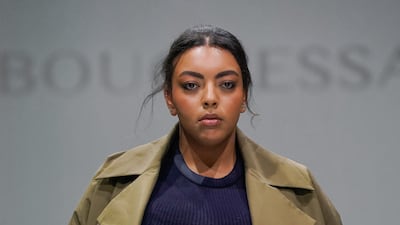
  • Slouchy masculine cuts at Bouguessa, at Arab Fashion Week.
    Slouchy masculine cuts at Bouguessa, at Arab Fashion Week.
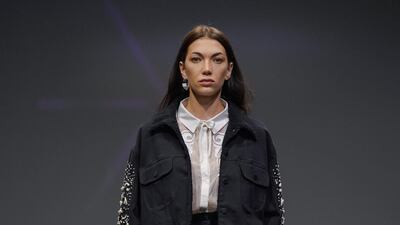
  • Many looks by Sara Altwaim had detailed embroidery work.
    Many looks by Sara Altwaim had detailed embroidery work.
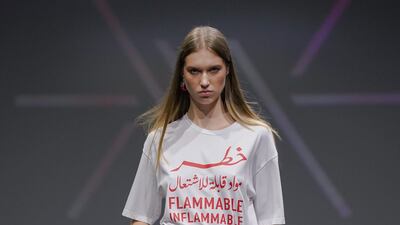
  • Born in Exile played on the 'Don't shoot' media T-shirt worn during the Lebanese Civil war, at Arab Fashion Week.
    Born in Exile played on the 'Don't shoot' media T-shirt worn during the Lebanese Civil war, at Arab Fashion Week.
  • A sharply tailored suit by Bouguessa, at Arab Fashion Week.
    A sharply tailored suit by Bouguessa, at Arab Fashion Week.
  • The Born in Exile finale at Arab Fashion Week.
    The Born in Exile finale at Arab Fashion Week.
  • Emergency Room's patchworked bodycon dress at Arab Fashion Week.
    Emergency Room's patchworked bodycon dress at Arab Fashion Week.
  • Born in Exile delivered simple cuts with fine detailing at Arab Fashion Week.
    Born in Exile delivered simple cuts with fine detailing at Arab Fashion Week.
  • Emergency Room sent out a collection made from headstock at Arab Fashion Week.
    Emergency Room sent out a collection made from headstock at Arab Fashion Week.
  • Classic tailoring was oversized at Bouguessa, as part of Arab Fashion Week.
    Classic tailoring was oversized at Bouguessa, as part of Arab Fashion Week.

"Over the course of more than a decade – including many years working hand-in-hand with Karl – we have developed a multifaceted fashion house and a strong business that we believe is poised for continued and significant growth," Pier Paolo Righi, chief executive of Karl Lagerfeld, said.

"This transaction is the natural evolution of this positive working relationship. Working even more closely with a team we know, trust and have a proven track record with will allow us to further accelerate the brand’s global opportunity.”

G-III designs, sources, manufactures and markets more than 30 notable fashion brands. It owns brands including Donna Karan, DKNY and Vilebrequin, its website says. It also has licensing agreements with Calvin Klein, Cole Haan, Dockers, Guess and Kenneth Cole.

The company also has a team sports business and has licences with North America's four major sports leagues – Major League Baseball, the National Basketball Association, the National Football League and the National Hockey League – and more than 100 US colleges and universities.


UAE squad

Esha Oza (captain), Al Maseera Jahangir, Emily Thomas, Heena Hotchandani, Indhuja Nandakumar, Katie Thompson, Lavanya Keny, Mehak Thakur, Michelle Botha, Rinitha Rajith, Samaira Dharnidharka, Siya Gokhale, Sashikala Silva, Suraksha Kotte, Theertha Satish (wicketkeeper) Udeni Kuruppuarachchige, Vaishnave Mahesh.

UAE tour of Zimbabwe

All matches in Bulawayo
Friday, Sept 26 – First ODI
Sunday, Sept 28 – Second ODI
Tuesday, Sept 30 – Third ODI
Thursday, Oct 2 – Fourth ODI
Sunday, Oct 5 – First T20I
Monday, Oct 6 – Second T20I

What is Genes in Space?

Genes in Space is an annual competition first launched by the UAE Space Agency, The National and Boeing in 2015.

It challenges school pupils to design experiments to be conducted in space and it aims to encourage future talent for the UAE’s fledgling space industry. It is the first of its kind in the UAE and, as well as encouraging talent, it also aims to raise interest and awareness among the general population about space exploration. 

Mercer, the investment consulting arm of US services company Marsh & McLennan, expects its wealth division to at least double its assets under management (AUM) in the Middle East as wealth in the region continues to grow despite economic headwinds, a company official said.

Mercer Wealth, which globally has $160 billion in AUM, plans to boost its AUM in the region to $2-$3bn in the next 2-3 years from the present $1bn, said Yasir AbuShaban, a Dubai-based principal with Mercer Wealth.

Within the next two to three years, we are looking at reaching $2 to $3 billion as a conservative estimate and we do see an opportunity to do so,” said Mr AbuShaban.

Mercer does not directly make investments, but allocates clients’ money they have discretion to, to professional asset managers. They also provide advice to clients.

“We have buying power. We can negotiate on their (client’s) behalf with asset managers to provide them lower fees than they otherwise would have to get on their own,” he added.

Mercer Wealth’s clients include sovereign wealth funds, family offices, and insurance companies among others.

From its office in Dubai, Mercer also looks after Africa, India and Turkey, where they also see opportunity for growth.

Wealth creation in Middle East and Africa (MEA) grew 8.5 per cent to $8.1 trillion last year from $7.5tn in 2015, higher than last year’s global average of 6 per cent and the second-highest growth in a region after Asia-Pacific which grew 9.9 per cent, according to consultancy Boston Consulting Group (BCG). In the region, where wealth grew just 1.9 per cent in 2015 compared with 2014, a pickup in oil prices has helped in wealth generation.

BCG is forecasting MEA wealth will rise to $12tn by 2021, growing at an annual average of 8 per cent.

Drivers of wealth generation in the region will be split evenly between new wealth creation and growth of performance of existing assets, according to BCG.

Another general trend in the region is clients’ looking for a comprehensive approach to investing, according to Mr AbuShaban.

“Institutional investors or some of the families are seeing a slowdown in the available capital they have to invest and in that sense they are looking at optimizing the way they manage their portfolios and making sure they are not investing haphazardly and different parts of their investment are working together,” said Mr AbuShaban.

Some clients also have a higher appetite for risk, given the low interest-rate environment that does not provide enough yield for some institutional investors. These clients are keen to invest in illiquid assets, such as private equity and infrastructure.

“What we have seen is a desire for higher returns in what has been a low-return environment specifically in various fixed income or bonds,” he said.

“In this environment, we have seen a de facto increase in the risk that clients are taking in things like illiquid investments, private equity investments, infrastructure and private debt, those kind of investments were higher illiquidity results in incrementally higher returns.”

The Abu Dhabi Investment Authority, one of the largest sovereign wealth funds, said in its 2016 report that has gradually increased its exposure in direct private equity and private credit transactions, mainly in Asian markets and especially in China and India. The authority’s private equity department focused on structured equities owing to “their defensive characteristics.”

Living in...

This article is part of a guide on where to live in the UAE. Our reporters will profile some of the country’s most desirable districts, provide an estimate of rental prices and introduce you to some of the residents who call each area home.

How much do leading UAE’s UK curriculum schools charge for Year 6?
  1. Nord Anglia International School (Dubai) – Dh85,032
  2. Kings School Al Barsha (Dubai) – Dh71,905
  3. Brighton College Abu Dhabi - Dh68,560
  4. Jumeirah English Speaking School (Dubai) – Dh59,728
  5. Gems Wellington International School – Dubai Branch – Dh58,488
  6. The British School Al Khubairat (Abu Dhabi) - Dh54,170
  7. Dubai English Speaking School – Dh51,269

*Annual tuition fees covering the 2024/2025 academic year

Who's who in Yemen conflict

Houthis: Iran-backed rebels who occupy Sanaa and run unrecognised government

Yemeni government: Exiled government in Aden led by eight-member Presidential Leadership Council

Southern Transitional Council: Faction in Yemeni government that seeks autonomy for the south

Habrish 'rebels': Tribal-backed forces feuding with STC over control of oil in government territory

'The Woman in the House Across the Street from the Girl in the Window'

Director:Michael Lehmann

Stars:Kristen Bell

Rating: 1/5

Milestones on the road to union

1970

October 26: Bahrain withdraws from a proposal to create a federation of nine with the seven Trucial States and Qatar. 

December: Ahmed Al Suwaidi visits New York to discuss potential UN membership.

1971

March 1:  Alex Douglas Hume, Conservative foreign secretary confirms that Britain will leave the Gulf and “strongly supports” the creation of a Union of Arab Emirates.

July 12: Historic meeting at which Sheikh Zayed and Sheikh Rashid make a binding agreement to create what will become the UAE.

July 18: It is announced that the UAE will be formed from six emirates, with a proposed constitution signed. RAK is not yet part of the agreement.

August 6:  The fifth anniversary of Sheikh Zayed becoming Ruler of Abu Dhabi, with official celebrations deferred until later in the year.

August 15: Bahrain becomes independent.

September 3: Qatar becomes independent.

November 23-25: Meeting with Sheikh Zayed and Sheikh Rashid and senior British officials to fix December 2 as date of creation of the UAE.

November 29:  At 5.30pm Iranian forces seize the Greater and Lesser Tunbs by force.

November 30: Despite  a power sharing agreement, Tehran takes full control of Abu Musa. 

November 31: UK officials visit all six participating Emirates to formally end the Trucial States treaties

December 2: 11am, Dubai. New Supreme Council formally elects Sheikh Zayed as President. Treaty of Friendship signed with the UK. 11.30am. Flag raising ceremony at Union House and Al Manhal Palace in Abu Dhabi witnessed by Sheikh Khalifa, then Crown Prince of Abu Dhabi.

December 6: Arab League formally admits the UAE. The first British Ambassador presents his credentials to Sheikh Zayed.

December 9: UAE joins the United Nations.

Updated: May 02, 2022, 1:58 PM