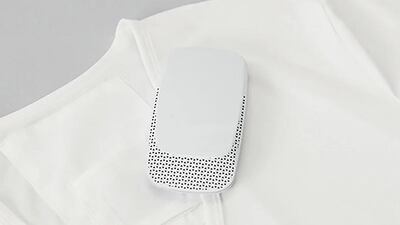
Sony's Reon Pocket claims to be able to lower your body's surface temperature. Courtesy Sony

Wearable air conditioners are here: the Reon Pocket can lower your temperature by 13 degrees Celsius


  • English
  • Arabic

Air conditioning presents the world with an uncomfortable paradox. The warmer the planet gets, the more air conditioning units we need to keep ourselves cool. And yet those units emit heat, which has to go somewhere – primarily into built-up areas of cities – and they also contribute to global warming through their massive consumption of energy.

An app allows you to adjust the desired temperature up or down, or give yourself a cool blast in boost mode

While it’s possible to design new buildings that reduce the need for air conditioners, this isn’t necessarily prioritised by developers, and older buildings will continue to be stubbornly warm as temperatures rise. But if a tiny device could lower our personal body temperature, might that lessen the need for us to cool the spaces we live and work in? And could they indirectly help to alleviate the climate crisis?

Recent efforts by scientists to combine electronics and clothing to make individual air conditioning units have been yielding results. One of the first to reach the market is the Reon Pocket, launched last week by Sony. While it is currently only available in Japan, there seems to be an intention to roll it out worldwide.

The small, very light device (it weighs only 80 grams) claims to reduce surface body temperature by as much as 13 degrees Celsius, simply by slotting into a pouch in a special V-neck undershirt. Another company, Embr Labs, sells a wrist-worn device called the Wave, which it describes as a “personal thermostat”. Wearing it, the company says, could lower the cost of cooling a building by as much as 35 per cent.

The need for such devices is particularly pressing in the Middle East. In the UAE, 70 per cent of electricity used during the summer months is devoted to cooling in one form or another, according to Powerwise, an Abu Dhabi government office focusing on the awareness of electricity use. The International Energy Agency, meanwhile, predicts that the energy demand from air conditioners will triple by the year 2050, accounting for 13 per cent of worldwide electricity use.

Embr Labs have been selling a wrist-worn device called the Wave, which they describe as a 'personal thermostat'. Courtesy Embr

Effective and convenient personal cooling isn’t easy to achieve. The biggest problem is the same one posed by air conditioners: in order to make us cool, physics tells us that something else has to be made warm, and that something would have to be carried around with you.

Fans are impractical, as are devices that need to be continually refilled with water. Twenty years ago, technology developed by the European Space Agency was incorporated into a cooling jacket by Italian fashion firm Corpo Nove, but it was incredibly cumbersome, incorporating 50 metres of 2mm plastic tubing to achieve the desired effect.

The solution now being touted by Sony and Embers Labs, among others, uses an electronic quirk called the Peltier effect. Discovered by French physicist Jean Charles Peltier in 1834, it relies on passing an electric current between two different metals.

Running it one way heats up one of the metals, but run it the other way and it cools down. These tiny devices have been deployed for years in water coolers and laptop computers, so why not clothing?

The summer heat in the UAE makes air conditioners a must-have. Antonie Robertson / The National

The new Sony device connects with your smartphone via Bluetooth, and an app allows you to gently adjust the desired temperature up or down, or give yourself a cool blast in boost mode. Sensors regulate that temperature, while movement detectors provide extra cooling when you’re active.

After initially being touted on Sony’s Japanese crowdfunding platform, First Flight, it struck a chord with the public and hit its target last year. Its launch was planned to coincide with the Tokyo Olympics, but it’s now being pitched at commuters travelling in Japan’s notorious humidity. “Reon Pocket solves the summer worries of business people,” says the website.

One early review on technology website The Verge indicates that it does the job: “I did find, generally, that the Reon Pocket improved matters somewhat,” it reads. “The cooling sensation does make a difference while you’re actually out there in the heat.”

And, as experiments continue, we’re likely to see greater efficacy; researchers at the University of California have been working with patches, which, when combined into a garment, promise to use just 26W to cool one person on a hot day. That’s in sharp contrast to the thousands of watts per day it takes to cool down an entire office.

Meanwhile, researchers at the University of Missouri have been working on a different kind of smart cooling, using a material that reflects sunlight from the body but allows body heat to pass through. Again, their ultimate aim is to save electricity.

It remains to be seen how appealing these devices are to the public, particularly as the cost of air conditioning is relatively affordable, and the damage that it may be doing to the planet is largely invisible, day to day.

Persuading us to change habits which affect our comfort isn’t easy. But as these devices get smaller, slimmer and more effective, popping one in our clothing may become second nature – just like putting on a wristwatch.


'The Batman'

Stars:Robert Pattinson

Director:Matt Reeves

Rating: 5/5

Tips%20for%20travelling%20while%20needing%20dialysis
%3Cul%3E%0A%3Cli%3EInform%20your%20doctor%20about%20your%20plans.%C2%A0%3C%2Fli%3E%0A%3Cli%3EAsk%20about%20your%20treatment%20so%20you%20know%20how%20it%20works.%C2%A0%3C%2Fli%3E%0A%3Cli%3EPay%20attention%20to%20your%20health%20if%20you%20travel%20to%20a%20hot%20destination.%C2%A0%3C%2Fli%3E%0A%3Cli%3EPlan%20your%20trip%20well.%C2%A0%3C%2Fli%3E%0A%3C%2Ful%3E%0A
What is the Supreme Petroleum Council?

The Abu Dhabi Supreme Petroleum Council was established in 1988 and is the highest governing body in Abu Dhabi’s oil and gas industry. The council formulates, oversees and executes the emirate’s petroleum-related policies. It also approves the allocation of capital spending across state-owned Adnoc’s upstream, downstream and midstream operations and functions as the company’s board of directors. The SPC’s mandate is also required for auctioning oil and gas concessions in Abu Dhabi and for awarding blocks to international oil companies. The council is chaired by Sheikh Khalifa, the President and Ruler of Abu Dhabi while Sheikh Mohamed bin Zayed, Abu Dhabi’s Crown Prince and Deputy Supreme Commander of the Armed Forces, is the vice chairman.

Mercer, the investment consulting arm of US services company Marsh & McLennan, expects its wealth division to at least double its assets under management (AUM) in the Middle East as wealth in the region continues to grow despite economic headwinds, a company official said.

Mercer Wealth, which globally has $160 billion in AUM, plans to boost its AUM in the region to $2-$3bn in the next 2-3 years from the present $1bn, said Yasir AbuShaban, a Dubai-based principal with Mercer Wealth.

Within the next two to three years, we are looking at reaching $2 to $3 billion as a conservative estimate and we do see an opportunity to do so,” said Mr AbuShaban.

Mercer does not directly make investments, but allocates clients’ money they have discretion to, to professional asset managers. They also provide advice to clients.

“We have buying power. We can negotiate on their (client’s) behalf with asset managers to provide them lower fees than they otherwise would have to get on their own,” he added.

Mercer Wealth’s clients include sovereign wealth funds, family offices, and insurance companies among others.

From its office in Dubai, Mercer also looks after Africa, India and Turkey, where they also see opportunity for growth.

Wealth creation in Middle East and Africa (MEA) grew 8.5 per cent to $8.1 trillion last year from $7.5tn in 2015, higher than last year’s global average of 6 per cent and the second-highest growth in a region after Asia-Pacific which grew 9.9 per cent, according to consultancy Boston Consulting Group (BCG). In the region, where wealth grew just 1.9 per cent in 2015 compared with 2014, a pickup in oil prices has helped in wealth generation.

BCG is forecasting MEA wealth will rise to $12tn by 2021, growing at an annual average of 8 per cent.

Drivers of wealth generation in the region will be split evenly between new wealth creation and growth of performance of existing assets, according to BCG.

Another general trend in the region is clients’ looking for a comprehensive approach to investing, according to Mr AbuShaban.

“Institutional investors or some of the families are seeing a slowdown in the available capital they have to invest and in that sense they are looking at optimizing the way they manage their portfolios and making sure they are not investing haphazardly and different parts of their investment are working together,” said Mr AbuShaban.

Some clients also have a higher appetite for risk, given the low interest-rate environment that does not provide enough yield for some institutional investors. These clients are keen to invest in illiquid assets, such as private equity and infrastructure.

“What we have seen is a desire for higher returns in what has been a low-return environment specifically in various fixed income or bonds,” he said.

“In this environment, we have seen a de facto increase in the risk that clients are taking in things like illiquid investments, private equity investments, infrastructure and private debt, those kind of investments were higher illiquidity results in incrementally higher returns.”

The Abu Dhabi Investment Authority, one of the largest sovereign wealth funds, said in its 2016 report that has gradually increased its exposure in direct private equity and private credit transactions, mainly in Asian markets and especially in China and India. The authority’s private equity department focused on structured equities owing to “their defensive characteristics.”

If you go
Where to stay: Courtyard by Marriott Titusville Kennedy Space Centre has unparalleled views of the Indian River. Alligators can be spotted from hotel room balconies, as can several rocket launch sites. The hotel also boasts cool space-themed decor.

When to go: Florida is best experienced during the winter months, from November to May, before the humidity kicks in.

How to get there: Emirates currently flies from Dubai to Orlando five times a week.
The biog:

Languages: Arabic, Farsi, Hindi, basic Russian 

Favourite food: Pizza 

Best food on the road: rice

Favourite colour: silver 

Favourite bike: Gold Wing, Honda

Favourite biking destination: Canada 

Avatar: Fire and Ash

Director: James Cameron

Starring: Sam Worthington, Sigourney Weaver, Zoe Saldana

Rating: 4.5/5