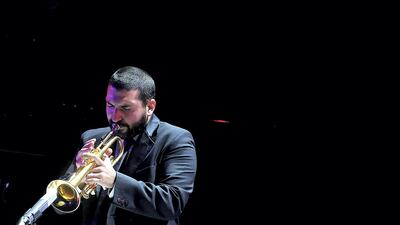

Play an Ibrahim Maalouf song, and by the end of it you’ll find yourself in a very different place than when you began. His is the kind of music that starts with meditative introspection before lifting off to a place of capering glee.
And the Franco-Lebanese maestro does it without paying mind to the confines of genre. With his custom-made trumpet – which allows him to find the half-sharps and half-flats found in the maqamat – he moves from melodies with Levantine flavours to Latin dance and jazz.
Over the past decade, Maalouf has produced, composed and arranged more than 15 albums for himself and other artists. He has also composed more than 10 symphonic works and has performed in some of the most prestigious venues around the world.
Looking at his career now, it seems almost a given that the trumpeter would build his future through the brass instrument his father taught him to play. But it wasn’t always evident to Maalouf.
"It was obvious for everybody around me, except for me," he said during the latest episode of Tonight's Chat, an online interview series exclusively on The National. "Everybody was telling me how I was going to be a musician, how I was going to play the trumpet."
Watch the full interview here:
Maalouf was only nine when he began performing live alongside his father, the famed classical trumpeter Nassim Maalouf. “It’s crazy when I think about it. My daughter is 10 years old now and it is inconceivable for me to imagine my daughter doing this so early. But my father was seeing things that I couldn’t see. He would tell me that I was going to play the trumpet and that I would play better than he did. I didn’t believe him. I didn’t even want to be a musician at the time. I wanted to be an architect. I wanted to rebuild Lebanon.”
Maalouf says his father is still one of his favourite musicians, “the greatest ever for me. He was a farmer in Lebanon in his early twenties when he decided to leave everything and go to Europe to learn the trumpet. He didn’t know anything about the instrument and he went on to become one of the best trumpet players ever.”
Early on in his career, Maalouf found that he was often comparing himself to his father, which comes as no surprise given that the older Maalouf taught him everything he knew about the trumpet. In fact, it was Nassim Maalouf himself who developed the quarter-tone trumpet by adding a fourth valve that allowed the production of half-sharps and half-flats.
“I was comparing myself to him all the time. Asking myself if I was doing as well as he did, if I was working as hard as he did. But at a certain point you have to stop doing it, you decide to end this mess and acknowledge that you have your own life, your own decisions.”
Maalouf moved to Paris with his family as a child during the Lebanese Civil War. When asked whether his career could have skyrocketed had he stayed in Lebanon, Maalouf’s response was a firm “no.”
He gave the example of artists like Zeid Hamdan – a Lebanese music producer who has worked with a number of leading indie artists and formed one half of the trip-hop band Soapkills. They have had a seminal imprint on contemporary Lebanese music, but have yet to get the international recognition they deserve.
“Those guys are doing some great, great things in Lebanon. [Hamdan] is an amazing artist and he should be a star in the whole world for me, but because he decided to stay in Lebanon, he is sacrificing part of what he could [be].”
Maalouf said that even the trumpet, as an instrument, is misunderstood in his native country. “The trumpet is mostly seen as an instrument that is played in funerals or weddings or things like that. Most people don't know anything about the trumpet.
"Most people in Lebanon prefer entertainment over music, which is extremely different. For them, music is for them to enjoy themselves. To play at parties, in restaurants or at birthdays. They rarely celebrate music for itself.”
However, that's not to say that Maalouf's career didn't face hurdles in the West. While France offered more opportunities for Maalouf to establish himself as a musician, racism was also a persistent obstacle. "[There was] lots and lots of racism, and this is something we have to fight against," Maalouf said. He recalled a specific incident with one of his teachers at the Paris Conservatory, who told the young Maalouf that he would "never play classical music like a Western person. Two years later, I won one of the biggest classical music competition. And he was in the jury, looking at me in a weird way. We should overcome the little barriers that people put in front of us. That's the only thing we can do."
Maalouf, who is preparing to release his 12th studio album in November, also spoke about how the coronavirus pandemic is affecting the industry. He says, while concerts and performances are going virtual as a way of acclimating to social distancing measures, the live concert experience is here to stay.
“I don’t think [virtual concerts] will replace the real thing. But they are something new. Maybe even something good that came out of a bad time,” Maalouf told Tonight's Chat host Ricardo Karam, adding that, when the time comes, these virtual concerts could inspire people to attend live concerts by musicians they wouldn't otherwise have been exposed to.
"It reminds me of how back in the day DVD tours of museums like the Louvre were being distributed and people were saying how people will stop visiting the spaces themselves. If anything, the opposite happened, it inspired many to go discover the artworks in person."
While the Covid-19 pandemic has been sweeping across France, Maalouf says that he has been staying at his home in Paris with his grandmother, Odette. “She is an amazing woman. She’s experienced a lot. She was only 17 when the Second World War began. She’s telling me not to worry about all this, and that it’s going to pass.”

