


Powerful women from present and past remain muses for Ibrahim Maalouf.
After releasing acclaimed albums dedicated to Arab songbirds — such as Egyptian singer Umm Kulthum (2015's Kalthoum) and Egyptian-born Italian-French pop star Dalida (2017’s Dalida by Ibrahim Maalouf) — the Lebanese-French trumpeter and composer conjures the drama and mystery of the Queen of Sheba.
The end result is a new collaborative album, named after the storied figure, with revered Beninese singer Angelique Kidjo.
Maalouf says the challenge of working on the ambitious project with someone described as a queen of the world music genre was an opportunity too good to pass up.
“It was Angelique who approached me years ago and said she wanted to work with me. That blew my mind because she is someone whose work I love so much,” he tells The National, at Morocco’s Jazzablanca Festival.
"We agreed that we would collaborate at some point but then a few days later, she messaged me saying that we should work on the story of Queen of Sheba, because she is a figure that's really at the meeting point between the Middle East and Arab culture and Africa.”
Scroll through the gallery below to see Jazzablanca Festival 2022 in Morocco
-
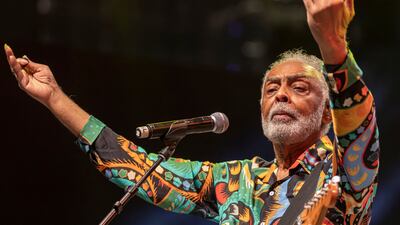
Gilberto Gil headlined the second night of the Jazzablanca Festival. Photo: Sife Elamine -
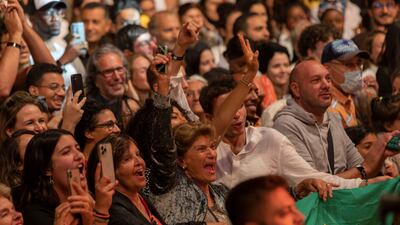
The crowd featured many compatriots from Brazil. Photo: Sife Elamine -
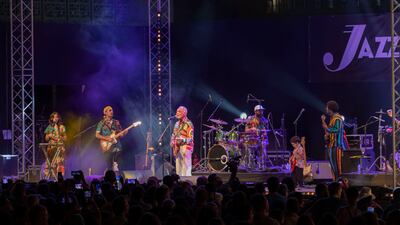
Gil performed a set spanning his six decade career. Photo: Sife Elamine -

Gilberto Gil, performing at Jazzablanca. Photo: Sife Elamine -
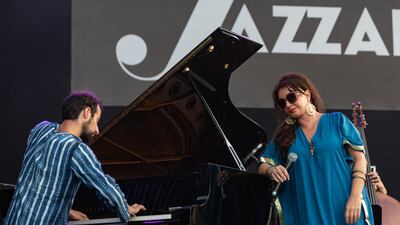
Egyptian-Belgian singer Natacha Atlas was one of the acts performing at Jazzablanca Festival. Photo: Sife El Amine -

She played songs from latest album 'Strange Days'. Courtesy: Jazzablanca Festival -

Natacha Atlas was in fine form throughout the hour long set. Courtesy: Jazzablanca Festival -

Lebanese-French trumpeter and composer Ibrahim Maalouf headlines the first night of the 2022 Jazzablanca Festival in Casablanca, Morocco. Photo: Sife Elamine -
Ethiopian jazz musician and arranger Mulatu Astatke perfoms on the Scene 21 stage at Jazzablanca Festival. Photo: Salima Moumni -
Bab L' Bluz bring their psychedelic rock take on Gnawa music – Moroccan and West African Islamic songs and rhythm – at the Jazzablanca Festival. Photo: Salima Moumni -
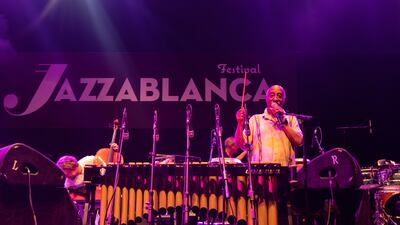
Mulatu Astatke is renowned as the father of the Ethio-Jazz genre. Photo: Salima Moumni -
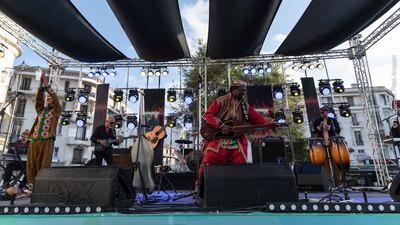
Moktar Gania and Gnawa Soul performing at Jazzablanca Festival. Photo: Mohamed Filali Anssari -
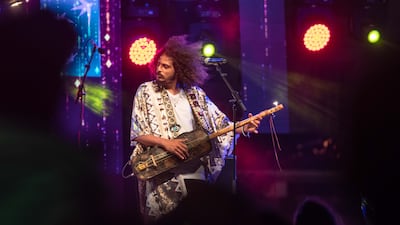
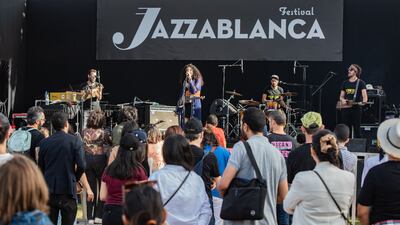
Morocco's Saad Tiouly headlined the Scene BMCI stage on day one of the 2022 Jazzablanca Festival. Photo: Mohamed Filali Anssari -

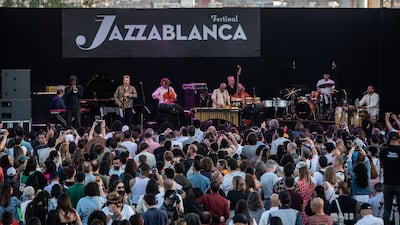
About 5,000 people attended the first day of the 2022 Jazzablanca Festival. Photo: Mohamed Filali Anssari -

The festival took place at new venue, the sprawling Anfa Park. Photo: Mohamed Filali Anssari -
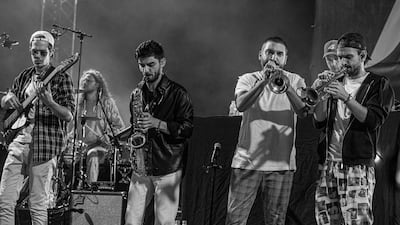
Ibrahim Maalouf and his band performing at the Jazzablanca Festival. Photo: Sife Elamine -
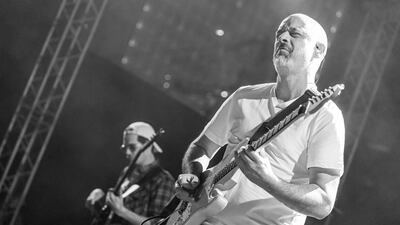
The three-day festival features artists performing jazz, soul, rock and Moroccan Gnawa music. Photo: Sife Elamine -

Ibrahim Maalouf performed songs from his new album 'Queen of Sheba', a collaboration with Beninese singer-songwriter Angelique Kidjo. Photo: Sife Elamine -
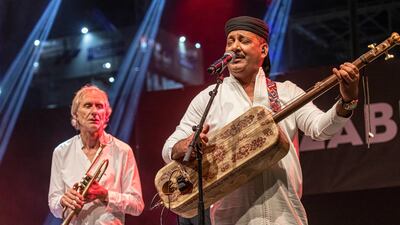
French trumpeter Erik Truffaz performs with Moroccan Gnawa musician Hamid El Kasri, on the Jazzablanca main stage. Photo: Sife Elamine -
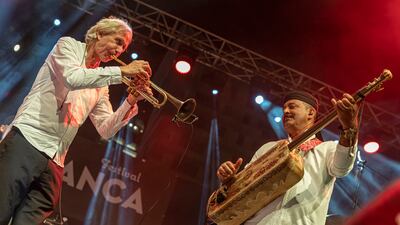
Jazzablanca launched as a small boutique event in 2006. Photo: Sife Elamine


A story for the ages
The story of the Queen of Sheba has been told in various guises across Jewish, Christian and Muslim traditions.
It is also told in the Kebra Nagast, a 14th-century epic poem forming the foundation story of Ethiopia.
All texts centre on her meeting with King Solomon and presenting him with riddles designed to test his wisdom.
Maalouf and Kidjo are among a number of artists who have attempted to capture the spirit of that exchange through music.
German-British composer George Frideric Handel wrote the 1748 oratorio Solomon, while the 1998 track Makeda (the name given to Sheba in the Kebra Negast) was performed by French RnB group Les Nubians.
Where those were singular pieces of music, Queen of Sheba could be the first album dedicated to the topic.
Each of the seven songs is inspired by a riddle posed to the king, with Kidjo providing the poetic lyrics in the west African Yoruba language and Maalouf in charge of the musical arrangements.
The project was originally conceived as a stage show and the success of a tour — with performances in New York’s prestigious Carnegie Hall and the Austrian festival Jazz a Vienne — convinced the duo to record the songs as an album.
"It is the format of the show that inspired me because seven songs are not too many, so that allowed me to write longer pieces," Kidjo says.
"If you hear it all together, it sounds like a symphony with seven parts.”
Featuring a classical orchestra, jazz players and African percussionists, Queen of Sheba is a melting pot of styles.
The opener Ahan (The Tongue) begins with an almost regal fluttering of horns before strident strings and percussion arrive with Kidjo, in the role of Sheba, questioning the king's patriarchal powers.
"Where does your strength derive from?” she says. “How much money do you have to pay?”
Watch Ibrahim Maalouf and Angelique Kidjo perform together in the video below
Omije (Tears) is a piano ballad in which Kidjo, supported by Maalouf's sorrowful trumpet, laments the destruction that pride has reeked on civilisations. "King Solomon, this day I am in the dark, I am like a little child of peace."
Maalouf says the intensity of her performance comes from her approach in the studio.
"She sent me the lyrics for the music and I sang her parts on the demos and sent it back to her," he says.
"She then recorded it exactly the same way but only better. Angelique wants things to be precise. She doesn't really go with the flow. Things have to be very much written already so I had to compose with her very specific voice in mind."
Voices to inspire
This way of working is something Maalouf is accustomed to.
Like Queen of Sheba, Maalouf's Kalthoum and Dalida by Ibrahim Maalouf albums also transcend mere tribute with their level of research and detail.
Maalouf describes his other muse, Umm Kulthum, as an "emblematic figure whose voice I have listened to the most since I was a child".
Kulthum's songs were some of the first pieces of music he was instructed to learn by his musician father, upon fleeing to Paris as a child during the Lebanese Civil War.
More inspiration comes from the women in his family, including his daughter, sisters, mother, aunt and grandmother.
Maalouf's grandmother, in particular, left him with the advice that has powered his eclectic career.
"She lived until she was 19 and before she died, I asked her if she thought she was an intelligent woman during her life and her response is something I will never forget. She looked at me and said 'I just adapt’.
"My grandmother is a woman who lived through three wars, lost a child and was a strong woman who adapted to everything around her.
“That's the strength of women in our society and I will continue to communicate this love and appreciation I have for them through my projects."

