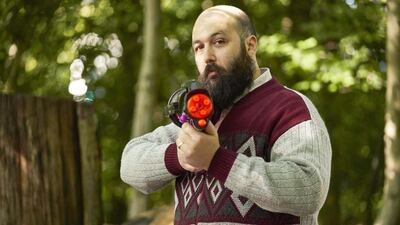
Youssef Kerkour plays Sami Ibrahimin 'Home'. Mark Johnson / Channel 4

'We should tell our stories': How Youssef Kerkour is knocking down Arab stereotypes, one role at a time


Samia Badih
  • English
  • Arabic

A few years ago, Moroccan actor Youssef Kerkour decided he would no longer play the stereotypical Arab bad guy.

Not long after he made that resolution, the opportunity to play Sami Ibrahim in Home came along. The British series, written by and starring Hunderby actor Rufus Jones, follows the story of Ibrahim, a Syrian asylum seeker who moves in with a middle-class English family after they find him hiding in the boot of their car upon their return from a family vacation in France.

The role has netted Kerkour, 42, his first Bafta nomination for Best Male Comedy Performance, announced earlier this month. The winners of the 2020 TV Baftas will be revealed on Friday, July 17.

For the actor, who grew up in Rabat, that prestigious nod is a reflection of changing times.

"If a guy like me can get hired to play a very sweet, cuddly Syrian refugee, then it means the industry is changing a little bit – but there is so much more to do," he tells The National from his home in London.

"In many ways, my career tracks that change. I spent my life playing terrorists. That’s my USP, that's why I grew my beard. I'm a very big guy. I speak Arabic, so a big bearded Arabic man, there’s really one kind of part, traditionally," he says. "[Playing] Sami is the first time somebody has taken the chance and given me something more."

While Home, which first debuted in March 2019, hasn't yet been confirmed for a third series, Kerkour is confident about the show's future.

I'd like our stories to be told in a more authentic, humane way

Ibrahim's story is based on that of Hassan Akkad, a Syrian English teacher who filmed his journey on a boat as he fled from Damascus. He was also part of the team that made Exodus: Our Journey to Europe, which won a Bafta for Best Factual Series or Strand in 2017.

"He was on set all the time and was helping us with everything," Kerkour says.

Akkad even helped Kerkour perfect his Syrian accent, specifically the dialect native to the city of Damascus. "Everyone comments on the Arabic, which I'm proud of. It's all him. It's his ear."

Today, the roles Kerkour takes on have shifted away from "terrorists", becoming more than just one-dimensional characters, he says.

This year, he also starred in new British production Baghdad Central, a police detective story set in the city following the US-led coalition's invasion of Iraq. Based on the crime novel by Elliott Colla, the six-part series stars American-Palestinian actor Waleed Zuaiter as police inspector Muhsin Khafaji, the show's main character.

Kerkour plays Karl, a taxi driver whose father was a communist in Iraq. Karl becomes Khafaji's confidant and for this role, it was the Iraqi accent that he had to work to perfect.

“Accents definitely form part of training and how to do them is a part of what you learn," says Kerkour, who attended the renowned London Academy of Music and Dramatic Arts (Lamda). "It’s part of your repertoire. It’s on your CV.”

But the actor, who is fluent in Arabic, French, English and Italian, has always had an affinity for languages.

"I believe if you want to learn a language you basically have to learn a thought process. You’re not learning words; you’re learning how somebody else thinks.”

Youssef Kerkour (left) in 'Dracula'. Courtesy BBC

For a role on the Netflix Original series Dracula, Kerkour had to master a Russian accent.

“When I commit to one language, people shouldn’t be able to tell the difference," he says. “That’s the idea. That’s my job.”

While he doesn't go back to Morocco as often as his parents would like, work in the past couple of years has sporadically taken him to his home country.

Baghdad Central was shot in Morocco, where the production team recreated the Iraqi city. Kerkour also took on his first role in a Moroccan production called De Sable et de Feu, directed by Amok's Souheil Ben-Barka. The film premiered at the Arpa International Film Festival in Los Angeles last November.

The excitement in Kerkour's voice when he speaks about his home country is tangible. He strongly believes in the power of storytelling, something that he hopes Arab nations will continue to push for and develop. "I’d like our stories to be told in a more authentic, humane way," he says.

The entertainment industry "is literally your country's flag that travels all around the ether and plants itself in somebody else's brain", he says. "Who tells your story when you're Arab? It should be us."

Until then, Kerkour is taking on that mission, one role at a time.

%20Ramez%20Gab%20Min%20El%20Akher
%3Cp%3E%3Cstrong%3ECreator%3A%3C%2Fstrong%3E%20Ramez%20Galal%3C%2Fp%3E%0A%3Cp%3E%3Cstrong%3EStarring%3A%3C%2Fstrong%3E%20Ramez%20Galal%3C%2Fp%3E%0A%3Cp%3E%3Cstrong%3EStreaming%20on%3A%20%3C%2Fstrong%3EMBC%20Shahid%3C%2Fp%3E%0A%3Cp%3E%3Cstrong%3ERating%3A%20%3C%2Fstrong%3E2.5%2F5%3C%2Fp%3E%0A
The%20specs
%3Cp%3E%3Cstrong%3EEngine%3A%3C%2Fstrong%3E%201.8-litre%204-cyl%20turbo%0D%3Cbr%3E%3Cstrong%3EPower%3A%20%3C%2Fstrong%3E190hp%20at%205%2C200rpm%0D%3Cbr%3E%3Cstrong%3ETorque%3A%3C%2Fstrong%3E%20320Nm%20from%201%2C800-5%2C000rpm%0D%3Cbr%3E%3Cstrong%3ETransmission%3A%20%3C%2Fstrong%3ESeven-speed%20dual-clutch%20auto%0D%3Cbr%3E%3Cstrong%3EFuel%20consumption%3A%3C%2Fstrong%3E%206.7L%2F100km%0D%3Cbr%3E%3Cstrong%3EPrice%3A%3C%2Fstrong%3E%20From%20Dh111%2C195%0D%3Cbr%3E%3Cstrong%3EOn%20sale%3A%20%3C%2Fstrong%3ENow%3C%2Fp%3E%0A
Ten tax points to be aware of in 2026

1. Domestic VAT refund amendments: request your refund within five years

If a business does not apply for the refund on time, they lose their credit.

2. E-invoicing in the UAE

Businesses should continue preparing for the implementation of e-invoicing in the UAE, with 2026 a preparation and transition period ahead of phased mandatory adoption. 

3. More tax audits

Tax authorities are increasingly using data already available across multiple filings to identify audit risks. 

4. More beneficial VAT and excise tax penalty regime

Tax disputes are expected to become more frequent and more structured, with clearer administrative objection and appeal processes. The UAE has adopted a new penalty regime for VAT and excise disputes, which now mirrors the penalty regime for corporate tax.

5. Greater emphasis on statutory audit

There is a greater need for the accuracy of financial statements. The International Financial Reporting Standards standards need to be strictly adhered to and, as a result, the quality of the audits will need to increase.

6. Further transfer pricing enforcement

Transfer pricing enforcement, which refers to the practice of establishing prices for internal transactions between related entities, is expected to broaden in scope. The UAE will shortly open the possibility to negotiate advance pricing agreements, or essentially rulings for transfer pricing purposes. 

7. Limited time periods for audits

Recent amendments also introduce a default five-year limitation period for tax audits and assessments, subject to specific statutory exceptions. While the standard audit and assessment period is five years, this may be extended to up to 15 years in cases involving fraud or tax evasion. 

8. Pillar 2 implementation 

Many multinational groups will begin to feel the practical effect of the Domestic Minimum Top-Up Tax (DMTT), the UAE's implementation of the OECD’s global minimum tax under Pillar 2. While the rules apply for financial years starting on or after January 1, 2025, it is 2026 that marks the transition to an operational phase.

9. Reduced compliance obligations for imported goods and services

Businesses that apply the reverse-charge mechanism for VAT purposes in the UAE may benefit from reduced compliance obligations. 

10. Substance and CbC reporting focus

Tax authorities are expected to continue strengthening the enforcement of economic substance and Country-by-Country (CbC) reporting frameworks. In the UAE, these regimes are increasingly being used as risk-assessment tools, providing tax authorities with a comprehensive view of multinational groups’ global footprints and enabling them to assess whether profits are aligned with real economic activity. 

Contributed by Thomas Vanhee and Hend Rashwan, Aurifer

EVIL%20DEAD%20RISE
%3Cp%3E%3Cstrong%3EDirector%3A%20%3C%2Fstrong%3ELee%20Cronin%3Cbr%3E%3Cstrong%3EStars%3A%20%3C%2Fstrong%3EAlyssa%20Sutherland%2C%20Morgan%20Davies%2C%20Lily%20Sullivan%3Cbr%3E%3Cstrong%3ERating%3A%3C%2Fstrong%3E%205%2F5%3C%2Fp%3E%0A

Crazy Rich Asians

Director: Jon M Chu

Starring: Constance Wu, Henry Golding, Michelle Yeon, Gemma Chan

Four stars

Schedule for show courts

Centre Court - from 4pm UAE time

Johanna Konta (6) v Donna Vekic

Andy Murray (1) v Dustin Brown

Rafael Nadal (4) v Donald Young


Court 1 - from 4pm UAE time

Kei Nishikori (9) v Sergiy Stakhovsky

Qiang Wang v Venus Williams (10)

Beatriz Haddad Maia v Simona Halep (2)


Court 2 - from 2.30pm

Heather Watson v Anastasija Sevastova (18)

Jo-Wilfried Tsonga (12) v Simone Bolelli

Florian Mayer v Marin Cilic (7)


Ireland (15-1):

Ireland (15-1): Rob Kearney; Keith Earls, Chris Farrell, Bundee Aki, Jacob Stockdale; Jonathan Sexton, Conor Murray; Jack Conan, Sean O'Brien, Peter O'Mahony; James Ryan, Quinn Roux; Tadhg Furlong, Rory Best (capt), Cian Healy

Replacements: Sean Cronin, Dave Kilcoyne, Andrew Porter, Ultan Dillane, Josh van der Flier, John Cooney, Joey Carbery, Jordan Larmour

Coach: Joe Schmidt (NZL)

McIlroy's struggles in 2016/17

European Tour: 6 events, 16 rounds, 5 cuts, 0 wins, 3 top-10s, 4 top-25s, 72,5567 points, ranked 16th

PGA Tour: 8 events, 26 rounds, 6 cuts, 0 wins, 4 top-10s, 5 top-25s, 526 points, ranked 71st
