



American filmmaker David Henry Gerson is the grandchild of Holocaust survivors.
It's this family history of exile and trauma that has enabled him to bond with Syrian artists whose lives have changed since protests first broke out in 2011.
Illustrator Diala Brisly and rapper Mohammad Abu Hajar are among those featured in Gerson's documentary The Story Won't Die, an intimate look at the political unrest in the nation.
He speaks to a handful of musicians, dancers and visual artists about how they have used their art to confront their trauma and share their experiences.
In 2016, Gerson watched a short documentary about refugees landing in Lesbos, Greece, called 4.1 Miles, directed by Daphne Matziaraki, and felt the resonance of what was the largest displacement of people since the Second World War.

His father was born in Uzbekistan and grew up in refugee camps in Germany. As a child in the US, “these stories of exile and how to process exile were encoded in my DNA”, says Gerson. “So this just felt like a real moment of, I have to do something.”
He started his own research and found stories of “people who were like my friends in Echo Park in Los Angeles or in Brooklyn — musicians, breakdancers, rappers, visual artists — people I really admired and loved.”
Gerson had won a Student Academy Award in 2016 for All These Voices, a short narrative film about Holocaust survivors confronting the horror of war, inspired by his interest in the fearless writing of Primo Levi.
In the years that followed, he wondered which artists were asking the most questions in Syria, the ones that looked into darkness to try and process it.
In reference to Pablo Picasso's anti-war oil painting Guernica and Francisco Goya's The Third of May 1808, which commemorates Spanish resistance to Napolean's army, Gerson told how The Story Won't Die began with asking himself: "Who is making the Guernica of the Syrian civil war? Who is making the Third of May of the Syrian civil war?"
Initially, he was interested in artists such as Tammam Azzam, whose work varies from digital mash-ups of famous European art and scenes of destruction from Syria designed to capture the world's attention during the early days of the Arab uprising, to huge, abstract oil paintings made in exile that seem to look back at Syria with horror and nostalgic longing.

Abdalaziz Alhamza, the film's co-producer and a co-founder of the Syrian citizen journalist collective, Raqqa is Being Slaughtered Silently, suggested Gerson widen his net to include activists and how they used their art, introducing him to Hajar and Brisly.
While Hajar has used his voice to question Syria's president Bashar Al Assad, some artists want nothing to do with activism, says Gerson.
"They just want to express themselves, and shake off the weight of what they have been forced into. Each person is sort of on that spectrum in different capacities," he says. "So we have a real balance.”

The film is alert to the frustrations of people who feel they have become curiosities as refugees, a label Gerson tries to avoid using in the film. It is a notion that leaves some people feeling like "lab rats for documentaries", according to Bahila Hijazi, a member of the first all-female rock band in Syria.
“To be told you are this or that is the brick in the wall you don't want to run into as a creative person,” says Gerson, adding that it was important to leave in statements like Hijazi's. “It involves me, in some regards, and who am I to be telling their story?”
Gerson sought to work with artists in a spirit of collaboration, going through many drafts of the film together and gathering opinions along the way.
For Brisly, who lost a younger brother in Syria, doing the film was an eye-opening journey. When Gerson showed her the first edited clip, she began to cry, he says, as she realised other people were going through the same challenges as her.
“As she told me that, I just felt so grateful, frankly, that this work could have that simple impact of one person feeling less alone in the world with their struggle," he says.
'The Story Won't Die' will be available on Google Play and Vimeo Plus from June 21.
Documentary on Syrian artist Mohamad Hafez makes Oscars shortlist - in pictures
-

'We have won' by Mohamad Hafez. Credit: Rodney Nelson -
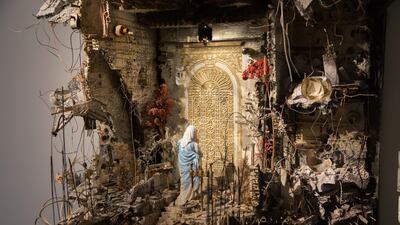
'Have you forsaken us' by Mohamed Hafez. Credit: Rodney Nelson -
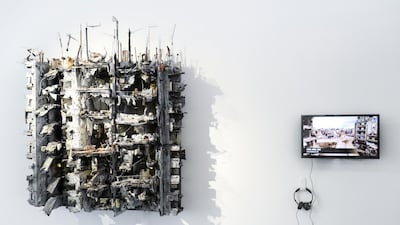
'Collateral damage' by Mohamad Hafez. Credit: Rodney Nelson -
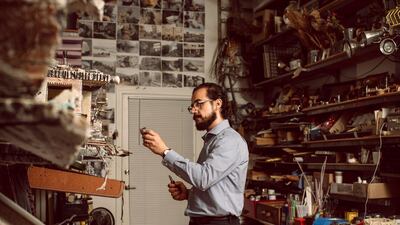
Mohamed Hafez’s New Haven studio is lined with stainless steel shelves housing buckets full of bits of junk, which he describes as his “ingredients of the day”. Credit: Cole Wilson -

'We have won!' by Mohamed Hafez. Credit: Rodney Nelson -

Unpacked Refugee Baggage' by Mohamed Hafez. Credit: Rodney Nelson -

“I’ve been making these models for 15 years now, but for the first 10 years, my practice was completely confidential and for me only,” he says. “It’s not until relatively recently that people have said to me that I need to exhibit these works," says Mohamed Hafez. Credit: Rodney Nelson -
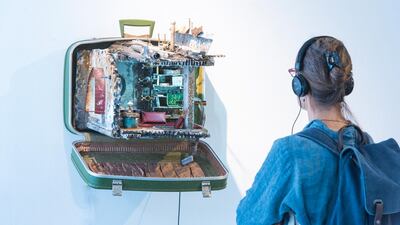
'Unpacked Refugee Baggage' by Mohamad Hafez. Credit: Rodney Nelson -
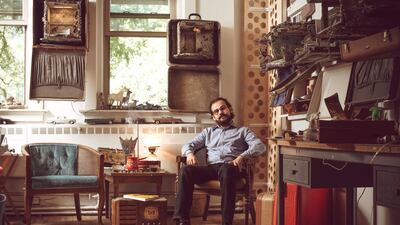
Making these miniature models – many of which are based on images Hafez has seen in newspapers and magazines – is no longer the cathartic experience it once was for Hafez, however. “If you are trying to remodel the ruins of Aleppo, I feel devastated after completing the work,” he says, “particularly when I incorporate the sound effects. You’re hearing children playing in the street and the call to prayer and church bells ringing. Anyone who has been to that region will recognise these noises as representations of a peace that no longer exists.” Credit: Rodney Nelson -
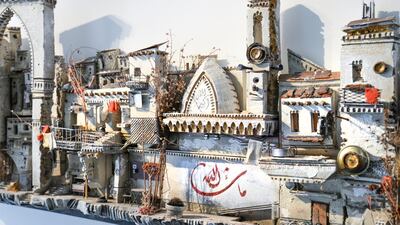
'Unsettled Nostalgia' by Mohamed Hafez. Credit: Rodney Nelson



