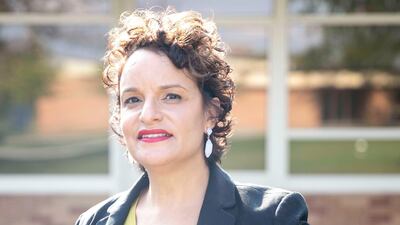
Author Sahar Mustafah is also a high school teacher. Photo by Rebecca Healy

Palestinian-American author Sahar Mustafah on telling all sides of a 'marginalised' story in 'The Beauty of Your Face'


  • English
  • Arabic

It’s a nightmare that has become distressingly familiar. But that doesn’t make the opening scenes in Sahar Mustafah’s debut novel any less harrowing.

A shooter, radicalised by the alt-right, enters a school in America and starts firing. Not indiscriminately, but close enough that he can “soak up their terror… their pleas for their lives”. The principal of Nurrideen School For Girls, Afaf Rahman, is faced with the day she always feared. 

It’s almost too difficult to read, and Mustafah, speaking from her Illinois home, recognises this. “It’s unpleasant, it’s disturbing, it’s uncomfortable. But I couldn’t let readers forget the immediate threat of violence our community always faces.”

Marginalised communities can't just be defined by trauma

Get past the horror, though, and The Beauty Of Your Face is actually the poignant story of Rahman's journey to this moment; in the midst of the Black Lives Matter protests, it's also an alarmingly timely look at the racism endemic in America.

Or perhaps, sadly, it's timeless.

Immediately going back in time to Rahman’s Palestinian-American family life in 1980s Illinois amid a bigoted society, the novel tracks the constant suspicion and casual cruelty they suffer. When her sister disappears, the police department don’t appear to take the investigation seriously. When Rahman belatedly seeks comfort in the Muslim community, she is called a “raghead” in public. 

“This micro-aggressive behaviour might seem low level, but it becomes internalised in the victim; someone like Afaf growing up in that environment will have their self-worth fractured,” explains Mustafah, a second generation Palestinian. 

The Beauty of Your Face by Sahar Mustafah. Courtesy Legend Press

“What does it look like not to belong, to have parents who also struggle to fit in, who are these unanchored immigrants? I have to say I have white friends who have been startled by this book. They say things like ‘I have no idea this happens’. So books like this can fill that void. That feels really important right now.”

Not least because when Mustafah sent the first manuscript to editors, some responded by asking her to drop the white shooter and instead focus just on Afaf’s immigrant story. If she did that, they suggested, it would be published very quickly. She stood her ground, and rightly so; this nuanced novel explores in impressive detail the forces that bring the shooter to the moment where he enters the school, the bifurcated timeline always building towards his encounter with Rahman in the third act. 

Writing stories 'that change preconceived notions'

“There has been a lot of control over the immigrant narrative, and it does feel that writers of colour are always asked how much of their stories are autobiographical,” says Mustafah, who is also a high school teacher. “Yes, of course, my lived experience is here, but I have to be able to control the fiction, too.”

Islam is not about being perfect but it is about forgiveness, both of yourself and others

The question is also whether authors like her are actually being heard. Mustafah feels optimistic about the future, partly because she’s seen a flourish of new Palestinian-American authors, such as Susan Muaddi Darraj, Zaina Arafat, Hala Alyan, Etaf Rum and Lena Mahmoud. But for her, the gatekeepers have to shift too; there need to be more editors of colour, agents of colour and publishing houses with people of colour in managerial positions.

Perhaps, then, the actual stories we get to read would change, too. 

“There was this interview I did which had a headline along the lines of “why Sahar hates happy endings,” she laughs. “I’m really not that dark, but there is definitely a burden placed on writers of colour who come from villainised communities to be hopeful. I put that down; what I can do is write a story which challenges preconceived notions in a good way.”

In a recent interview, the Pulitzer Prize-winning author Colson Whitehead was doubtful that fiction has the power to change anything. “Politicians don’t read,” he said.

But individuals do, and if Mustafah has a dream, it’s that her intimate look at the Palestinian-American experience makes people “speak up, or change their vote in November. These are things I wish for. If nothing else, I hope people will see a shared humanity.”

And the way readers will navigate The Beauty of Your Face, from despair and horror to hard-won peace and acceptance, is in some ways a mirror of Mustafah's own state of mind. She admits that sometimes she just has to switch off the news and social media, but also, more recently, there has been some succour in the idea of "black joy". 

“Being a teacher, there’s this idea you have to challenge students to see beyond their privilege and develop empathy for other communities. But then, these last few weeks I’ve read so much from black authors and scholars who have said there’s got to be room for joy.

"We won’t be able to get through our struggles without humour and happiness; these are the things that make us human and elevate us – and which also change the narrative of the so-called downtrodden black person. Marginalised communities can’t just be defined by trauma.”

And even in Rahman’s case, Mustafah thinks that might be possible. 

“She’s forever changed but I think she’s also stronger – she’s able to ask: ‘What do I do with this experience?’ It’s unwanted wisdom – life will go on, but with this knowledge there will always be this threat of violence.

"And that felt authentic to me; Islam is not about being perfect but it is about forgiveness, both of yourself and others.”

The Beauty of Your Face (Legend) is out in the US now and will be available worldwide from Monday, August 3 

Who's who in Yemen conflict

Houthis: Iran-backed rebels who occupy Sanaa and run unrecognised government

Yemeni government: Exiled government in Aden led by eight-member Presidential Leadership Council

Southern Transitional Council: Faction in Yemeni government that seeks autonomy for the south

Habrish 'rebels': Tribal-backed forces feuding with STC over control of oil in government territory

SPEC%20SHEET
%3Cp%3E%3Cstrong%3EProcessor%3A%3C%2Fstrong%3E%20Apple%20M2%2C%208-core%20GPU%2C%2010-core%20CPU%2C%2016-core%20Neural%20Engine%3C%2Fp%3E%0A%3Cp%3E%3Cstrong%3EDisplay%3A%3C%2Fstrong%3E%2013.3-inch%20Retina%2C%202560%20x%201600%2C%20227ppi%2C%20500%20nits%2C%20True%20Tone%2C%20wide%20colour%3C%2Fp%3E%0A%3Cp%3E%3Cstrong%3EMemory%3A%3C%2Fstrong%3E%208%2F16%2F24GB%3C%2Fp%3E%0A%3Cp%3E%3Cstrong%3EStorage%3A%3C%2Fstrong%3E%20256%2F512GB%20%2F%201%2F2TB%3C%2Fp%3E%0A%3Cp%3E%3Cstrong%3EI%2FO%3A%3C%2Fstrong%3E%20Thunderbolt%203%20(2)%2C%203.5mm%20audio%3B%20Touch%20Bar%20with%20Touch%20ID%3C%2Fp%3E%0A%3Cp%3E%3Cstrong%3EConnectivity%3A%3C%2Fstrong%3E%20Wi-Fi%206%2C%20Bluetooth%205.0%3C%2Fp%3E%0A%3Cp%3E%3Cstrong%3EBattery%3A%3C%2Fstrong%3E%2058.2Wh%20lithium-polymer%2C%20up%20to%2020%20hours%3C%2Fp%3E%0A%3Cp%3E%3Cstrong%3ECamera%3A%3C%2Fstrong%3E%20720p%20FaceTime%20HD%3C%2Fp%3E%0A%3Cp%3E%3Cstrong%3EVideo%3A%3C%2Fstrong%3E%20Support%20for%20HDR%20with%20Dolby%20Vision%2C%20HDR10%2C%20ProRes%3C%2Fp%3E%0A%3Cp%3E%3Cstrong%3EAudio%3A%3C%2Fstrong%3E%20Stereo%20speakers%20with%20HDR%2C%20wide%20stereo%2C%20Spatial%20Audio%20support%2C%20Dolby%20support%3C%2Fp%3E%0A%3Cp%3E%3Cstrong%3EIn%20the%20box%3A%3C%2Fstrong%3E%20MacBook%20Pro%2C%2067W%20power%20adapter%2C%20USB-C%20cable%3C%2Fp%3E%0A%3Cp%3E%3Cstrong%3EPrice%3A%3C%2Fstrong%3E%20From%20Dh5%2C499%3C%2Fp%3E%0A
The specs

Engine: 2x201bhp AC Permanent-magnetic electric

Transmission: n/a

Power: 402bhp

Torque: 659Nm

Price estimate: Dh200,000

On sale: Q3 2022 

Profile of Tarabut Gateway

Founder: Abdulla Almoayed

Based: UAE

Founded: 2017

Number of employees: 35

Sector: FinTech

Raised: $13 million

Backers: Berlin-based venture capital company Target Global, Kingsway, CE Ventures, Entrée Capital, Zamil Investment Group, Global Ventures, Almoayed Technologies and Mad’a Investment.

Ruwais timeline

1971 Abu Dhabi National Oil Company established

1980 Ruwais Housing Complex built, located 10 kilometres away from industrial plants

1982 120,000 bpd capacity Ruwais refinery complex officially inaugurated by the founder of the UAE Sheikh Zayed

1984 Second phase of Ruwais Housing Complex built. Today the 7,000-unit complex houses some 24,000 people.  

1985 The refinery is expanded with the commissioning of a 27,000 b/d hydro cracker complex

2009 Plans announced to build $1.2 billion fertilizer plant in Ruwais, producing urea

2010 Adnoc awards $10bn contracts for expansion of Ruwais refinery, to double capacity from 415,000 bpd

2014 Ruwais 261-outlet shopping mall opens

2014 Production starts at newly expanded Ruwais refinery, providing jet fuel and diesel and allowing the UAE to be self-sufficient for petrol supplies

2014 Etihad Rail begins transportation of sulphur from Shah and Habshan to Ruwais for export

2017 Aldar Academies to operate Adnoc’s schools including in Ruwais from September. Eight schools operate in total within the housing complex.

2018 Adnoc announces plans to invest $3.1 billion on upgrading its Ruwais refinery 

2018 NMC Healthcare selected to manage operations of Ruwais Hospital

2018 Adnoc announces new downstream strategy at event in Abu Dhabi on May 13

Source: The National

Mercer, the investment consulting arm of US services company Marsh & McLennan, expects its wealth division to at least double its assets under management (AUM) in the Middle East as wealth in the region continues to grow despite economic headwinds, a company official said.

Mercer Wealth, which globally has $160 billion in AUM, plans to boost its AUM in the region to $2-$3bn in the next 2-3 years from the present $1bn, said Yasir AbuShaban, a Dubai-based principal with Mercer Wealth.

Within the next two to three years, we are looking at reaching $2 to $3 billion as a conservative estimate and we do see an opportunity to do so,” said Mr AbuShaban.

Mercer does not directly make investments, but allocates clients’ money they have discretion to, to professional asset managers. They also provide advice to clients.

“We have buying power. We can negotiate on their (client’s) behalf with asset managers to provide them lower fees than they otherwise would have to get on their own,” he added.

Mercer Wealth’s clients include sovereign wealth funds, family offices, and insurance companies among others.

From its office in Dubai, Mercer also looks after Africa, India and Turkey, where they also see opportunity for growth.

Wealth creation in Middle East and Africa (MEA) grew 8.5 per cent to $8.1 trillion last year from $7.5tn in 2015, higher than last year’s global average of 6 per cent and the second-highest growth in a region after Asia-Pacific which grew 9.9 per cent, according to consultancy Boston Consulting Group (BCG). In the region, where wealth grew just 1.9 per cent in 2015 compared with 2014, a pickup in oil prices has helped in wealth generation.

BCG is forecasting MEA wealth will rise to $12tn by 2021, growing at an annual average of 8 per cent.

Drivers of wealth generation in the region will be split evenly between new wealth creation and growth of performance of existing assets, according to BCG.

Another general trend in the region is clients’ looking for a comprehensive approach to investing, according to Mr AbuShaban.

“Institutional investors or some of the families are seeing a slowdown in the available capital they have to invest and in that sense they are looking at optimizing the way they manage their portfolios and making sure they are not investing haphazardly and different parts of their investment are working together,” said Mr AbuShaban.

Some clients also have a higher appetite for risk, given the low interest-rate environment that does not provide enough yield for some institutional investors. These clients are keen to invest in illiquid assets, such as private equity and infrastructure.

“What we have seen is a desire for higher returns in what has been a low-return environment specifically in various fixed income or bonds,” he said.

“In this environment, we have seen a de facto increase in the risk that clients are taking in things like illiquid investments, private equity investments, infrastructure and private debt, those kind of investments were higher illiquidity results in incrementally higher returns.”

The Abu Dhabi Investment Authority, one of the largest sovereign wealth funds, said in its 2016 report that has gradually increased its exposure in direct private equity and private credit transactions, mainly in Asian markets and especially in China and India. The authority’s private equity department focused on structured equities owing to “their defensive characteristics.”

What vitamins do we know are beneficial for living in the UAE

Vitamin D: Highly relevant in the UAE due to limited sun exposure; supports bone health, immunity and mood.Vitamin B12: Important for nerve health and energy production, especially for vegetarians, vegans and individuals with absorption issues.Iron: Useful only when deficiency or anaemia is confirmed; helps reduce fatigue and support immunity.Omega-3 (EPA/DHA): Supports heart health and reduces inflammation, especially for those who consume little fish.

Specs

Engine: 51.5kW electric motor

Range: 400km

Power: 134bhp

Torque: 175Nm

Price: From Dh98,800

Available: Now

The%20specs
%3Cp%3E%3Cstrong%3EEngine%3A%3C%2Fstrong%3E%201.5-litre%204-cylinder%3Cbr%3E%3Cstrong%3ETransmission%3A%20%3C%2Fstrong%3ECVT%3Cbr%3E%3Cstrong%3EPower%3A%20%3C%2Fstrong%3E119bhp%3Cbr%3E%3Cstrong%3ETorque%3A%20%3C%2Fstrong%3E145Nm%3Cbr%3E%3Cstrong%3EPrice%3A%20%3C%2Fstrong%3EDh%2C89%2C900%20(%2424%2C230)%3Cbr%3E%3Cstrong%3EOn%20sale%3A%20%3C%2Fstrong%3Enow%3C%2Fp%3E%0A
Grand Slam Los Angeles results

Men:
56kg – Jorge Nakamura
62kg – Joao Gabriel de Sousa
69kg – Gianni Grippo
77kg – Caio Soares
85kg – Manuel Ribamar
94kg – Gustavo Batista
110kg – Erberth Santos

Women:
49kg – Mayssa Bastos
55kg – Nathalie Ribeiro
62kg – Gabrielle McComb
70kg – Thamara Silva
90kg – Gabrieli Pessanha

Our legal consultant

Name: Hassan Mohsen Elhais

Position: legal consultant with Al Rowaad Advocates and Legal Consultants

Gulf Under 19s final

Dubai College A 50-12 Dubai College B
