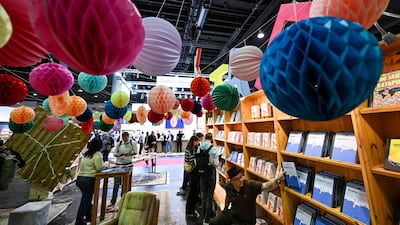

Arabic books are finding new readers in Brazil, India and North Macedonia through a series of translation and co-publishing agreements signed at the Frankfurt Book Fair.
The Abu Dhabi Arabic Language Centre announced 14 projects in seven languages, teaming up with 10 publishing and cultural partners, to mark the first anniversary of Kalima to the World. The programme was launched at last year's fair to support the translation and publication of Emirati and Arab books internationally.
The new projects cover fiction, children's literature, history, heritage and social subjects, with editions planned in Portuguese, Macedonian, Hindi, Urdu, Greek, Spanish and English. Titles and publication dates are expected soon.

North Macedonian publishing house Bata Press, which has released works by Egyptian Nobel laureate Naguib Mahfouz and contemporary Arab authors, is preparing to publish an Emirati novel about life in the UAE before its oil-driven development.

Its publisher, Filip Batkoski, sees cultural connections between North Macedonia and the Arab world, particularly through their shared Ottoman history.
“Actually, we have a lot of shared cultural heritage between the Arab world and North Macedonia. For example, we have been 500 years in the Ottoman Empire. And the Ottoman Empire has, of course, a huge impact from the Arabic world,” he said.
“You cannot believe how many things we have in common between Arab people and us. I would say we are closer to Arab people than to western Europe or the United States.”
The Frankfurt projects also include Hindi and Urdu translations through partnerships with India's National Book Trust and Pakistan's Book Corner and National Book Foundation. Greek publishers Kaktos and Vakxikon are also participating.
The effort to reach more international readers has been extended through a separate agreement signed at the fair between the Abu Dhabi Arabic Language Centre and the Arab Publishers Association, an industry body representing publishers across the Middle East and North Africa.
The partnership aims to expand the catalogue of Arabic titles available for translation and introduce them to international publishers.
Speaking to The National, Mohamed Rashad, president of the association, said the aim was to reverse the "longstanding emphasis on translating foreign literature into Arabic", rather than taking Arabic writing to readers abroad.
“For many years, what we have seen at Arab book fairs is that translation has always been from foreign languages into Arabic,” he said. “Yet we have enormous treasures in our heritage, history and civilisation.”
Arab publishers were invited to nominate two or three books each, after which a specialist committee of writers, critics, translators and other experts examined more than 100 titles for inclusion in the catalogue.
“Every publisher believes their book is the most important and deserves to be translated,” Rashad says. “Of course, that is not necessarily true. There must be certain criteria, and specialists who can make these decisions.”

The catalogue is intended to introduce international publishers to a wider selection of Arab authors, with the centre's support helping to facilitate translation and provide funding.
For Brazilian publisher Leonardo Garzaro, whose company Editora Rua do Sabao is among the partners, the opportunity is as much about challenging perceptions as it is about introducing new authors.
“Many people in Brazil think about the Arab world as just one big thing. Literature can help them to understand, oh, this is the Emirates, this is Egyptian, this is Palestine. So they understand better the region and the different people who build the region,” he said.
His company has already published almost 15 Arabic titles outside the initiative, including Iman Mersal's In the Footsteps of Enayat Al-Zayyat, which won the 2021 Sheikh Zayed Book Award for Literature.
While its treatment of women's rights appealed to him, Garzaro said literary merit did not always translate into commercial appeal.
“Sometimes a book is an award winner but doesn't work in Brazil because it's very specific,” he said. “But sometimes, as a publisher, you just like a book because you think it's important. You need to be brave and take a chance in order to help push your respective market and expand your readership.”
Having worked with Abu Dhabi's publishing representatives for five years, Garzaro says that consistency can determine whether a publisher builds a collection of translated works or abandons plans to enter a new market.
“That reliability is so important. While the budget is great, publishing is ultimately a business based on relationships. It's about building trust and ensuring the person you're dealing with is reliable. That's one of the first things we look for when meeting potential partners, apart from the budget,” he said.

Saeed Al Tunaiji, executive director of the Abu Dhabi Arabic Language Centre, said the growing interest from international publishers was opening new markets for Emirati authors and Arabic literature.
“Usually, Arabic books are translated into one or two languages, but now we are seeing interest in Arabic books and culture from speakers of these other languages,” he said. “Today, different cultures and language communities around the world have a real desire to discover Arabic literature and culture, as well as young, creative Emirati writers.”