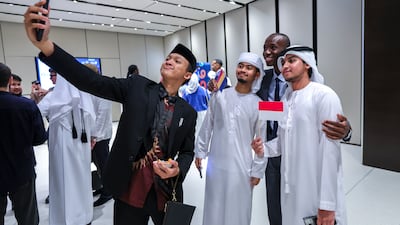

Readers from 69 nationalities gathered at Zayed National Museum in Abu Dhabi for a book club session on Monday that set a new Guinness World Record title.
The event, organised by the Abu Dhabi Arabic Language Centre’s Kalima Reading Club, brought participants together to discuss Bedouin and Abbasid Cultural Identities: The Arabic Majnun Layla Story by Ruqayya Yasmine Khan.
The gathering set the inaugural record, and formed part of the club’s wider work with schools, universities and communities across the UAE.

Saeed Al Tunaiji, executive director of the Abu Dhabi Arabic Language Centre, said the initiative is part of the organisation’s broader effort to engage different sections of society with books and Arabic.
“Encouraging and supporting reading is a fundamental objective,” he told The National. “How can Arabic spread and become stronger in society, in spoken language and in other areas? I think today one of the most important elements supporting this is to focus on reading sessions, on the reading club, and also to attract different age groups.”
The book chosen for the Zayed National Museum session was Khan’s study of Majnun-Layla, a classic love story rooted in seventh-century Arabia. Her book looks at how the story developed and was understood during the Bedouin and Abbasid periods.

Al Tunaiji says its long history was part of the appeal.
“This story and this book deal with the cultural identities of the Bedouin and Abbasid periods, and even the influence of international cultures in shaping regional stories,” he says.
“Today it is a subject with a great deal of passion and interest, something that attracts the public to explore its details and history. There is also an important historical connection: how the story came about, how it developed, how imagination and reality shaped it, and how it became part of Arab society’s identity and culture through these transformations.”
The session continues the work of the Kalima Reading Club, launched in 2018 as part of the Kalima translation project established in 2007, with reading sessions held at schools, universities and public events.
“The club also has activities that take place weekly during the school term through the Kalima Reading Club for Schools,” Al Tunaiji says. “It organises reading sessions in schools and it also organises sessions in universities. So, the idea of the club today revolves around different segments of society.”

The record came on the back of the 35th Abu Dhabi International Book Fair, which ended on Sunday and was also organised by the Abu Dhabi Arabic Language Centre.
While full sales figures are still being studied, Al Tunaiji says attendance at cultural programmes and book-related sessions surpassed expectations.
“The number of people attending doubled compared with what we expected,” he says. “That was one of the real achievements of the fair. The diversity, the momentum and the joy we felt among publishers and the public made us very happy, while the audience described the fair as vibrant, elegant and successful. It also placed a greater responsibility on us for the next stage.”
While the programme is still being devised, Al Tunaiji said the centre will return to Frankfurt Book Fair with the results of the first year of From Kalima to the World, an initiative launched there last year to support the translation of Arabic books into other languages.
“I think we achieved important results and partnerships that can help Arabic books and the Arabic language reach different cultures through translation,” he says.
“We used to cross from other languages into Arabic, and now that movement is going in the other direction as well, from Arabic into the languages of the world.”

