

Most of us swat flies away when they enter our personal space. But Nigara Afsharzadeh would spend hours talking to insects while imprisoned in Iran. “I would chop up the lumps of rice and throw them on the ground to attract an ant or something else, to entertain myself,” she says. “I was overjoyed when a fly appeared. I was careful not to let it leave when the door was open. I followed it around in the cell and talked to it.”
A citizen of Turkmenistan, Afsharzadeh was charged with espionage in Iran in 2014, and sentenced to five years in prison, a year and a half of which was spent in solitary confinement.
Her interview, along with 12 others, appears in White Torture: Interviews with Iranian Women Prisoners, a new book from Oneworld Publications that will be released on Thursday.

The interviews were compiled from prison by Iranian human rights activist Narges Mohammadi, who documented fellow female prisoners’ experiences in solitary confinement. Publishing now for the first time in English, the book features a foreword by Nobel Peace Prize laureate Shirin Ebadi, and an interview with Nazanin Zaghari-Ratcliffe, who was sentenced to five years in prison in 2016 for plotting to topple the Iranian government. She has become the global face of wrongful imprisonment in Iran.
Its release is timely, with the global spotlight currently on women in the Islamic republic after the death of Mahsa Amini and protests against compulsory veiling.
Life in prison
From beetles lining squat toilets within their cells to enormous cockroaches patrolling corridors, insects and inhumane, unsanitary conditions are common among most of the women’s recollections of Evin Prison, where the death penalty if often sought.
Not having committed actual crimes, these women are “prisoners of conscience”, detained for their religious or political views. Many are journalists and human rights activists, while some hail from minority ethnicities or religious sects. All of them have been punished with “white torture”, or solitary confinement, with extreme sensory deprivation, which has been deemed a severe violation of international human rights.
“To be isolated from the passage of time, to be isolated from society, to be removed from the natural cycle of life, and to be thrown into a corner out of reach, is the definition of solitary confinement,” explains former headteacher Mahvash Shahriari, who belongs to the minority Baha’i sect and was sentenced to 20 years.
The women aren’t given pillows or beds — only dirty military blankets, some stained with vomit, recalls Zaghari-Ratcliffe. Their meals consist of bread, cheese and tea in a plastic cup, with an egg or fruit reserved for special occasions.
-

Nazanin Zaghari-Ratcliffe holds a press conference hosted by her local Member of Parliament Tulip Siddiq, in Portcullis House, London, after her release from detention in Iran. PA -

Ms Zaghari-Ratcliffe, pictured with her husband Richard Ratcliffe, called for the release of other dual citizens still held in Iran. PA -
!['What's happened now should have happened six years ago,' she said of her own case. 'I’m not going to let the torch be put down until they [other dual citizens held in Iran] are back home with their families.' PA](https://www.thenationalnews.com/resizer/v2/3HQ4NOTNJBO6OJSX5QVTWY2QAU.jpg?smart=true&auth=094d869f24e19ca0d7645e860a246b4ee522e1c8151c181a56444a73fa0f666c&width=400&height=225)
'What's happened now should have happened six years ago,' she said of her own case. 'I’m not going to let the torch be put down until they [other dual citizens held in Iran] are back home with their families.' PA -
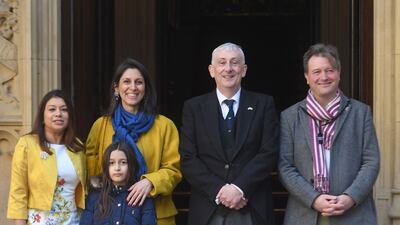
MP Tulip Siddiq, Nazanin Zaghari-Ratcliffe, her daughter Gabriella and her husband Richard Ratcliffe, alongside Speaker of the House of Commons Lindsay Hoyle. AFP -
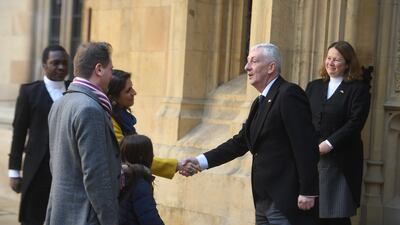
Lindsay Hoyle welcomes Nazanin Zaghari-Ratcliffe to the House of Commons in Westminster, London. EPA -

'I was told many, many times we’re going to get you home,' she said of her six-year ordeal. 'That never happened.' AFP -

Lindsay Hoyle gives a present to Gabriella. Her mother said: 'It has been cruel what happened to me.' AFP


!['What's happened now should have happened six years ago,' she said of her own case. 'I’m not going to let the torch be put down until they [other dual citizens held in Iran] are back home with their families.' PA](https://www.thenationalnews.com/resizer/v2/3HQ4NOTNJBO6OJSX5QVTWY2QAU.jpg?smart=true&auth=094d869f24e19ca0d7645e860a246b4ee522e1c8151c181a56444a73fa0f666c&width=800&height=450)


Trips to the bathroom are regulated and access to showers is sparse. “Our hair became rough like a scrub sponge and couldn’t be combed,” writes Nazila Nouri, who was arrested and beaten in 2018 for being a part of a Sufi order. Her group was also beaten, and many were wounded when imprisoned — some were even electrocuted. “I had been electrocuted so much that I became completely numb. They shocked me from head to toe,” recalls Shokoufeh Yadollah, who was arrested with Nouri.
Gender discrimination amplified
Besides physical torture, Iranian women are vulnerable to a type of mental torture that is meant to embarrass, degrade and shame them. They speak of being forced to bathe and use the bathroom in front of officers and cameras, and being bombarded with vulgar, sexual insults.
Officers pry into their personal lives by scrutinising the chat histories and photo galleries on their laptops and phones, and some women are coerced to confess to sexual charges.
Journalist and women’s rights activist Hengameh Shahidi shares the bizarre yet haunting experience of being stalked and proposed to by her interrogator, even after she is released.
Marzieh Amiri, also journalist and women’s rights activist, who was sentenced to 10 years and 148 lashes, says: “In prison, the interrogator is not merely an interrogator, but a representative of the patriarchal order that silences your voice if you refuse to do what he wants.
“Fear, reprimand, punishment, isolation, intimidation, deprivation and coercion are things that are strongly imposed on you in detention, but you have already experienced that as the logic behind all politics as a woman behind your arrest.”

These women’s roles as spouses, mothers and caretakers are constantly used against them by the interrogators, who are on a relentless mission to extract confessions. Afsharzadeh, who was arrested on the street in front of her children, was told that they had been taken to an orphanage and that her son was dying, and Zaghari-Ratcliffe was told that her husband would abandon her if the interrogation process took too long.
Passing the time
The interrogation processes are lengthy and drawn out, from citing lost files to claiming court date delays, spanning months and, in some cases, years.
With white torture, Amiri explains, there is nothing there to stimulate the mind while you wait — sometimes, all you can do is try to remember and review things from the past, but even those things fade in your memory.
Journalist and political activist Reyhaneh Tabatabai read one 700-page book seven times — after getting through the first 100 pages, she would go back to the beginning to make the book last longer.
“The interrogators advised me to pray in order to pass time in the cell,” she recalls. Most of the cells were equipped with copies of the Quran, and many prisoners speak of reading it repeatedly throughout their confinement.
Zahra Zahtabchi, a sociologist and researcher who is still serving her 10-year sentence, says: “I studied the Quran 14 times carefully and meaningfully over the course of a year. This factor had a tremendous effect on reinforcing my resistance.”
For some, religion plays a positive role in helping to survive solitary confinement, an experience that Sima Kiani compares to being in a monastery. “This was an opportunity that life had given me to think and pray,” she says. “It was a unique, perhaps once-in-a-lifetime experience, agonising but exceptionally spiritual. I hope its good effects will last for the rest of my life.”
The more adverse impacts of imprisonment, however, will forever be imprinted on these women’s bodies and minds. Throughout White Torture, they speak of the heightened anxiety, dizziness, panic attacks, numbness, dramatic weight loss, palpitations, insomnia and memory impairment brought on by solitary confinement. The lack of beds causes bedsores, pelvic joint pain and lifelong backaches. Kiani is almost blind in her left eye, having severe corneal swelling due to anxiety.
And beyond the physical effects, is the lasting mental trauma brought on by white torture. As Mohammadi writes: “Sometimes blisters of wounds from the solitary confinement burst, sometimes they fester, sometimes they burn and sometimes fear leaks into my veins. There is still no end to the invisible and unhealed wounds.”
Scroll through the gallery below to see the latest images of the ongoing protests in Iran
-

Iranians protest in Tehran after the death of 22-year-old Mahsa Amini after she was detained by the morality police in September. AP Photo -
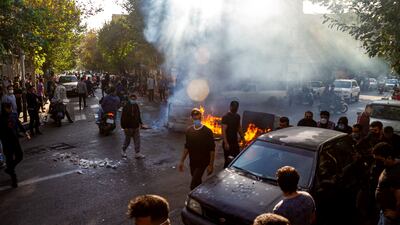
Protests have intensified despite a vicious government crackdown that has left as many as 200 people dead, although estimates of the toll by rights groups vary. AP Photo -
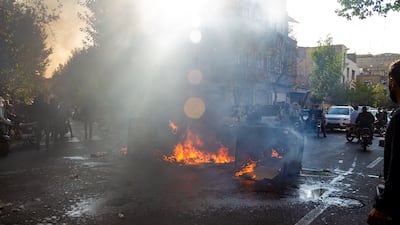
At least eight members of the security forces have also been killed or wounded during the unrest and there are signs that violent resistance could be intensifying. AP Photo -
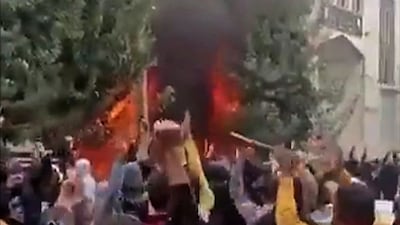
A fire burns at the office of the governor of Mahabad, in the West Azerbaijan province of Iran. AFP -
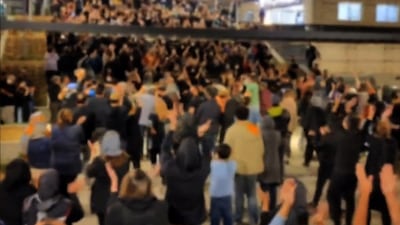
Protesters gather in the a courtyard of Chitgar complex in western Tehran. AFP -

Iranian protesters continue to defy a deadly crackdown by security forces. AFP -

A woman cuts her hair at the grave site of Nika Shahkarami in the city of Khorramabad, during a reported memorial held to mark 40 days since the death of the 16-year-old. AFP -
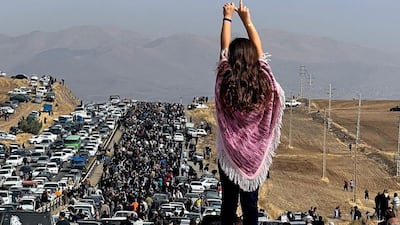
A woman not wearing a headscarf stands on top of a vehicle as thousands make their way towards Saqez, Mahsa Amini's home town, to mark 40 days since her death in police custody. AFP -
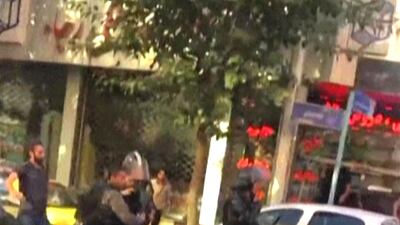
Iranian riot police prepare to confront protesters the capital, Tehran. AFP -

Iranian protesters surge forward amid clashes with riot police in Tehran. AFP -

A crowd blocks an intersection during a protest to mark 40 days since Amini's death in custody. AP Photo -

Iranian police arrive to disperse a protest in Tehran. AP Photo -
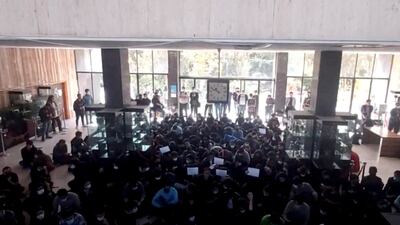
Protesters chant at a vigil for Amini at the Khajeh Nasir Toosi University of Technology in Tehran. Reuters -
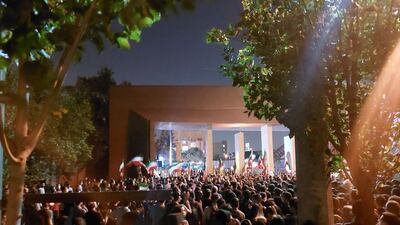
Students at Sharif University of Technology attend a protest. AP Photo -

Police outside Sharif University during a student protest. AP Photo -
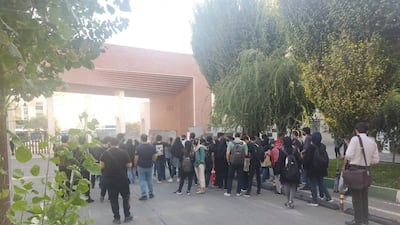
Students at the university protest over the death of Amini, who was in 'morality police' custody for allegedly breaking strict rules on head coverings for women. AP Photo -
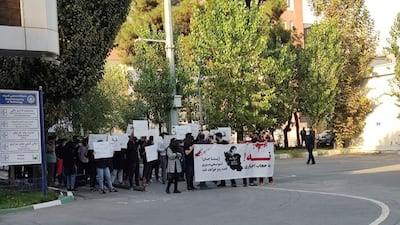
The students' banner says: 'No to mandatory hijab'. AP Photo



