


Novelist Mohammed Alnaas is the first Libyan and the youngest author to win the International Prize for Arabic Fiction, for his debut novel Bread on Uncle Milad's Table, it was announced on Sunday.
Published by Rasham, the book was named the winner of the $50,000 prize, at a ceremony in Abu Dhabi.
In addition to the money, Alnaas, 31, will also receive funding for an English translation of his novel.
Scroll through the gallery below to see photos from the ceremony in Abu Dhabi:
-

Tunisian author Shukri Mabkhout, chairman of the judging panel for the 2022 International Prize for Arabic Fiction, speaks at the awards ceremony held in The Ritz-Carlton, Abu Dhabi. All Photos: Khushnum Bhandari / The National -

An audience member taking photos at the International Prize for Arabic Fiction awards ceremony. -

A representative accepts the award on behalf of Mohammed Alnaas, Libyan writer and winner of the International Prize for Arabic Fiction 2022. Alnaas, the youngest winner in the award's history, receives $50,000. -
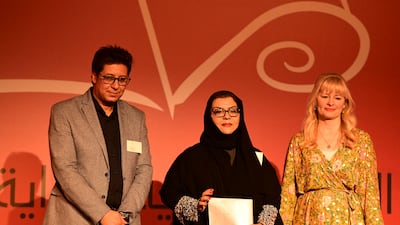
All runners-up win $10,000, including Oman’s Bushra Khalfan for 'Dilshad'. -

Moroccan author Mohsine Loukili accepts his cheque for being shortlisted for 'The Prisoner of the Portuguese'. -

The International Prize for Arabic Fiction held the first in-person prize ceremony since 2020. -

Reem Alkamali, the first Emirati author to be shortlisted for the prize, accepts her cheque. -

Tunisian author and Ipaf judge Shukri Mabkhout speaks. -

Egyptian author Tarek Imam accepts the cheque for 'Cairo Maquette'. -

The 2022 shortlisted nominees on stage together.


Bread on Uncle Milad's Table explores gender roles and notions of masculinity in a remote village in Libya.
After getting engaged to his sweetheart, the title character’s family life becomes the talk of the neighbourhood when Milad indulges in his passion for bread-making, while his fiance Zeinab works to support the household.
Upon learning from his nephew that he is scorned in the village, Milad publicly questions some of the outdated notions of gender and champions the role of individuality in the face of a suspicious community.

Tunisian author Shukri Mabkhout, the 2015 Ipaf award winner and chairman of this year's judging panel, hailed the work for its complexity.
“Its plethora of detail is deftly unified by a gripping narrative. This offers a deep and meticulous critique of prevailing concepts of masculinity and femininity and the division of work between men and women, and the effect of these on both a psychological and social level,” he said.
“It falls into the category of novels which question cultural norms about gender. However, it is embedded in its local Arab context and steers away from any ideological treatment of the issues, as such a treatment would be contrary to the way in which fiction can present multiple points of view.”

Professor Yasir Suleiman, chairman of the award's board of trustees, praised Alnaas's literary flair and for showcasing the dynamism of the Arabic language.
“The language of the novel is an excellent testimony to the malleability of the high register of the Arabic language and its ability to deal with intimate matters of the body and soul with naturalness and ease,” he said.
“Sometimes wistful, but always lyrical, the narrative succeeds in evoking a conflicted cultural fabric that fuses time with place in a Libyan milieu that speaks to and for Arabs everywhere.”
Alnaas's work emerged victorious out of six shortlisted novels, including Rose's Diary by Reem Alkamali.
Set in 1960s Dubai, it is the first Emirati novel to make it to the shortlist.
All shortlisted authors will receive $10,000 for their efforts.
Who is Mohamed Alnaas?
Born in Libya, Alnaas holds an engineering degree from the University of Tripoli and made his literary debut with the Arabic short story collection Blue Blood in 2020.
Speaking to The National prior to the ceremony, he says Bread on Uncle Milad's Table was inspired by his foray into bread-making as a way to cope with the social restrictions of the pandemic.
It was during the practice, where he would go through a kilogram of flour every day, that he began plotting the novel.
“Because I was ignorant of baking techniques, I began to research and learn all the types mentioned in the novel, even croissants, which are one of the most difficult baked goods to make. When I did, the novel opened up for me,” he says.
As for being in the running for one of the Arab world’s most prestigious literary prizes, he hoped the attention and monetary support acts as further encouragement to continue perfecting his craft.
“The reading rate is low [in the Arab world],” he says.
“That is why the novel's arrival at this stage of the Ipaf award means a space of financial stability, in addition to marketing the rest of what I will write in the future.
"As for the book itself, prizes are not the only value from which one can determine the value of a particular book.
“The book’s endurance over time is what makes it valuable. That is why we still read many great novels that did not win prizes.”
Naas, who was unable to make it to the ceremony, is set to make his first public appearance after winning the award on Tuesday at the Abu Dhabi International Book Fair.
He will join fellow nominees for a 7pm session, discussing their respective acclaimed works and inspirations.

