Applications for the Christo and Jeanne-Claude Award, presented by NYU Abu Dhabi (NYUAD) and Abu Dhabi Music and Arts Foundation (ADMAF), are now open.
The award is granted to students and young artists who propose artworks intended to be shown publicly and draw from elements of architecture, installation, photography, video and land art, similar to the work of duo Christo and Jeanne-Claude. During their time, the two produced environmental and installation art, often using everyday materials such as plastic and fabric.
University students or those who have graduated within the last five years must submit their applications online, which should include a nomination by a mentor, whether it is a practicing artist, professor or gallerist. Applicants must also provide details about their proposed artwork, including the production process and costs.
The winner or winners will receive $10,000 to create their work, as well as an additional $5,000 from Christo’s estate. The work will then be presented to the public at NYUAD’s campus in November 2021 before touring other public spaces in the capital.
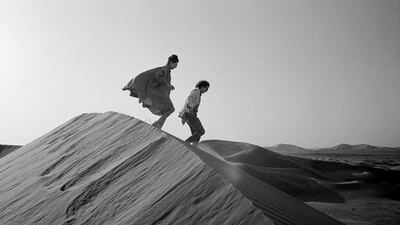
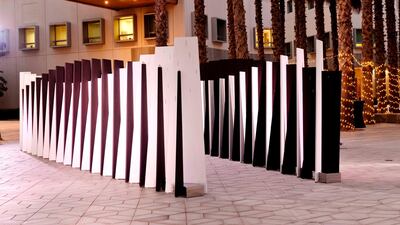
Last year's winners were students from the American University of Sharjah, Falwah Alhouti, Ibrahim Abdellatif, and Omer Al Raee, who created Sila, a black and white installation inspired by the Emirati folkloric dance Al-Ayyalah, where men dance to drum beats and poetic chanting. This sense of unity and rhythm was visually translated in the work, which comprised of two rows of units with alternating heights that tapered towards each other, giving the illusion of movement.
Established in 2012, the Christo and Jeanne-Claude Award is supported under the patronage of Sheikha Shamsa bint Hamdan Al Nahyan. It is named after artists Christo Vladimirov Javacheff and Jeanne-Claude Marie Denat, whose ambitious public works include the wrapping and draping of historical buildings such as the Pont Neuf in Paris and the Reichstag in Berlin in the mid-1980s and 1990s.
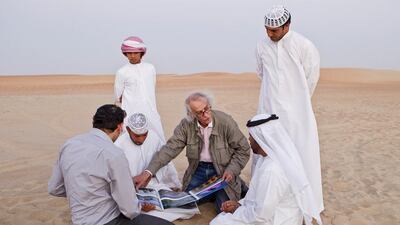
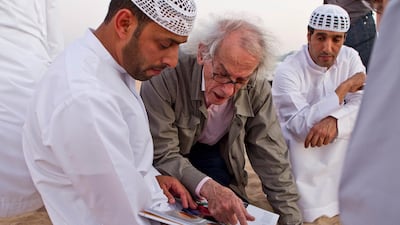
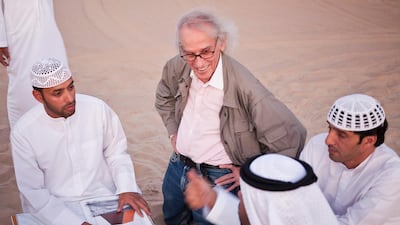
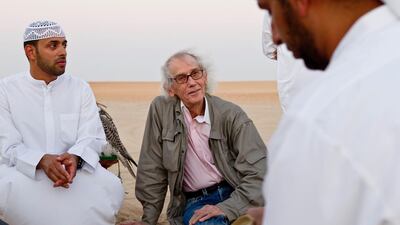
The artist Christo Yavacheff, centre, meets with Liwa residents Khalfan Al Qubasi, left, Saeed Al Falahi, right, and Obaid Al Mazrouei, front right, in October 2012, to discuss his plans to construct The Mastaba, a pyramid of 410,000 barrels. Antonie Robertson / The National
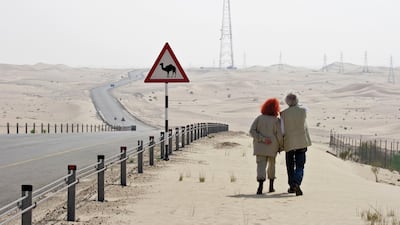
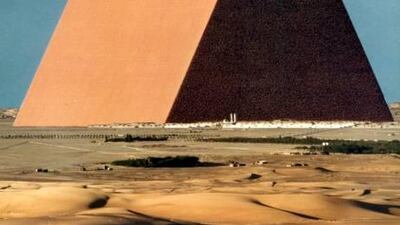
The couple had a special relationship to the UAE, where they intended to install a massive mastaba, or Mesopotamian mud bench, made of 410,000 oil barrels in Abu Dhabi’s Liwa desert. Though the work never came to fruition in the artists’ lifetimes – Jeanne-Claude died in 2009 and Christo in June – they developed a love for the UAE landscape, with Christo in particular travelling to Al Dhafra and Madinat Zayed for research and art workshops.
This appreciation for the emirates also led to his development of the award, which aims to nurture emerging artists in the UAE. Christo would often meet with the students and artists, and in 2018 took two award winners to London to see his work The London Mastaba in Hyde Park. Consisting of 7,506 red and blue barrels, the piece was a smaller-scale version of his Abu Dhabi aspiration.
Before his death, Christo was developing L'Arc de Triomphe, Wrapped, which planned for Paris's Arc de Triomphe to be wrapped in 25,000 square metres of blue fabric and 7,000 metres of red rope. Due to the Covid-19 pandemic, the work is now scheduled to be unveiled in September 2021.
Applications for the ninth edition of the Christo and Jeanne-Claude Award are open until February 4, 2021.
See more images of Christo in the UAE in the gallery below:
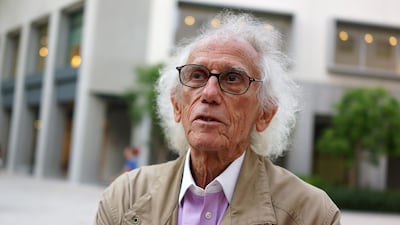
Christo Vladimirov Jaacheff at the unveiling of 'Dunescape', an installation by Anna Kurkova, at NYUAD in Abu Dhabi in 2017. Delores Johnson / The National
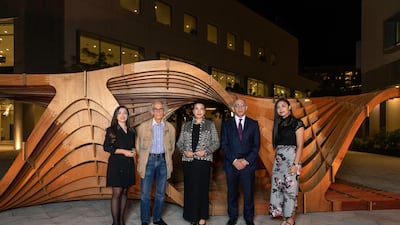
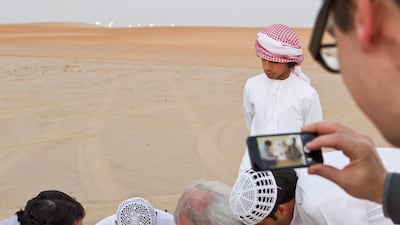
Maram Kassab, Christo, Huda Kanoo, WHO, and Mariam Ayoub in front of the 2018 Christo and Jeanne-Claude Award-winning pavilion
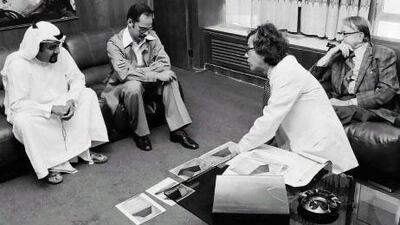
Christo visits the UAE in 1979 to explain the preliminary engineering concept for The Mastaba to officials of the Ministry of Construction.
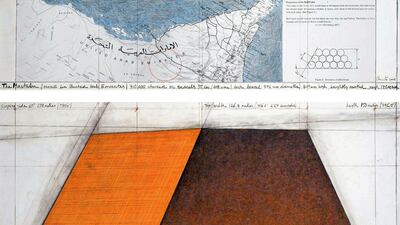
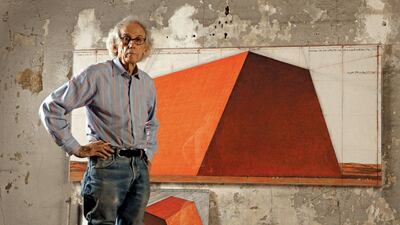
A 2009 drawing showing the concept for Christo's 'The Mastaba' project in the UAE. Photo by Wolfgang Volz
Christo and Jeanne-Claude scout for locations for the site of 'The Mastaba' in October 2007. Photo by Wolfgang Volz
Christo and Jeanne-Claude looking for a possible site for 'The Mastaba' in February 1982. Photo by Wolfgang Volz
A collage, from 1979, showing how 'The Mastaba' would appear in the Liwa desert. Photo by Wolfgang Volz
Christo meets with Liwa residents Khalfan Al Qubasi, left, Saeed Al Falahi, right, and Obaid Al Mazrouei, front right, in October 2012, to discuss his plans to construct 'The Mastaba', a pyramid of 410,000 barrels. Antonie Robertson / The National
Christo in his studio with a preparatory drawing for 'The Mastaba' Courtesy Christo and the Maeght Foundation
Christo with Mohammed bin Azzan Al Mazrouei, the director general of the Western Region Development Council. Delores Johnson / The National
Christo Yavacheff (centre), meets with Liwa residents Khalfan Al Qubasi (L) and Saeed Al Falahi (R) to discuss his plans to construct in Liwa a pyramid of 415,000 oil drums that will be bigger than the main pyramid of giza. Antonie Robertson / The National
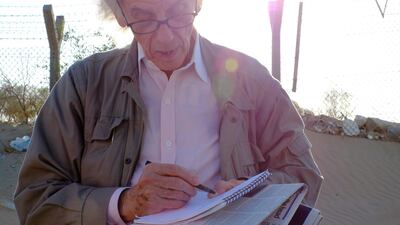
Christo Yavacheff sketches out his plans to construct in Liwa a pyramid of 415,000 oil drums that will be bigger than the main pyramid of giza. Antonie Robertson / The National
Christo with Khalfan Al Qubasi, left, Saeed Al Falahi, right, and Obaid Al Mazrouei, front right, in Liwa. Antonie Robertson / The National
Christo meets with Liwa residents Khalfan Al Qubasi, left, and Saeed Al Falahi, right. Antonie Robertson / The National
Christo Yavacheff (centre), meets with Liwa residents Khalfan Al Qubasi (L) to discuss his plans to construct in Liwa a pyramid of 415,000 oil drums that will be bigger than the main pyramid of giza. Antonie Robertson / The National
A lesson in simple, seasonal eating. Wedges of tomato, chunks of cucumber, thinly sliced red onion, coriander or parsley leaves, and perhaps some fresh dill are drizzled with a crushed walnut and garlic dressing. Do consider yourself warned: if you eat this salad in Georgia during the summer months, the tomatoes will be so ripe and flavourful that every tomato you eat from that day forth will taste lacklustre in comparison.
Badrijani nigvzit
A delicious vegetarian snack or starter. It consists of thinly sliced, fried then cooled aubergine smothered with a thick and creamy walnut sauce and folded or rolled. Take note, even though it seems like you should be able to pick these morsels up with your hands, they’re not as durable as they look. A knife and fork is the way to go.
Pkhali
This healthy little dish (a nice antidote to the khachapuri) is usually made with steamed then chopped cabbage, spinach, beetroot or green beans, combined with walnuts, garlic and herbs to make a vegetable pâté or paste. The mix is then often formed into rounds, chilled in the fridge and topped with pomegranate seeds before being served.
Notable cricketers and political careers
India: Kirti Azad, Navjot Sidhu and Gautam Gambhir (rumoured)
Pakistan: Imran Khan and Shahid Afridi (rumoured)
Sri Lanka: Arjuna Ranatunga, Sanath Jayasuriya, Tillakaratne Dilshan (rumoured)
Bangladesh (Mashrafe Mortaza)
Skoda Superb Specs
Engine: 2-litre TSI petrol
Power: 190hp
Torque: 320Nm
Price: From Dh147,000
Available: Now
The specs
Engine: 3.0-litre 6-cyl turbo
Power: 374hp at 5,500-6,500rpm
Torque: 500Nm from 1,900-5,000rpm
Transmission: 8-speed auto
Fuel consumption: 8.5L/100km
Price: from Dh285,000
On sale: from January 2022
What is a black hole?
1. Black holes are objects whose gravity is so strong not even light can escape their pull
2. They can be created when massive stars collapse under their own weight
3. Large black holes can also be formed when smaller ones collide and merge
4. The biggest black holes lurk at the centre of many galaxies, including our own
5. Astronomers believe that when the universe was very young, black holes affected how galaxies formed
Once the domain of newspaper home deliveries, subscription model retailing has combined with e-commerce to permeate myriad products and services.
The concept has grown tremendously around the world and is forecast to thrive further, according to UnivDatos Market Insights’ report on recent and predicted trends in the sector.
The global subscription e-commerce market was valued at $13.2 billion (Dh48.5bn) in 2018. It is forecast to touch $478.2bn in 2025, and include the entertainment, fitness, food, cosmetics, baby care and fashion sectors.
The report says subscription-based services currently constitute “a small trend within e-commerce”. The US hosts almost 70 per cent of recurring plan firms, including leaders Dollar Shave Club, Hello Fresh and Netflix. Walmart and Sephora are among longer established retailers entering the space.
UnivDatos cites younger and affluent urbanites as prime subscription targets, with women currently the largest share of end-users.
That’s expected to remain unchanged until 2025, when women will represent a $246.6bn market share, owing to increasing numbers of start-ups targeting women.
Personal care and beauty occupy the largest chunk of the worldwide subscription e-commerce market, with changing lifestyles, work schedules, customisation and convenience among the chief future drivers.
Words come easy for aspiring writer Afra Al Muhairb. The business side of books, on the other hand, is entirely foreign to the 16-year-old Emirati. So, she followed her father’s advice and enroled in the Abu Dhabi Education Council’s summer entrepreneurship course at Abu Dhabi University hoping to pick up a few new skills.
“Most of us have this dream of opening a business,” said Afra, referring to her peers are “young girls thinking of big ideas.”
In the three-week class, pupils are challenged to come up with a business and develop an operational and marketing plan to support their idea. But, the learning goes far beyond sales and branding, said teacher Sonia Elhaj.
“It’s not only about starting up a business, it’s all the meta skills that goes with it -- building self confidence, communication,” said Ms Elhaj. “It’s a way to coach them and to harness ideas and to allow them to be creative. They are really hungry to do this and be heard. They are so happy to be actually doing something, to be engaged in creating something new, not only sitting and listening and getting new information and new knowledge. Now they are applying that knowledge.”
Afra’s team decided to focus their business idea on a restaurant modelled after the Leaning Tower of Pisa. Each level would have a different international cuisine and all the meat would be halal. The pupils thought of this after discussing a common problem they face when travelling abroad.
“Sometimes we find the struggle of finding halal food, so we just eat fish and cheese, so it’s hard for us to spend 20 days with fish and cheese,” said Afra. “So we made this tower so every person who comes – from Africa, from America – they will find the right food to eat.”
The company offers payments/bribes to win key contracts in the Middle East
May 2017
The UK SFO officially opens investigation into Petrofac’s use of agents, corruption, and potential bribery to secure contracts
September 2021
Petrofac pleads guilty to seven counts of failing to prevent bribery under the UK Bribery Act
October 2021
Court fines Petrofac £77 million for bribery. Former executive receives a two-year suspended sentence
December 2024
Petrofac enters into comprehensive restructuring to strengthen the financial position of the group
May 2025
The High Court of England and Wales approves the company’s restructuring plan
July 2025
The Court of Appeal issues a judgment challenging parts of the restructuring plan
August 2025
Petrofac issues a business update to execute the restructuring and confirms it will appeal the Court of Appeal decision
October 2025
Petrofac loses a major TenneT offshore wind contract worth €13 billion. Holding company files for administration in the UK. Petrofac delisted from the London Stock Exchange