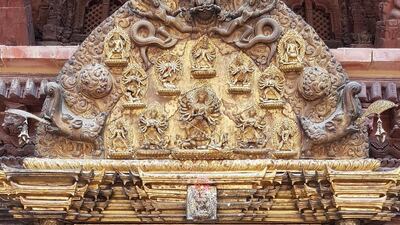
A total of 12 bronze figures were once part the 16th century torona at the south door of Mulchok of the Taleju Bhavani Temple in Patan. The stolen figures were replaced with replicas in 2013. Courtesy Lost Arts of Nepal
A total of 12 bronze figures were once part the 16th century torona at the south door of Mulchok of the Taleju Bhavani Temple in Patan. The stolen figures were replaced with replicas in 2013. Courtesy

Nepalese figures withdrawn from Bonhams auction after identified as looted art


Alexandra Chaves
  • English
  • Arabic

A total of five gilded copper-bronze Nepalese sculptures were withdrawn from a Bonhams auction in Paris after it was discovered that they were looted from a temple in the 1980s.

The sculptures were included in an online auction of Himalayan and Buddhist art at Bonhams, which is ongoing until June 10. According to the website of the auction house, the lots in the sale include “Deities and Buddhas, Thangkas, Stupas, Ritual Ornaments and Aprons – all dated between the 3rd and 19th century, and collected during the 1960s and 1970s by a private European collector.”

The consignor, however, decided to withdraw five gilded figures, which were priced between €3,000 to €5,000 ($3,650 to $6,100) each, after the organisation Lost Arts of Nepal pointed out that they were stolen on their Facebook page.

The five gilded figures are among 12 embedded in a torana, or arched gateway, at the south door of Mulchok of the Taleju Bhavani Temple in Patan. The frieze dates back to the 16th century.

The original pieces were documented in the early 1970s by Indian art historian BN Banerjee before they were stolen from the site in 1984, eventually making their way to auction houses in Europe.

Nepali Times, which first reported the story about the looted items, stated that the thefts were recorded in a 1989 book titled Gods are Leaving the Country: Art Theft from Nepal by German scholar Jurgen Schick.

In the book, Schick describes the incident "one of the most odious cases of art theft in Nepal was the plundering of the torana of the Taleju Bhavani temple in the royal palace of Patan".

Following Lost Arts of Nepal's findings and the newspaper report, Nepal's Ministry of Foreign Affairs and the Nepal office of Unesco called on Bonhmans and the French government to return the objects. Though the consignor has now withdrawn the figures, The Art Newspaper reported that he did not respond to the question of whether he would negotiate with the Nepalese claimants.

Lost Arts of Nepal details the objects that were looted from the Mulchok of Patan’s Taleju temple in the 1970s and 1980s. Courtesy Lost Arts of Nepal on Facebook

On its Facebook page, the Lost Arts of Nepal showed side-by-side comparisons of images of the original torana from the early 1970s that still had the bronzes and the empty frieze after the objects were stolen.

The organisation also showed images of the bronzes that were on sale at Bonhams, pointing out that they match the figures on the original gateway. Currently, the torana in Nepal features 12 replicas of the original that were placed in 2013.

Recently, there have been cases of reparations of stolen objects from collectors and museums to Nepal, including the return of an 800-year-old Laxmi-Narayan figure in April. The object was stolen from its shrine in Patan’s Pakto Tole in 1984. Though it appeared at a Sotheby’s auction in 1990, it disappeared again and only resurfaced in 2007, when it was displayed at the Dallas Museum of Art.


Tips for used car buyers
  • Choose cars with GCC specifications
  • Get a service history for cars less than five years old
  • Don’t go cheap on the inspection
  • Check for oil leaks
  • Do a Google search on the standard problems for your car model
  • Do your due diligence. Get a transfer of ownership done at an official RTA centre
  • Check the vehicle’s condition. You don’t want to buy a car that’s a good deal but ends up costing you Dh10,000 in repairs every month
  • Validate warranty and service contracts with the relevant agency and and make sure they are valid when ownership is transferred
  • If you are planning to sell the car soon, buy one with a good resale value. The two most popular cars in the UAE are black or white in colour and other colours are harder to sell

Tarek Kabrit, chief executive of Seez, and Imad Hammad, chief executive and co-founder of CarSwitch.com

Specs

Engine: Dual-motor all-wheel-drive electric

Range: Up to 610km

Power: 905hp

Torque: 985Nm

Price: From Dh439,000

Available: Now

Zodi%20%26%20Tehu%3A%20Princes%20Of%20The%20Desert
%3Cp%3E%3Cstrong%3EDirector%3A%20%3C%2Fstrong%3EEric%20Barbier%26nbsp%3B%3C%2Fp%3E%0A%3Cp%3E%3Cstrong%3EStarring%3A%20%3C%2Fstrong%3EYoussef%20Hajdi%2C%20Nadia%20Benzakour%2C%20Yasser%20Drief%3C%2Fp%3E%0A%3Cp%3E%3Cstrong%3ERating%3A%3C%2Fstrong%3E%204%2F5%3C%2Fp%3E%0A
How Apple's credit card works

The Apple Card looks different from a traditional credit card — there's no number on the front and the users' name is etched in metal. The card expands the company's digital Apple Pay services, marrying the physical card to a virtual one and integrating both with the iPhone. Its attributes include quick sign-up, elimination of most fees, strong security protections and cash back.

What does it cost?

Apple says there are no fees associated with the card. That means no late fee, no annual fee, no international fee and no over-the-limit fees. It also said it aims to have among the lowest interest rates in the industry. Users must have an iPhone to use the card, which comes at a cost. But they will earn cash back on their purchases — 3 per cent on Apple purchases, 2 per cent on those with the virtual card and 1 per cent with the physical card. Apple says it is the only card to provide those rewards in real time, so that cash earned can be used immediately.

What will the interest rate be?

The card doesn't come out until summer but Apple has said that as of March, the variable annual percentage rate on the card could be anywhere from 13.24 per cent to 24.24 per cent based on creditworthiness. That's in line with the rest of the market, according to analysts

What about security? 

The physical card has no numbers so purchases are made with the embedded chip and the digital version lives in your Apple Wallet on your phone, where it's protected by fingerprints or facial recognition. That means that even if someone steals your phone, they won't be able to use the card to buy things.

Is it easy to use?

Apple says users will be able to sign up for the card in the Wallet app on their iPhone and begin using it almost immediately. It also tracks spending on the phone in a more user-friendly format, eliminating some of the gibberish that fills a traditional credit card statement. Plus it includes some budgeting tools, such as tracking spending and providing estimates of how much interest could be charged on a purchase to help people make an informed decision. 

* Associated Press 

Indoor cricket in a nutshell

Indoor Cricket World Cup - Sep 16-20, Insportz, Dubai

16 Indoor cricket matches are 16 overs per side

8 There are eight players per team

There have been nine Indoor Cricket World Cups for men. Australia have won every one.

5 Five runs are deducted from the score when a wickets falls

Batsmen bat in pairs, facing four overs per partnership

Scoring In indoor cricket, runs are scored by way of both physical and bonus runs. Physical runs are scored by both batsmen completing a run from one crease to the other. Bonus runs are scored when the ball hits a net in different zones, but only when at least one physical run is score.

Zones

A Front net, behind the striker and wicketkeeper: 0 runs

B Side nets, between the striker and halfway down the pitch: 1 run

Side nets between halfway and the bowlers end: 2 runs

Back net: 4 runs on the bounce, 6 runs on the full