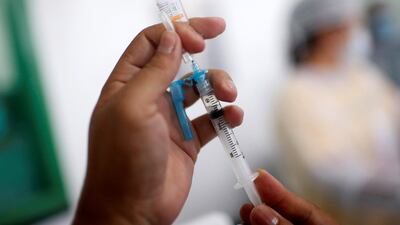
A health worker prepares a coronavirus disease vaccine shot as the UK considers targeting new groups. Reuters

Museums in the UK and Italy to turn into vaccine centres


  • English
  • Arabic

As countries around the world are rolling out their Covid-19 vaccination programmes, museums are being turned into vaccine centres.

As museums remain closed owing to coronavirus restrictions in the UK and Europe, institutions such as the Science Museum in London and Castello di Rivoli Museum of Contemporary Art in Italy will use their spaces as vaccination hubs, The Art Newspaper reports.

In December, the Thackray Museum of Medicine in Leeds became one of the first UK museums to adapt its conference centre into a centre for people to receive the Pfizer-BioNTech vaccine. The first rollout was open to patients over 80, care home staff and the UK's National Health Service (NHS) staff.

Since then, other museums have followed suit, including the Science Museum in west London, which is currently drawing up plans to transform its space as a vaccine hub with the NHS and local authorities. The vaccination centre is expected to be operational in February.

Meanwhile, the Black Country Living Museum in Dudley is scheduled to welcome visitors for vaccinations at the end of the month.

The UK has been battling a surge in Covid-19 cases since the end of 2020 after a new, more infectious strain was detected. This led to the return of a national lockdown, causing retail stores and cultural spaces to shutter again.

The British government is currently conducting its biggest mass vaccination programme, planning to vaccinate 15 million people by mid-February and an additional 21 million people by autumn. The UK has recorded more than 91,000 deaths from the virus at the time of writing.

In Italy, a representative for the Castello di Rivoli told The Art Newspaper that the museum will open as a vaccine centre within the next month, after medical staff in hospital and those in old age homes have been inoculated.

This month, Italy has delivered 1.4 million doses of vaccine to its population, putting it ahead of other countries in the EU. At one point during the pandemic, the country was the hardest hit on the continent, with recorded deaths now above 83,000 at the time of writing.


Match info

Uefa Champions League Group H

Juventus v Valencia, Tuesday, midnight (UAE)

Florida: The critical Sunshine State

Though mostly conservative, Florida is usually always “close” in presidential elections. In most elections, the candidate that wins the Sunshine State almost always wins the election, as evidenced in 2016 when Trump took Florida, a state which has not had a democratic governor since 1991. 

Joe Biden’s campaign has spent $100 million there to turn things around, understandable given the state’s crucial 29 electoral votes.

In 2016, Mr Trump’s democratic rival Hillary Clinton paid frequent visits to Florida though analysts concluded that she failed to appeal towards middle-class voters, whom Barack Obama won over in the previous election.

Mercer, the investment consulting arm of US services company Marsh & McLennan, expects its wealth division to at least double its assets under management (AUM) in the Middle East as wealth in the region continues to grow despite economic headwinds, a company official said.

Mercer Wealth, which globally has $160 billion in AUM, plans to boost its AUM in the region to $2-$3bn in the next 2-3 years from the present $1bn, said Yasir AbuShaban, a Dubai-based principal with Mercer Wealth.

Within the next two to three years, we are looking at reaching $2 to $3 billion as a conservative estimate and we do see an opportunity to do so,” said Mr AbuShaban.

Mercer does not directly make investments, but allocates clients’ money they have discretion to, to professional asset managers. They also provide advice to clients.

“We have buying power. We can negotiate on their (client’s) behalf with asset managers to provide them lower fees than they otherwise would have to get on their own,” he added.

Mercer Wealth’s clients include sovereign wealth funds, family offices, and insurance companies among others.

From its office in Dubai, Mercer also looks after Africa, India and Turkey, where they also see opportunity for growth.

Wealth creation in Middle East and Africa (MEA) grew 8.5 per cent to $8.1 trillion last year from $7.5tn in 2015, higher than last year’s global average of 6 per cent and the second-highest growth in a region after Asia-Pacific which grew 9.9 per cent, according to consultancy Boston Consulting Group (BCG). In the region, where wealth grew just 1.9 per cent in 2015 compared with 2014, a pickup in oil prices has helped in wealth generation.

BCG is forecasting MEA wealth will rise to $12tn by 2021, growing at an annual average of 8 per cent.

Drivers of wealth generation in the region will be split evenly between new wealth creation and growth of performance of existing assets, according to BCG.

Another general trend in the region is clients’ looking for a comprehensive approach to investing, according to Mr AbuShaban.

“Institutional investors or some of the families are seeing a slowdown in the available capital they have to invest and in that sense they are looking at optimizing the way they manage their portfolios and making sure they are not investing haphazardly and different parts of their investment are working together,” said Mr AbuShaban.

Some clients also have a higher appetite for risk, given the low interest-rate environment that does not provide enough yield for some institutional investors. These clients are keen to invest in illiquid assets, such as private equity and infrastructure.

“What we have seen is a desire for higher returns in what has been a low-return environment specifically in various fixed income or bonds,” he said.

“In this environment, we have seen a de facto increase in the risk that clients are taking in things like illiquid investments, private equity investments, infrastructure and private debt, those kind of investments were higher illiquidity results in incrementally higher returns.”

The Abu Dhabi Investment Authority, one of the largest sovereign wealth funds, said in its 2016 report that has gradually increased its exposure in direct private equity and private credit transactions, mainly in Asian markets and especially in China and India. The authority’s private equity department focused on structured equities owing to “their defensive characteristics.”

The%20specs%3A%202024%20Mercedes%20E200
%3Cp%3E%3Cstrong%3EEngine%3A%20%3C%2Fstrong%3E2.0-litre%20four-cyl%20turbo%20%2B%20mild%20hybrid%0D%3Cbr%3E%3Cstrong%3EPower%3A%20%3C%2Fstrong%3E204hp%20at%205%2C800rpm%20%2B23hp%20hybrid%20boost%0D%3Cbr%3E%3Cstrong%3ETorque%3A%20%3C%2Fstrong%3E320Nm%20at%201%2C800rpm%20%2B205Nm%20hybrid%20boost%0D%3Cbr%3E%3Cstrong%3ETransmission%3A%20%3C%2Fstrong%3E9-speed%20auto%0D%3Cbr%3E%3Cstrong%3EFuel%20consumption%3A%20%3C%2Fstrong%3E7.3L%2F100km%0D%3Cbr%3E%3Cstrong%3EOn%20sale%3A%20%3C%2Fstrong%3ENovember%2FDecember%0D%3Cbr%3E%3Cstrong%3EPrice%3A%20%3C%2Fstrong%3EFrom%20Dh205%2C000%20(estimate)%3C%2Fp%3E%0A