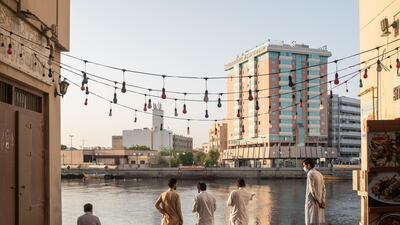
Mohamed Somji photographed Bur Dubai in May 2020, when movement was limited. Courtesy Mohamed Somji

How artists in the UAE have changed the way they work amid the pandemic


Melissa Gronlund
  • English
  • Arabic

How has creating art changed in the pandemic? It may be too early to ask this question, as we could only be in limbo before a second wave of coronavirus infections emerges. But five months in, Covid-19 has caused significant changes for artists.

Photographers were unable to go out and capture images because of movement restrictions, and are only now returning to discover new challenges. Artists whose work is a social practice, such as bringing people together for discussions and shared experiences, are learning to cope with new restrictions. And those with studios are learning to get by without feedback from other people.

The past five months have also been a journey – internal rather than cartographic. This emotional trajectory, though individually experienced, seems in retrospect to be a common feeling. Many recall an early feeling of frenzy, with the deluge of online cultural programming, as well as what Saudi Arabian artist Hadil Moufti calls the “banana bread time”, when the baked loaf became “symbolic of trying to make a home”. Now, the re-emergence of normal life comes with confusion around what “normal” means, after months of discovering a slower pace of life.  

Over the past few weeks, The National has spoken to a number of UAE artists from various fields, to ask them what has changed in their work since the onset of the coronavirus crisis.

Nearly all bristled at the idea that having to stay at home should make them more productive. But all of them have kept making artworks, often revisiting old media such as painting or drawing, or finding subjects that are surprising, even to themselves.  

Hadil Moufti

For many artists in the UAE, the coronavirus came in one distinct, calamitous form: the cancellation of Art Dubai and the events that surround it. As part of her first participation at the fair, Moufti was meant to show a new work in the Saudi Arabian art space Hafez Gallery's booth: the large-scale Le Village de ma Mere. The drawn-and-pasted collage was made of the elements of a pendant that her father, a diplomat, gave her mother while they were living in Cameroon.

Saudi Arabian artist Hadil Moufti in Dubai, where she now lives, photographed by Lebanese artist Camile Zakharia, as part of the latter's 'Photos a la Chair' series (2019). Courtesy Hadil Moufti

"I put all my mental strength and energy into the work," she says. "It was really exciting, but also stressful, as I wanted to do my best. And then, Art Dubai was cancelled. The hardest thing was that the work was almost finished. I had to leave it at Tashkeel, and it's waiting there for me. It's covered in plastic and looks like a big ghost in my studio."

A few months into the pandemic, Moufti began working again, responding to a subject that she had not yet broached: the death of her father. He died a decade ago, she says, during a time eerily similar to that of the coronavirus: when there was a temporary suspension of air travel caused by the eruption of the Eyjafjallajokull volcano in Iceland in April 2010. Moufti was in Jamaica then, and could not return to Madinah to lay him to rest. 

An image of Hadil Moufti's desk, featuring a collage work in progress of a minaret of the Grand Mosque of Madinah, where her father was buried 10 years ago. Courtesy Hadil Moufti

Now she is making a series called Medina Minaret, of collages and drawings of a minaret at the Grand Mosque of Madinah, where her father is buried. For Resting, Heart Rate, part of the series, she traced the minaret in different scales, arranging the towers as if they are the spikes of an ECG heart-rate monitor. The minarets look almost fantastical, with bulges that evoke the contours of a body as much as the sterile spikes on a machine.

“It has been calming,” Moufti says. “It’s always so therapeutic working, with the repetition and the cutting, the gluing, the drawing of the same image. And I’m able to think about my dad in a positive way.”

Nadine Ghandour

Covid-19 restrictions have particularly weighed on artists whose work is not wholly studio-based. Nadine Ghandour, for example, an Egyptian artist who grew up in the UAE, is fascinated by a daily part of Gulf life: driving. In a series of small, attenuated Plasticine sculptures she made during the The Salama bint Hamdan Emerging Artists Fellowship programme in 2018, Ghandour captured what one sees while in a car, rendering the partial attention given to surroundings as a mix of surreal scales: the bank-like curve of a highway barrier; shadows of trees; lane dividers; advertisement hoardings rendered in miniature.

UAE artist Nadine Ghandour's work typically investigates movement. While self-isolating at home, she turned her attention to the outlines of her room. This image shows a drawing she placed next to her door. Courtesy Nadine Ghandour

Since then, Ghandour has remained compelled by movement, collecting writings on aeronautics, flying objects and flight systems. But this interest hit a literal stumbling block when the pandemic confined her to her home. Eventually, she started drawing again, a practice she studied, but dropped, and making new sculptures, which she calls replicas, in Plasticine.

These reflected not movement, but the overlooked edges of her space – corners, skirting boards, or a brush she installed under the balcony door – or emphasised, in long, semi-gridded abstractions, its dimensions. 

Ghandour says a major effect of the coronavirus has been the social isolation. "I miss being in the studio, where I might leave a replica of something out," she says.

“Sometimes it would not work, but sometimes people would come to the studio and you would realise you got the replica right. Having social gatherings around your work was really nice, especially if you are not showing or exhibiting all the time. That has gone away.”

Talin Hazbar 

Syrian architect and artist Talin Hazbar grew up in the UAE. She has been working on collaborative projects with labourers and fishermen in Sharjah, and found herself adapting to their schedule. She became attuned, like the fishermen, to the natural rhythm of the day. 

Syrian artist Talin Hazbar has found life's rhythms to have changed while in self-isolation. Courtesy Warehouse421

“Even looking at the sunset and the sunrise is completely different now,” Hazbar says. “Fishing is all about these timings. They go out at sunrise, around 5am, and then after sunset there is a feeling that everything stops, and it’s more about cleaning for the next day. That is, if they are going out on the boat, and they might not go because of the waves or the weather.” 

The fluctuating schedules of the fishermen reflect, she says, the uncertainty that accompanies life under a pandemic more generally.

“There is a realisation that we plan, but you cannot really plan,” Hazbar says. “And that is how I feel we are living now. As much as you want to plan, but it’s really more day to day.” 

Mohamed Somji

For those whose work relies on leaving the studio, quarantine was felt more keenly. Dubai photographer Mohamed Somji captures images on commission as well as out in the field. He is well-known for his photographs of migrant workers in places such as Deira and Satwa, where he visits parks on a Friday when it is their day off. Somji's photos have become testimonies to the experiences of people in Dubai and provide a more nuanced image of immigrant life in the city.

Photographer Mohamed Somji. Courtesy Tamara Abdul Hadi

“People come together in a variety of ways for recreation, sport, cooking and cultural activities,” he says. “They forge connections with people from back home or make new relationships and friends.” 

Now, visitors have returned to the parks, and Somji, too, is back photographing them. But he has encountered new challenges in a post-coronavirus environment.

“I remember getting some really nice photos, and they were people who were wearing their masks around their necks,” he says. “But I felt, this person might get in trouble, or people might look at that picture and say, oh look at this group of men, they are very reckless with not wearing masks. And that’s not the case.”

Mohamed Somji photographed Bur Dubai in May when movement was limited. Mohamed Somji

Somji says there are new responsibilities that come with shooting during the pandemic. Public anxiety around the spread of infection often translates into assumptions about which members of the Dubai community might not be following the rules, and he is keen to represent how seriously restrictions are being taken everywhere. 

“What is also great is I don’t see the spirit of coming together being dampened,” he adds.” People are finding these ways to convene together, being safe, but still connecting.”

Tarek Al Ghoussein

For Palestinian photographer Tarek Al Ghoussein, the pandemic has brought his work almost to a standstill. For the past four years, he has been working on one project, Odysseus, in which he aims to photograph all 214 of Abu Dhabi's islands. This year he had taken a sabbatical from teaching at NYUAD in order to finish it. 

"I don't want to complain," Al Ghoussein says. "But it has not been good timing."

Tarek Al Ghoussein at the exhibition of his ongoing work 'Odysseus', at Warehouse 421 in 2018. Reem Mohammed / The National

Al Ghoussein has photographed about half of the islands so far, from uninhabited land masses to those that the Environment Agency Abu Dhabi and other ministries helped him get access to. For months, he was waiting for work to start again.

He is, however, no stranger to long-haul projects. From 2014 to 2017, Al Ghoussein photographed the sprawling Modernist complex Al Sawaber in Kuwait, which was built as social housing in the 1970s and was earmarked for demolition. (It has since been destroyed.) He photographed every apartment in the complex, showing the research-driven, even taxonomic underpinnings of his practice.

After months in isolation, Tarek Al Ghoussein has been able to go out and shoot images of Abu Dhabi's islands for his 'Odysseus' project. Courtesy Tarek Al Ghoussein

When we spoke in mid-July, he had just returned from his first shoot for Odysseus in five months. He had been to Al Alia Island, which has a handful of residences and is only accessible by boat. He took some images, with his camera and with a drone. I ask him how it felt to get back to work. 

“Amazing,” he says.

Where to donate in the UAE

The Emirates Charity Portal

You can donate to several registered charities through a “donation catalogue”. The use of the donation is quite specific, such as buying a fan for a poor family in Niger for Dh130.

The General Authority of Islamic Affairs & Endowments

The site has an e-donation service accepting debit card, credit card or e-Dirham, an electronic payment tool developed by the Ministry of Finance and First Abu Dhabi Bank.

Al Noor Special Needs Centre

You can donate online or order Smiles n’ Stuff products handcrafted by Al Noor students. The centre publishes a wish list of extras needed, starting at Dh500.

Beit Al Khair Society

Beit Al Khair Society has the motto “From – and to – the UAE,” with donations going towards the neediest in the country. Its website has a list of physical donation sites, but people can also contribute money by SMS, bank transfer and through the hotline 800-22554.

Dar Al Ber Society

Dar Al Ber Society, which has charity projects in 39 countries, accept cash payments, money transfers or SMS donations. Its donation hotline is 800-79.

Dubai Cares

Dubai Cares provides several options for individuals and companies to donate, including online, through banks, at retail outlets, via phone and by purchasing Dubai Cares branded merchandise. It is currently running a campaign called Bookings 2030, which allows people to help change the future of six underprivileged children and young people.

Emirates Airline Foundation

Those who travel on Emirates have undoubtedly seen the little donation envelopes in the seat pockets. But the foundation also accepts donations online and in the form of Skywards Miles. Donated miles are used to sponsor travel for doctors, surgeons, engineers and other professionals volunteering on humanitarian missions around the world.

Emirates Red Crescent

On the Emirates Red Crescent website you can choose between 35 different purposes for your donation, such as providing food for fasters, supporting debtors and contributing to a refugee women fund. It also has a list of bank accounts for each donation type.

Gulf for Good

Gulf for Good raises funds for partner charity projects through challenges, like climbing Kilimanjaro and cycling through Thailand. This year’s projects are in partnership with Street Child Nepal, Larchfield Kids, the Foundation for African Empowerment and SOS Children's Villages. Since 2001, the organisation has raised more than $3.5 million (Dh12.8m) in support of over 50 children’s charities.

Noor Dubai Foundation

Sheikh Mohammed bin Rashid Al Maktoum launched the Noor Dubai Foundation a decade ago with the aim of eliminating all forms of preventable blindness globally. You can donate Dh50 to support mobile eye camps by texting the word “Noor” to 4565 (Etisalat) or 4849 (du).

Mrs%20Chatterjee%20Vs%20Norway
%3Cp%3E%3Cstrong%3EDirector%3A%3C%2Fstrong%3E%20Ashima%20Chibber%C2%A0%3C%2Fp%3E%0A%3Cp%3E%3Cstrong%3EStars%3A%3C%2Fstrong%3E%20Rani%20Mukerji%2C%20Anirban%20Bhattacharya%20and%20Jim%20Sarbh%C2%A0%3C%2Fp%3E%0A%3Cp%3E%3Cstrong%3ERating%3A%3C%2Fstrong%3E%202%2F5%3C%2Fp%3E%0A
Sole survivors
  • Cecelia Crocker was on board Northwest Airlines Flight 255 in 1987 when it crashed in Detroit, killing 154 people, including her parents and brother. The plane had hit a light pole on take off
  • George Lamson Jr, from Minnesota, was on a Galaxy Airlines flight that crashed in Reno in 1985, killing 68 people. His entire seat was launched out of the plane
  • Bahia Bakari, then 12, survived when a Yemenia Airways flight crashed near the Comoros in 2009, killing 152. She was found clinging to wreckage after floating in the ocean for 13 hours.
  • Jim Polehinke was the co-pilot and sole survivor of a 2006 Comair flight that crashed in Lexington, Kentucky, killing 49.
Series info

Test series schedule 1st Test, Abu Dhabi: Sri Lanka won by 21 runs; 2nd Test, Dubai: Play starts at 2pm, Friday-Tuesday

ODI series schedule 1st ODI, Dubai: October 13; 2nd ODI, Abu Dhabi: October 16; 3rd ODI, Abu Dhabi: October 18; 4th ODI, Sharjah: October 20; 5th ODI, Sharjah: October 23

T20 series schedule 1st T20, Abu Dhabi: October 26; 2nd T20, Abu Dhabi: October 27; 3rd T20, Lahore: October 29

Tickets Available at www.q-tickets.com

Stat Fourteen Fourteen of the past 15 Test matches in the UAE have been decided on the final day. Both of the previous two Tests at Dubai International Stadium have been settled in the last session. Pakistan won with less than an hour to go against West Indies last year. Against England in 2015, there were just three balls left.

Key battle - Azhar Ali v Rangana Herath Herath may not quite be as flash as Muttiah Muralitharan, his former spin-twin who ended his career by taking his 800th wicket with his final delivery in Tests. He still has a decent sense of an ending, though. He won the Abu Dhabi match for his side with 11 wickets, the last of which was his 400th in Tests. It was not the first time he has owned Pakistan, either. A quarter of all his Test victims have been Pakistani. If Pakistan are going to avoid a first ever series defeat in the UAE, Azhar, their senior batsman, needs to stand up and show the way to blunt Herath.

Company name: Play:Date

Launched: March 2017 on UAE Mother’s Day

Founder: Shamim Kassibawi

Based: Dubai with operations in the UAE and US

Sector: Tech 

Size: 20 employees

Stage of funding: Seed

Investors: Three founders (two silent co-founders) and one venture capital fund

The Vile

Starring: Bdoor Mohammad, Jasem Alkharraz, Iman Tarik, Sarah Taibah

Director: Majid Al Ansari

Rating: 4/5

Key findings of Jenkins report
  • Founder of the Muslim Brotherhood, Hassan al Banna, "accepted the political utility of violence"
  • Views of key Muslim Brotherhood ideologue, Sayyid Qutb, have “consistently been understood” as permitting “the use of extreme violence in the pursuit of the perfect Islamic society” and “never been institutionally disowned” by the movement.
  • Muslim Brotherhood at all levels has repeatedly defended Hamas attacks against Israel, including the use of suicide bombers and the killing of civilians.
  • Laying out the report in the House of Commons, David Cameron told MPs: "The main findings of the review support the conclusion that membership of, association with, or influence by the Muslim Brotherhood should be considered as a possible indicator of extremism."
Match info

Manchester City 3 (Jesus 22', 50', Sterling 69')
Everton 1 (Calvert-Lewin 65')

General%20Classification
%3Cp%3E1.%20Elisa%20Longo%20Borghini%20(ITA)%20Trek-Segafredo%3Cbr%3E2.%20Gaia%20Realini%20(ITA)%20Trek-Segafredo%207%20secs%3Cbr%3E3.%20Silvia%20Persico%20(ITA)%20UAE%20Team%20ADQ%201%20min%2018%20secs%3C%2Fp%3E%0A
