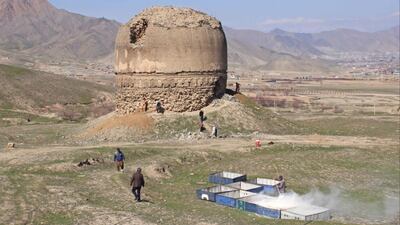
A stupa at Shewaki, Afghanistan, photographed in June 2020, that is being rehabilitated with funds from the Aliph Foundation. Work on the Shewaki site was interrupted by the coronavirus, but has now resumed. ACHCO
A stupa at Shewaki, Afghanistan, photographed in June 2020, that is being rehabilitated with funds from the Aliph Foundation. Work on the Shewaki site was interrupted by the coronavirus, but has now r

Aliph doubles its emergency funding for cultural sites in response to overwhelming need


Melissa Gronlund
  • English
  • Arabic

The Aliph Foundation has doubled the amount of emergency funding allocated for its coronavirus relief call.

The Swiss-based organisation, which helps safeguard world heritage sites that are in conflict or post-conflict areas, will give more than $2 million (Dh7.3 million), up from the $1m it envisaged giving to cultural heritage sites that have been affected by the coronavirus pandemic. These include more than 100 organisations in 60 countries, including the National Museum of Mali, the Uganda Museum in Kampala, Corporacion Cultural Museo del Vidrio of Bogota and the Directorate of Heritage and Archaeology of Mosul.

“We knew that there was a need, but we didn't know that it would be this much,” says Sandra Bialystok, a spokeswoman for Aliph. “We were also gratified that we were able to reach so many local and regional cultural heritage operators.”

Heritage sites have been particularly affected by the pandemic. They have met many of the same challenges as major museums and cultural organisations worldwide – such as closures, the postponement of rehabilitation or building work, and most crucially the loss of revenue and jobs – but from a standpoint of having smaller budgets and operating in more complicated conditions.

A substantial proportion of Aliph’s emergency funding will go to local organisations, around 90 per cent of which have not been supported by Aliph before. The young foundation credits being able to leverage its open call among its partners for having had a particularly wide reach, as well as the fact that it, for first time, held an information meeting for the grants in Arabic. Working with smaller projects has also diversified the type of work Aliph is supporting, with funding going to intangible heritage projects as well as museums and restoration sites.

Executive director Valery Freland says that the move towards local funding is one of the goals of the foundation.
"Our objective is to be able to work more and more with local organisations, and closer to communities," Freland says. "Of course, it's challenging because working in conflict areas there are not so many specialised operators able to accomplish huge rehabilitation projects, so we need both."

Aliph Foundation executive director Valery Freland. Aliph

One of the new recipients of the emergency funding is Palestinian craft organisation Sunbula, which supports the preservation of traditional craft techniques. Sunbala’s store has been closed since March, causing a steep loss of revenue for the 2,000 workers in its affiliated artisan groups.

Aliph will also be distributing funds via partner organisations, such as Unesco, the International Council of Museums, the World Monuments Fund, and the Aga Khan Trust for Culture.

A slim organisation of eight people, such partnerships are key to Aliph’s modus operandi. Aliph was founded in 2016 with seed money from seven countries, including $30m from France, $20m from Saudi Arabia, and $15m from the UAE.

Our objective is to be able to work more and more with local organisations, and closer to communities

It supports a number of large-scale rehabilitation projects, such as the restoration of the Beit Al Tutunji in the old city of Mosul, a grand Ottoman-era house that was used as an artillery encampment by ISIS and partially destroyed by coalition air strikes, and the conservation of a Buddhist-era stupa in Shewaki, Afghanistan. (Both these projects were put on hold following the coronavirus outbreak and have since resumed.)

But the foundation also aims to be a coordinator, streamlining projects in a sector with many stakeholders. It has now launched, for example, a website with training resources for those in the cultural heritage field, such as practical modules in illegal trafficking and preventive conservation, and courses designed to raise general knowledge of the areas it is helping to safeguard, such as African rock art or the history of Mesopotamia in 3rd century BCE.

“This was the very first time that someone does something like this,” says Freland, “which is just trying to put everything and everyone in the same page, on the same website."

Another part of the $2m funding will go towards capacity-building initiatives, accomplished in partnership with the International Centre for the Study of the Preservation and Restoration of Cultural Property and the Prince Claus Fund’s Cultural Emergency Response programme. These will support distance-learning initiatives for what is called cultural heritage “first-aid"  – immediate responses to destruction that occurs mid-conflict.

“What we are creating with Aliph is something quite new: a small international organisation, focusing on concrete initiatives, concrete projects on the ground,” says Freland. “That’s what we tried to show with our action plan for Covid-19: a new way to do multilateralism.”


The National Archives, Abu Dhabi

Founded over 50 years ago, the National Archives collects valuable historical material relating to the UAE, and is the oldest and richest archive relating to the Arabian Gulf.

Much of the material can be viewed on line at the Arabian Gulf Digital Archive - https://www.agda.ae/en

Who's who in Yemen conflict

Houthis: Iran-backed rebels who occupy Sanaa and run unrecognised government

Yemeni government: Exiled government in Aden led by eight-member Presidential Leadership Council

Southern Transitional Council: Faction in Yemeni government that seeks autonomy for the south

Habrish 'rebels': Tribal-backed forces feuding with STC over control of oil in government territory

The specs

Engine: 6.2-litre V8

Transmission: seven-speed auto

Power: 420 bhp

Torque: 624Nm

Price: from Dh293,200

On sale: now

Godzilla%20x%20Kong%3A%20The%20New%20Empire
%3Cp%3E%3Cstrong%3EDirector%3A%20%3C%2Fstrong%3EAdam%20Wingard%3C%2Fp%3E%0A%3Cp%3E%3Cstrong%3EStarring%3A%20%3C%2Fstrong%3EBrian%20Tyree%20Henry%2C%20Rebecca%20Hall%2C%20Dan%20Stevens%3C%2Fp%3E%0A%3Cp%3E%3Cstrong%3ERating%3A%3C%2Fstrong%3E%204%2F5%3C%2Fp%3E%0A
Sole survivors
  • Cecelia Crocker was on board Northwest Airlines Flight 255 in 1987 when it crashed in Detroit, killing 154 people, including her parents and brother. The plane had hit a light pole on take off
  • George Lamson Jr, from Minnesota, was on a Galaxy Airlines flight that crashed in Reno in 1985, killing 68 people. His entire seat was launched out of the plane
  • Bahia Bakari, then 12, survived when a Yemenia Airways flight crashed near the Comoros in 2009, killing 152. She was found clinging to wreckage after floating in the ocean for 13 hours.
  • Jim Polehinke was the co-pilot and sole survivor of a 2006 Comair flight that crashed in Lexington, Kentucky, killing 49.
COMPANY%20PROFILE%20
%3Cp%3EName%3A%20DarDoc%3Cbr%3EBased%3A%20Abu%20Dhabi%3Cbr%3EFounders%3A%20Samer%20Masri%2C%20Keswin%20Suresh%3Cbr%3ESector%3A%20HealthTech%3Cbr%3ETotal%20funding%3A%20%24800%2C000%3Cbr%3EInvestors%3A%20Flat6Labs%2C%20angel%20investors%20%2B%20Incubated%20by%20Hub71%2C%20Abu%20Dhabi's%20Department%20of%20Health%3Cbr%3ENumber%20of%20employees%3A%2010%3C%2Fp%3E%0A
UAE currency: the story behind the money in your pockets
Wicked: For Good

Director: Jon M Chu

Starring: Ariana Grande, Cynthia Erivo, Jonathan Bailey, Jeff Goldblum, Michelle Yeoh, Ethan Slater

Rating: 4/5

Moon Music

Artist: Coldplay

Label: Parlophone/Atlantic

Number of tracks: 10

Rating: 3/5

White hydrogen: Naturally occurring hydrogenChromite: Hard, metallic mineral containing iron oxide and chromium oxideUltramafic rocks: Dark-coloured rocks rich in magnesium or iron with very low silica contentOphiolite: A section of the earth’s crust, which is oceanic in nature that has since been uplifted and exposed on landOlivine: A commonly occurring magnesium iron silicate mineral that derives its name for its olive-green yellow-green colour

The specs

Engine: 3.8-litre twin-turbo flat-six

Power: 650hp at 6,750rpm

Torque: 800Nm from 2,500-4,000rpm

Transmission: 8-speed dual-clutch auto

Fuel consumption: 11.12L/100km

Price: From Dh796,600

On sale: now

500 People from Gaza enter France

115 Special programme for artists

25   Evacuation of injured and sick

ASSASSIN'S%20CREED%20MIRAGE
%3Cp%3E%0DDeveloper%3A%20Ubisoft%20Bordeaux%0D%3Cbr%3EPublisher%3A%20Ubisoft%0D%3Cbr%3EConsoles%3A%20PlayStation%204%26amp%3B5%2C%20PC%20and%20Xbox%20Series%20S%26amp%3BX%0D%3Cbr%3ERating%3A%203.5%2F5%3C%2Fp%3E%0A
French business

France has organised a delegation of leading businesses to travel to Syria. The group was led by French shipping giant CMA CGM, which struck a 30-year contract in May with the Syrian government to develop and run Latakia port. Also present were water and waste management company Suez, defence multinational Thales, and Ellipse Group, which is currently looking into rehabilitating Syrian hospitals.

Europe’s rearming plan
  • Suspend strict budget rules to allow member countries to step up defence spending
  • Create new "instrument" providing €150 billion of loans to member countries for defence investment
  • Use the existing EU budget to direct more funds towards defence-related investment
  • Engage the bloc's European Investment Bank to drop limits on lending to defence firms
  • Create a savings and investments union to help companies access capital
What is cyberbullying?

Cyberbullying or online bullying could take many forms such as sending unkind or rude messages to someone, socially isolating people from groups, sharing embarrassing pictures of them, or spreading rumors about them.

Cyberbullying can take place on various platforms such as messages, on social media, on group chats, or games.

Parents should watch out for behavioural changes in their children.

When children are being bullied they they may be feel embarrassed and isolated, so parents should watch out for signs of signs of depression and anxiety

Key facilities
  • Olympic-size swimming pool with a split bulkhead for multi-use configurations, including water polo and 50m/25m training lanes
  • Premier League-standard football pitch
  • 400m Olympic running track
  • NBA-spec basketball court with auditorium
  • 600-seat auditorium
  • Spaces for historical and cultural exploration
  • An elevated football field that doubles as a helipad
  • Specialist robotics and science laboratories
  • AR and VR-enabled learning centres
  • Disruption Lab and Research Centre for developing entrepreneurial skills
Company profile

Company: Eighty6 

Date started: October 2021 

Founders: Abdul Kader Saadi and Anwar Nusseibeh 

Based: Dubai, UAE 

Sector: Hospitality 

Size: 25 employees 

Funding stage: Pre-series A 

Investment: $1 million 

Investors: Seed funding, angel investors  

How much do leading UAE’s UK curriculum schools charge for Year 6?
  1. Nord Anglia International School (Dubai) – Dh85,032
  2. Kings School Al Barsha (Dubai) – Dh71,905
  3. Brighton College Abu Dhabi - Dh68,560
  4. Jumeirah English Speaking School (Dubai) – Dh59,728
  5. Gems Wellington International School – Dubai Branch – Dh58,488
  6. The British School Al Khubairat (Abu Dhabi) - Dh54,170
  7. Dubai English Speaking School – Dh51,269

*Annual tuition fees covering the 2024/2025 academic year

Results

5pm: Wadi Nagab – Maiden (PA) Dh80,000 (Turf) 1,200m; Winner: Al Falaq, Antonio Fresu (jockey), Ahmed Al Shemaili (trainer)

5.30pm: Wadi Sidr – Handicap (PA) Dh80,000 (T) 1,200m; Winner: AF Majalis, Tadhg O’Shea, Ernst Oertel

6pm: Wathba Stallions Cup – Handicap (PA) Dh70,000 (T) 2,200m; Winner: AF Fakhama, Fernando Jara, Mohamed Daggash

6.30pm: Wadi Shees – Handicap (PA) Dh80,000 (T) 2,200m; Winner: Mutaqadim, Antonio Fresu, Ibrahim Al Hadhrami

7pm: Arabian Triple Crown Round-1 – Listed (PA) Dh230,000 (T) 1,600m; Winner: Bahar Muscat, Antonio Fresu, Ibrahim Al Hadhrami

7.30pm: Wadi Tayyibah – Maiden (TB) Dh80,000 (T) 1,600m; Winner: Poster Paint, Patrick Cosgrave, Bhupat Seemar