

After acquiring more than 2,800 rare Islamic silver coins earlier this year, Louvre Abu Dhabi is preparing to unveil the objects as part of a two-year project.
Referred to as the Hoard of Jazira, the collection of medieval Islamic coins dates back from the reign of King Shapur II (AD 309-379) until that of Abbasid Caliph Al Ma’mun (AD 813-833). Among the museum’s acquisitions are the hoard of 2,861 silver coins manufactured in the Eurasian continent, including currencies of the Umayyad and Abbasid dynasties. There are also 67 additional single coins, in gold or gold alloy, created from the sixth to the 16th century in the regions of Eurasia and the Mediterranean basin.
The images and symbols on the coins range from names of rulers to lines from the Quran.

Louvre Abu Dhabi acquired the hoard in 2019 from a private collector in Europe whose identity has not been revealed.
As part of the project, the museum has studied and restored the coins before installing them for display. The process includes weighing the coins, documenting their diameter and thickness, as well as identifying the metals used and examining the shifting designs closely. A team of restorers have also been working to remove scratches and corrosive materials on the coins.
Theofanis Karafotias, who leads preventive conservation at Louvre Abu Dhabi, explained part of the process. “The coins were not only conserved by the museum but also documented and digitised as well so that they could be studied in greater detail. We had to decide how to conserve each coin among the thousands – whether [using] chemicals, an ultrasonic bath, or simple distilled water – considering which treatment would be the best, least intrusive way to reveal each coin’s face,” he said.
The significance of the coins lies in the way they reveal political changes in regional history, including the value placed on precious metals throughout various periods, as well as how the symbols on coins shifted as the Umayyad caliphate sought to establish a single Islamic currency.
Leading on the curation of the Hoard of Jazira, Guilhem Andre, chief curator at Louvre Abu Dhabi, explained how the coins have served not only as a valuable research tool, but as tangible markers of the development of economy and the shifts in power and geography at the time.
“This display will showcase a global monetary history. It highlights the trade, cultural exchanges and political dynamics revealing an interconnected world economy between distant regions. It testifies to the birth of Islamic coinage and its evolution,” he said.
“The Sasanian drachmas, Umayyad dirhams, Abbasid silver coins, alongside the gold Byzantine solidus, the Genoese and Venetian gold coins, and more will prove how a simple coin can illustrate power relationships and rivalries among competing, growing empires well, as the emergence of major trade hubs.”
Originally meant to go on view in September, the exhibition opening date for the Hoard of Jazira has yet to be announced.
Also at Louvre Abu Dhabi: Dragon and Phoenix - in pictures
-

The interactive bestiary at the Dragon and Phoenix – Centuries of Exchange between Chinese and Islamic Worlds exhibition at the Louvre Abu Dhabi. Khushnum Bhandari / The National -
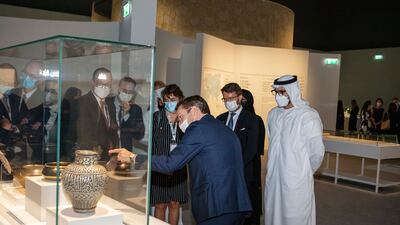
Mohamed Khalifa Al Mubarak, chairman of the Department of Culture and Tourism – Abu Dhabi, inaugurated the Dragon and Phoenix exhibition at Louvre Abu Dhabi. Photo: Louvre Abu Dhabi -
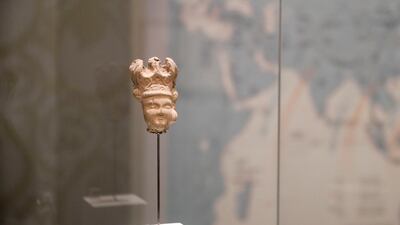
The new exhibition at Louvre Abu Dhabi features diverse artworks, including paintings, silverware, ceramic, glassware, manuscripts and luxury fabrics. Khushnum Bhandari / The National -
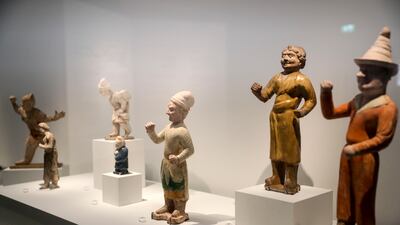
Terracotta figures based on characters one would meet along the Silk Road. Khushnum Bhandari / The National -
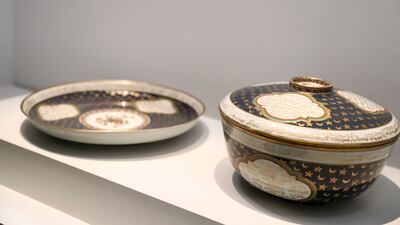
Bowl with lid and platter with Arabic inscriptions from China's Jiangxi Province dating back to the 18th century. Khushnum Bhandari / The National -

Guilhem Andre, chief curator at Louvre Abu Dhabi, explains the history behind the artefacts. Khushnum Bhandari / The National -
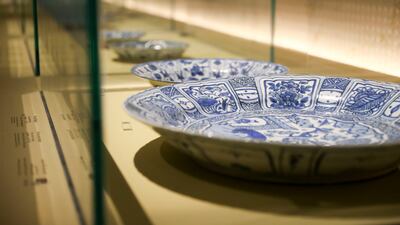
Dragon and Phoenix showcases several Chinese crafts that were specifically made for the Islamic traders. Khushnum Bhandari / The National -

The exhibition was organised with the Musee national des arts asiatiques – Guimet, popularly known as the Musee Guimet. Khushnum Bhandari / The National -
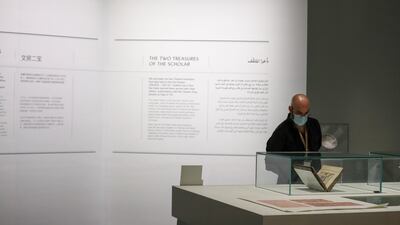
The exhibition, which opens to the public on October 6, showcases the cultural and artistic exchange between the Chinese and Islamic civilisations from the 8th to the 18th century. Khushnum Bhandari / The National -

Funerary figures from northern China. Khushnum Bhandari / The National -
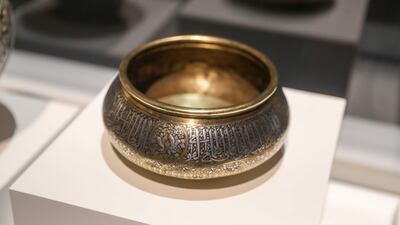
An alloy basin with the name of an officer of the sultan Al-Malik Al-Nasir Muhammad ibn Qalawun from Egypt or Syria, late 13th early 14th century. Khushnum Bhandari / The National -
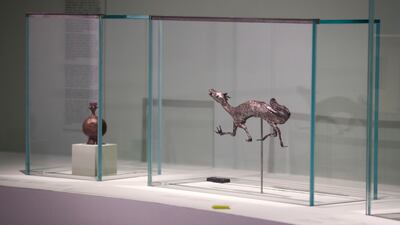
A sculpture of a fabulous animal from China - Liao dynasty (907/ 916-1125) - in chased and gilded silver. Khushnum Bhandari / The National -

Panel with poetic inscription by Hafez, a 14th-century Persian poet and writer, from Damascus dating to the 17th century. Khushnum Bhandari / The National -

A Quran by an anonymous Chinese copyist dating to the 17th century, ink and gold on paper. Khushnum Bhandari / The National -

'Ata Malik Djoveni, Tarikh-e djahan gusha' (History of the Conqueror of the World) copied by Rashid Khwafi from Baghdad 1290. Khushnum Bhandari / The National -

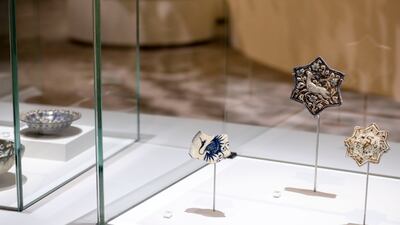
Ceramics embellished with intricate cobalt blue designs. Khushnum Bhandari / The National -
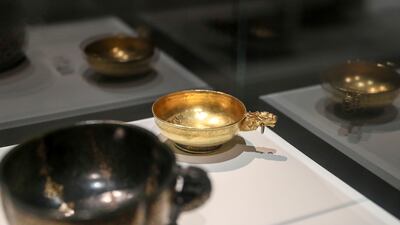
Right, a cup with dragon-shaped handle from China, Yuan dynasty (1279-1368) in hammered embossed gold with chasing. Left, a larger, more bulbous variation made of black jade. Khushnum Bhandari / The National -
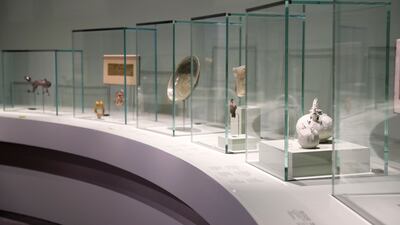
The Dragon and Phoenix exhibit embodies two cultures - China, the dragon, and Islamic world, the phoenix. Khushnum Bhandari / The National -
There are more than 200 artefacts spread across five sections. Khushnum Bhandari / The National



