
The check-in counters and old airport signs remain at Abu Dhabi's former Terminal 1, but the direction of travel has changed.
Opened in 1982, the terminal, with its distinctive emerald-green and blue-tiled ceiling, welcomed travellers to an emirate in the early years of its development. Decommissioned in 2023 following the opening of the nearby Terminal A, now part of Zayed International Airport, it is once again receiving international visitors, this time artists, galleries and collectors attending the second Nomad Abu Dhabi art and design fair.
For longtime Abu Dhabi residents, much of the building remains familiar. During Wednesday's invitation-only preview, visitors passed signs for the former Etihad Lounge and airport hotel before entering the terminal's signature passenger tunnel. Once illuminated in green, the corridor is now bathed in red light, leading into the circular departure hall beneath its spectacular patterned ceiling.

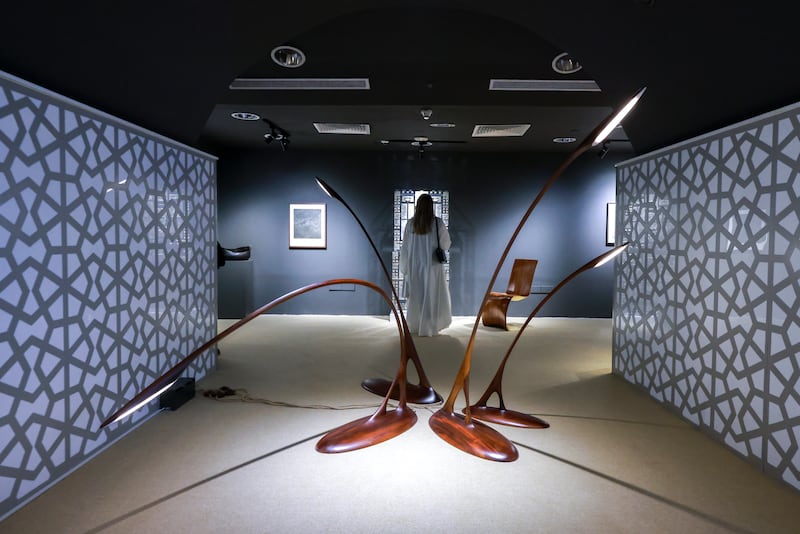
The former boarding gates now house galleries, with more than 50 exhibitors from Seoul to Burkina Faso presenting contemporary art, collectable furniture and traditional craftsmanship across the terminal's exhibition spaces.
Among the works are Osanna Visconti's Magnolia sofa, cast in bronze and inspired by the shape of a magnolia bud, and Rooshad Shroff's Big B console, combining stone and metal in an asymmetrical arrangement inspired by stacked pebbles.
“I don't know if many fairs take place in an airport on such a scale, but it's absolutely perfect to do it here because you feel like you're on an adventure, surrounded by people from all over the world. It's like going on a journey where you meet interesting people along the way,” says Agnes Nordio, from the gallery's sales team.
“Our work focuses on vintage and contemporary design, so I think the idea of Nomad really works for us. The venue is so interesting that it pushes galleries to be creative in how we showcase our work.”
Continuing that sense of travel, a short walk away is a display of painstaking Korean craftsmanship from Seoul's Gallery Vein.
Hanging in the minimalist space are Samyong Hwang's A Droplet sculptures, their rounded forms covered in mother-of-pearl, with iridescent shells arranged across the surface to suggest the movement of water.
On the other side are contemporary interpretations of Korean furniture, including Kuho Jung's reinterpretation of the bandaji, a traditional storage chest, alongside lacquerware by master artisan Kangyong Park. The latter uses ottchil, a natural lacquer extracted from trees and applied in successive layers.

Gallery Vein's Julie Kim says some objects require at least 30 layers of lacquer, with the process taking up to a year depending on their size.
Kim, who grew up in Saudi Arabia between 1984 and 1999, says the gallery's Abu Dhabi debut is an opportunity to introduce Korean craftsmanship to a market she is still getting to know.
“That's why I'm participating, because I need to understand what's going on. I need to know what collectors are really into,” she tells The National.
Her interest in the emirate extends to plans for a gallery and cultural initiative in Abu Dhabi's MiZa district, combining exhibitions with artist residencies.
“I'm envisaging exhibitions where visitors can meet designers and discuss their work, alongside opportunities for artists from the UAE to connect with their Korean counterparts,” she says. “You know, I have a tattoo on my arm that reads Amal, the Arabic word for hope. And discussions are under way to make this happen.”
An example of what cross-cultural collaboration can achieve can be found at Mumbai gallery Aequo, which is showcasing French designer Frederic Imbert's Waxed Coffee Table (2025), created using traditional Indian metalworking techniques.
Gallery director Sejal Jain says Imbert travelled to Chhattisgarh, a state in Central India, in 2023 to work with local master craftsmen specialising in Dhokra, a centuries-old metal casting technique. The process involves shaping a model from wax, which is then used to create a mould for casting metal. This allows the finished furniture to retain the impressions and irregularities of the original wax model.
“It's a meeting of cultures and knowledge sharing,” she says. “And this kind of work and practice shows how you can push a tradition forward while maintaining its integrity.”
Emirati and Syrian artisans are working together on another collection at the fair. Sharjah's Irthi Contemporary Crafts Council and design collective Super Loop have produced five pieces for Al Taif Collection – Al Thini Edition, combining traditional talli braiding with Syrian woodworking and mother-of-pearl inlay.

Talli is traditionally used to embellish Emirati clothing, with cotton and metallic threads interlaced into narrow patterned strips. Here, the braiding is incorporated into wooden furniture and functional objects, with the softness of the textiles worked into the more rigid forms of the wood.
Reem Bin Karam, director general of Irthi Contemporary Crafts Council, describes the collection as a way to challenge some perceptions of UAE art.
“There can be those who think that it's too rigid, but in fact there is a variety of materials being used by emerging designers from the UAE, which you can see in contemporary fairs. It's not just painting on a canvas,” she says.
Reem hopes Nomad Abu Dhabi forms only the opening stop of collectors' journey in the UAE.
“We are in an airport, so this means we also need to go outside and see all the other Emirati works on display so you can see the coherence and vision of what is happening here, which I feel is exciting.”
Nomad Abu Dhabi runs at the former Terminal 1 from November 19 to 22. Opening hours are 1pm to 9pm from Thursday to Saturday and 1pm to 8pm on Sunday

