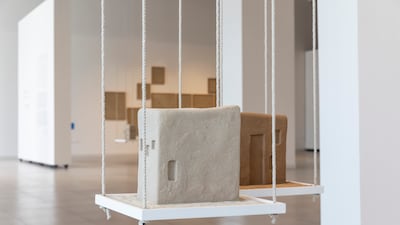

The sound of popping bubble wrap, the texture of sand or the sight of a familiar plastic chair can transport us back to moments from childhood that otherwise seem lost to time. These ordinary objects are at the heart of Emirati artist Reem Al Mubarak's new solo exhibition, which explores memory, play and the experiences that shape who we become.
What We Left In The Sandbox opened at Rizq Art Gallery on Abu Dhabi's Reem Island on Friday. Running until January 10, the exhibition features interactive artworks made from familiar materials, inviting visitors to reconsider their childhoods through touch, movement and play.
Curated by Emirati architect and researcher Azza Aboualam, the exhibition explores the unreliable nature of memory and the ways in which people reconstruct the past through objects and experiences.

Al Mubarak says the project grew partly from a personal realisation that modern life offers fewer opportunities to create lasting memories, despite the countless ways people can now document their experiences.

“Why do I remember so much of my time at school or as a kid? Because we used to [have] a lot of experiences together,” she tells The National. “Now we're bound to just have a call or grab a coffee, but no experiences that make me remember the full scene.”
That realisation has also changed her relationship with her nieces and nephew. Rather than spending time shopping or visiting malls, she makes a conscious effort to create shared experiences with them, believing that physically doing something together leaves a stronger impression than everyday conversations.
“It's more of, let's do something together. Let's go outside. Let's enjoy, let's play together,” she says. “That stays.”
An exhibition made to be experienced
Visitors are encouraged to interact with the artworks, which incorporate materials including bubble wrap, sand and objects associated with childhood games.
A sandcastle constructed inside the gallery is deliberately proportioned to the way a child might remember it, requiring adults to stoop to enter. Another work transforms a photograph into a sliding puzzle cast in metal, allowing visitors to rearrange its pieces without ever quite restoring the original image.
The exhibition also features acrylic pieces, plastic chairs and elements inspired by tic-tac-toe, drawing on objects that may carry different associations for different generations.
Aboualam says the exhibition was designed without a prescribed route, allowing visitors to follow their instincts and discover connections between the artworks.
“As with childhood and exploration, I wanted the visitors to be guided by the artworks and to see what actually attracts them first,” she says.
The tactile nature of the exhibition also encourages visitors to engage with their surroundings rather than simply document them. Aboualam thinks that while people have become accustomed to photographing every experience, those images often receive little attention afterwards.

“I think one or two moments would be sufficient, in my very personal opinion,” she says. “If someone recalls, 'Oh, I remember when I sat on that chair,' or 'I remember my childhood home' … once we instigate a memory or unlock it, take as many photos as you want.”
Al Mubarak agrees that photography alone cannot communicate the full experience of encountering her work.
“Even if you show up, take a picture of every artwork and leave, you've not experienced it at all,” she says.
The artist hopes the journey through the gallery will encourage conversations, with visitors contributing their own interpretations and associations to the works.
When someone else's memory becomes your own
Al Mubarak says conversations during her recent residency at Abu Dhabi's Cultural Foundation became an important source of inspiration, sometimes leading her to recreate experiences that weren't originally her own.
During one conversation, someone recalled trying to ride a bicycle over bubble wrap, popping the bubbles in a straight line. Intrigued, Al Mubarak returned to her studio and attempted the same thing herself.
She then created a mould from the experiment, transforming the experience into one of the blue artworks featured in the exhibition.
“It became ours, and I recreated her own memory and now it became mine because I forever remember me grabbing the bike and doing it in my studio,” she says.

The exhibition builds on the experimentation that characterised her six-month Cultural Foundation residency, where she explored overlooked materials including bubble wrap and sands collected from different parts of the UAE.
The creative process also prompted Al Mubarak to examine her existing practice. She laid out her previous works, analysed recurring ideas, and wrote an essay titled The Thinking Archive, questioning her attachment to certain objects.
She says the resulting exhibition combines personal research, physical experimentation and the experiences of others.
“I kept telling my family, the work is not mine,” she says. “It's everyone else's conversations [that] came into place.”
Another conversation revealed the different associations people can have with everyday materials.
When Al Mubarak asked a friend about the friend's earliest memory of aluminium foil, she initially struggled to remember anything. Eventually, the friend recalled flattening the foil and pretending it was money. The friend later became a businesswoman.
Al Mubarak, by contrast, remembered using foil to make toys for herself and other children.
The exchange fascinated her because it demonstrated the different meanings people can assign to the same material and the ways childhood experiences might influence their adult lives.
“Who are we without our memories? Who are we without our past?” she asks.
A growing space for Emirati artists
What We Left In The Sandbox also brings together two Emirati creatives whose careers have developed across different disciplines.
Al Mubarak, an artist, author and curator, founded Studio Untitled, described as the UAE's first female-only studio space for artists. She has published four poetry collections and exhibited her work in the UAE and internationally.
Aboualam became the first Emirati woman to curate the UAE National Pavilion at the Venice Architecture Biennale in 2025, presenting Pressure Cooker, an exhibition examining food security and architecture in arid environments.

Aboualam says she has noticed an increasingly visible generation of Emirati artists and designers, alongside a greater willingness to experiment with physical materials.
She wonders whether the renewed emphasis on making physical objects might partly be a response to the growing presence of artificial intelligence, although she stresses that this is her personal interpretation.
Al Mubarak says the most rewarding part of the exhibition was seeing visitors contribute their own memories to the artworks. One visitor told her that seeing the bubble wrap had brought back the forgotten childhood pleasure of popping its bubbles.
The artist deliberately avoids revealing too much of her personal history within the works, preferring to give others the freedom to discover their own connections. She is happy to share her memories through conversation, but feels the artworks should be accessible regardless of a visitor's background or experiences.
“You need to show something and respect the audience enough to relate to it and feel included.”
Ultimately, she hopes visitors leave with something more meaningful than a photograph.
“I'd love for people to feel like they belong in a place one way or another.”
What We Left In The Sandbox runs at Rizq Art Gallery, Al Reem Island, Abu Dhabi, until January 10

