
Oversized red and green beads visible from a hundred metres away are the first signs that something has taken over Al Towayya Roundabout in Al Ain.
From a distance, the beads look like flowers, arranged in clusters on the grass. Nearing the roundabout, the complexity of the design becomes apparent. Triangular, circular, floral and teardrop shapes fan out from the centre – all in gold and all linked together. The beads are peppered throughout like gemstones.
Roudhah Al Mazrouei’s installation Tassa, for the second Public Art Abu Dhabi Biennial, is inspired by a traditional Emirati headpiece from her family’s collection.

“It actually exists in my parents’ house,” she says. “We’ve worn it in so many events. It’s a way of showing how we grow up with our culture.”

Al Mazrouei has drawn inspiration from jewellery before. Her installation Reverie, shown at the 2024 Sikka Art and Design Platform, reimagined an heirloom bracelet belonging to her mother on an oversized scale. Even so, it was smaller than Tassa, which crowns the roundabout in Al Ain and measures 80 metres in diameter.
She conceived the installation years ago. The project never materialised, however, and the artist revisited it during this biennial. It was a natural fit, she says, given the event’s theme of Home: A Glossary for a Communal Sense of Place.
“I grew up in Al Ain,” she says. “The roundabout was also perfect because I went to school right at the end of this street.”
Tassa is the only installation within the city of Al Ain. The other three have been installed at Al Qattara Oasis, and respond to different aspects of the Unesco World Heritage Site and its history.
This includes Asuncion Molinos Gordo’s Bil Hana wa Al Afia. The installation – made from rammed earth – alludes to the inner structure of the falaj, branching out in root-like forms similar to the millennia-old irrigation system that can still be seen in the oasis.
Stratified into seven layers, it also represents the different historical periods of Al Ain dating back to the Neolithic era.
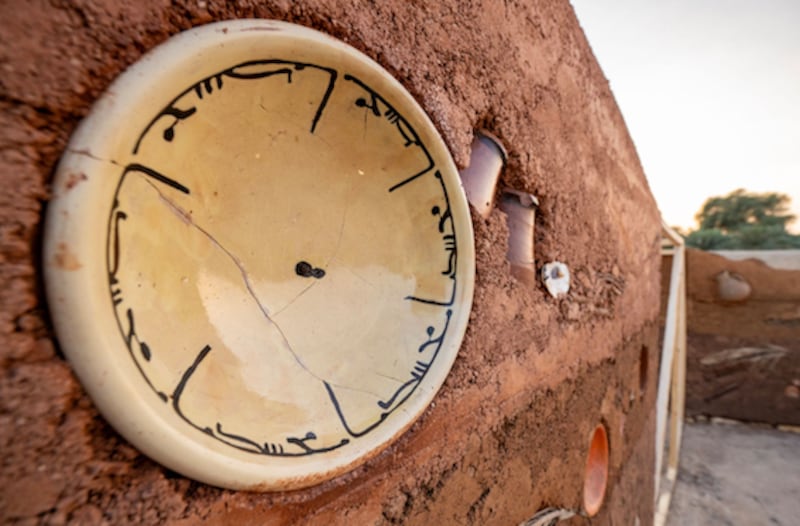
Objects embedded in the rammed earth also represent the passage of history, from earthenware and palm reeds to cassettes and air conditioning remotes that encroach on our current period. Perhaps they are making a point about the continuing effectiveness of the ancient falaj system, which is still used to distribute water on many farms across the country.
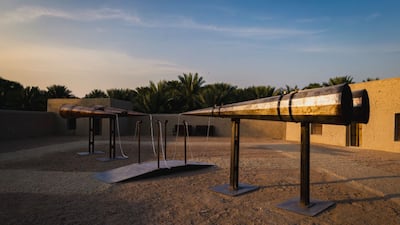
On the other hand, Reena Saini Kallat’s Thresholds: Requiem (The Last Call) offers insights into an inaccessible past, or even perhaps an alternate dimension where extinct birds still live.
The installation features two pairs of conical devices inspired by 20th-century acoustic locators detecting faraway aircraft. Arranged on a listening platform, these devices don’t listen in on the puttering engines of planes, but to the chirping of extinct and critically endangered birds. Several of these species either migrated through, or were native to, the UAE or the wider Gulf. They include the extinct dusky seaside sparrow and the endangered saker falcon.
Finally, M’barek Bouchichi’s installation beckons a species of bird that is alive and well: the pigeon. Titled I am not the stone thrown into the water, but the seed sown in the field, the work comprises two pigeon towers made of stainless steel.

It solidifies the pigeon tower as a space of refuge by replacing the mud bricks traditionally used for construction with a far more resilient material. The porous patterns on Bouchichi’s towers are significant, rendering traditional Emirati sea shanties in Braille to give a tactile representation of the work songs sung by sailors during their arduous journeys away from home.
The installations in Al Ain are the first set to be unveiled as part of the second Public Art Biennial. More will be revealed in Abu Dhabi on November 15. The exhibition runs across both cities until February 15, 2027.
The works will collectively explore notions of home as an evolving, shared human experience, exploring how people’s relationships with places are shaped by community, memory and everyday encounters.
“What do we mean when we say home? It is one of the most used terms in any language, and yet many aspects of it often go unexamined,” artistic director Elvira Dyangani Ose said in a statement.
“Home is not only a location. It is a condition: felt before it is understood, carried in the body before it is articulated in language.
“Al Ain is where this edition begins, in an oasis landscape shaped over millennia by co-operation, shared water and collective care. We offer this biennial as a glossary, not as a guide to correct interpretations but as a set of terms to think with. The definitions are partial by design, and yours to complete,” she added/
Public Art Abu Dhabi Biennial is on until February 15, 2027

