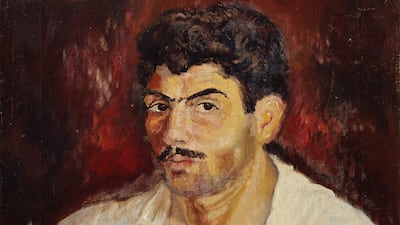

Manuella Guiragossian recalls the shelling and gunfire, the family rushing out of the house and towards the shelters. She recalls the painting her father Paul would remove from the wall, from its place above the piano, and bring with him as if “it was a member of the family”.
She remembers this detail as a speckle of warmth in an otherwise traumatic cycle during the Lebanese Civil War. As a young girl, she couldn’t understand why her father insisted on bringing the painting along every time they sought shelter. She couldn’t have been the only one.
The sight of Paul Guiragossian in pyjamas, on crutches (he had lost his leg in a lift accident in 1974), leading his family to safety with a painting tucked under his arm must have struck many as strange. Amid the violence and absurdities of war, many must have seen Guiragossian’s protectiveness of his painting as an artist’s eccentricity.

For the young Manuella, what was strange was not so much the fact her father wanted to protect his work. She knew how dedicated he was to his practice. What confounded her was the fact he always wanted to safeguard this particular piece, this one self-portrait.
“I was wondering why it was this painting that was coming with us,” she says. “We are running, we are in a rush, we are trying to make it to the shelter. It is chaos, and this portrait is coming with us regardless.”
The painting is one of the works featured in Paul Guiragossian: 100 Years of Art, an exhibition at Abu Dhabi’s Bassam Freiha Art Foundation running until January 17, 2027. It is also the cover image for the exhibition catalogue.
The painting shows Guiragossian as a young man. His posture seems to be caught between two moods. One hand hangs from the armrest of his chair, the other holds a brush. His gaze is intense and unwavering. His shirt is unbuttoned, relaxed and wrinkled. The Guiragossian in the image is an artist intently observing himself. He is wary of being observed, yet also trying to exist outside his own eye. The tension is heightened by the dark reds and browns in the backdrop around his head, an ill-defined ring of fire that adds to the intensity of his look.
The painting is being exhibited outside Lebanon for the first time. It was an emotional leap to let go of the work that has always remained within the family and the artist’s estate, Manuella says. Yet it was important to include the work in an exhibition that celebrates the centenary of the late artist’s birth.
“After my father passed away, whenever we did retrospectives in Lebanon, this portrait would travel by hand with me or my siblings, and always come back by hand,” says Manuella, who is the president of the Paul Guiragossian Foundation, as well as an artist herself.
“So you can imagine the emotions when the painting was packed and went outside Lebanon for the first time, the responsibility of letting go.”

The painting was produced in 1948 – the same year that Guiragossian and his family were displaced from Jerusalem as a result of the Nakba. In the tumult of the displacement, the artist was forced to leave most of his works behind – among them a self-portrait that he regarded as one of his best at that time.
The self-portrait he later produced was a memento of that painting, that experience of displacement – and perhaps of the experience of his parents, who had come to Jerusalem as survivors of the Armenian genocide.
Guiragossian’s 1948 self-portrait is displayed in the opening section of his retrospective at the Bassam Freiha Art Foundation. The exhibition is segmented into different phases of Guiragossian’s life. Special attention is also dedicated to the women who influenced his life and career. The exhibition presents a portrait of the artist as a son, husband and father.
“They are interconnected chapters, each dedicated to a specific time in the life of Paul Guiragossian,” says Michaela Watrelot, head curator at the foundation.
“A lot of people know Guiragossian the artist. But we wanted to tell the story of his life through the women in his life. How his humanity translated into his work. No matter how iconic his works have become, they are rooted in the humanity of who Paul was as a person. We wanted to show works that people had rarely seen before, that may not be associated with Paul.”
Guiragossian’s mother, Rahel, is the star of the opening section, In Search of Belonging. Ink and charcoal drawings of her are featured alongside an oil painting, also produced in 1948, that shows her in a palette similar to Guiragossian’s self-portrait. She seems to have bequeathed her son her eyes, yet her gaze is less intense – almost elsewhere.
“The first chapter highlights the resilience of his mother and the influence she had on him,” says Watrelot, who co-curated the exhibition with Manuella. These works, along with archival images, give visitors a sense of how close Guiragossian was to his mother.
The section also includes other self-portraits as Guiragossian sought to emulate the artists he looked up to in his youth. An oil-on-canvas piece, composed with thick brushstrokes and a subdued palette, features the artist looking out with a sideways glance reminiscent of paintings by Paul Gauguin. The charcoal drawing adjacent to it has feverish swirls and lines apparently inspired by Vincent van Gogh.

These early works show an artist experimenting with media and techniques to find himself on paper and canvas. Earth tones dominate the oil paintings, and it is not until the following section – presenting works produced between 1950 and 1959 – that we begin seeing the first signs of the motifs that would become characteristic of Guiragossian, the vibrant colours that would become his emotional palette.
“In the beginning, he was almost scared of using colours,” Manuella says. “He had a lot of sadness and pain, and couldn’t imagine using colours. All that changed when he got married and had children. His life became injected with colour.”
Sure enough, the paintings he produced in the early to mid-1950s, though still dominated by earth tones, begin to show more vibrant hues. Two, in particular, are ablaze with a mesmerising yellow, which expresses tenderness in Maternité (1953) and anguish in Le Cycle de Vie (1955).
Motherhood also manifests clearly as a focal interest during this period. Portraits of the artist's wife feeding their infant children allude to Christian iconography – a testament, Manuella says, to how Guiragossian considered “the mother as a sacred figure”.
The archival images and posters in this section reference Guiragossian’s time in Florence, after he received a scholarship to the Accademia di Belle Arti. In 1958, he held a solo exhibition at Galleria d’Arte Moderna La Permanente, where he presented some of his first experiments with figurative abstraction.

A few of those works are on show in this exhibition. Here, we see some of the earliest elongated figures, such as in La Famille (1957). The figures appear as colourful outlines, their insides left bare. Manuella says the approach earned praise from Italian critics who came to see the exhibition. The minimalism, she says, was enforced: Guiragossian simply did not have the money to buy more paint and so had no choice but to keep his figures unfilled.
Interestingly, there are also works that do not seem like Guiragossian’s at first glance, such as Les Amies (1958) or Femmes en Conversation (1951). Yet we begin seeing here elements that Guiragossian would continue to develop, such as the abstracted figures, stripped of their features and instead depicted in their postural essences.
A 1978 portrait of his wife, Juliette, is a highlight of the following section, titled Painting Humanity, which brings together works from 1960 to 1979. The two-metre-long painting shows Juliette poised and upright, but seemingly caught off guard. The colours, though restrained, are more vivid here, the brushstrokes more economical.
Here, we begin to see works that are classic Guiragossian in style: vivid, elongated figures, silhouetted and huddled in groups, such as in the mournful Silence, painted in 1968, and the mirthful Rythme, painted in 1978. Physical and facial features are totally abstracted, with postures and colours filling the emotional spectrum of each work.

La Lettre (1978) is a strong example. The painting shows children gathered around a mother as she reads from a letter. The child in the foreground appears to be on tiptoe. The letter may be a source of joy or sorrow – the painting can be read either way. But the family is nonetheless experiencing it as one, huddled together as a single dynamic mass, an unbroken assemblage of hues and brushstrokes.
It is around this point in the exhibition that we see more of how fatherhood inspired Guiragossian's work. While there were paintings of his wife and children in the preceding section, he seems to step into the frame through an archival image that is presented alongside portraits of Manuella. The photograph shows Guiragossian entertaining his daughter with a puppet.
“During the war, my brothers and sisters travelled abroad,” Manuella says. “For a time, I was alone with my parents. During this period, I became extremely close with my father. There was a lot of complicity between us, inside jokes and humour.”
The concluding section, Beyond Time and Form, exhibits the final, artistically intense years of Guiragossian’s life. His paintings ramp up in size. His figures loom over the viewer with the aplomb of Mesopotamian reliefs, albeit colourful, drawing from the people around him instead of mythological deities, but exalting them all the same. This is especially seen in Portrait de Famille and L’Echarpe, both of which were painted in 1986.
Guiragossian’s last painting is presented here and was seen by him as the effective culmination of his practice. According to the exhibition catalogue, when Guiragossian finished this painting on November 20, 1993, he told Manuella that “he had finally managed to draw together the many strands he had grappled with as an artist his whole life”.

With the achingly apt title of L’Adieu, the painting features a huddle of abstracted figures in thickly layered reds, greens and yellows, brushstrokes fervent in each form, each figure holding its independent logic of motion. What is particularly arresting are the feet of the figures, perhaps their only defined feature – alluding to Guiragossian’s paintings from the late 1940s, in which he depicted porters with enlarged feet.
But the final painting of the exhibition is a self-portrait produced in the last year of his life, elegantly bracketing the show between two self-examinations. Here, however, Guiragossian’s gaze is a lot less confrontational. He seems at ease with himself, at ease with what he sees. It is the look of a person who, after experiencing displacement, war, grief, family and love, is intimate with the full spectrum of life, knows that hardship is unavoidable and knows how to find peace and fulfilment within.
“There are so many stories, so many moments that are connected to the artworks,” Manuella says. “Once you know them, once you go a little bit behind the scenes, you start seeing how all this evolved gradually. So much humanity. So much beauty in the hardships and the hope. It’s all connected. And that’s what makes the beauty of a retrospective like this.”

