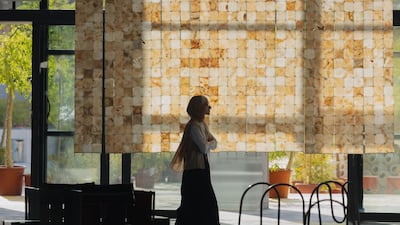
Returning after a seven-year hiatus, Amman Design Week opened its highly anticipated fourth edition on October 2, celebrating the evolution of architecture and design across Jordan and the wider region.
Held under the theme, Accumulations, the biennial event runs until October 17, with a range of multidisciplinary exhibitions and installations spread across Amman and further afield in the coastal city of Aqaba.
The relaunch of ADW marks a major expansion in scope and programming for the event, featuring 120 exhibited creatives, and many more in parallel workshops and talks.

“This whole time, the designers kept working and creating. The research kept going, and this is what led to the theme Accumulations, because this edition is the accumulated work that has been going on behind the curtains, now being put in the spotlight,” ADW co-director Bisher Tabbaa tells The National. “We’ve expanded our locations and number of exhibitions, and now we also have some installations that will remain a permanent part of the city after ADW ends.”
That idea of accumulation extends beyond the work produced during ADW's seven-year absence, becoming a broader exploration of how the past continues to shape contemporary design.

“The theme is really about how our daily practices, our environment, and cultural memories come together and entangle. How do they accumulate and shape what we do? How does our heritage leave traces that can be expressed in our life today?” exhibitions curator Faysal Tabbarah adds. “Some of what you’ll see is almost a material inventory, but then we look at how designers can stretch units of materials, reshape them or combine them in different ways.”
Many of the works are spread across Ras El Ain, with the major showcase taking place at The Hanger – an old 1930s electricity-generating plant transformed into a public cultural and exhibition space – which serves as ADW's headquarters. The works range from product design and material experimentation to research-driven projects visualising cultural practices or rethinking historic narratives.
One such project is Troubled Waters by Palestinian architect and historian Nadi Abusaada, nine years in the making. A white plaster octagonal fountain sits within the exhibition space like a ghostly apparition of the grand, intricately decorated courtyard fountains of a bygone era.

The only dash of colour is a single geometric tile, adorned with blue and red florals. That tile is the only surviving piece of a fountain designed by Armenian ceramist David Ohanessian, which once occupied the now-demolished 1920s Palace Hotel in Jerusalem. Abusaada’s piece recreates what he believes the fountain would have looked like, based on the tile’s design and historic references.
“The hotel was occupied by Israelis in 1948 and destroyed in 2008. Many of the artefacts were dispersed all over the place, including this one tile,” Abusaada tells The National. “A Palestinian collector named George Al-A’ma was able to buy it back from the Israeli contractor that destroyed the building, and this whole installation is an attempt at speculating what that fountain looked like.
“Usually, we use plaster to fix little cracks in small objects, but in this instance, the ‘cracks’ are basically the whole body of the fountain, and a comment on this convoluted way of retrieving your history.”
A short walk away in Ras El Ain Park is one of the permanent installations, titled Folly by Civil Architecture, co-founded by Bahraini architect Ali Ismail Karimi and Kuwaiti architect Hamed Bukhamseen.

The project introduces a ceramic tile canopy structure, made from discarded eucalyptus wood, which winds between the treetops of the park to create a shaded walkway and gathering spot. Small sculptures of animals and people are placed on the roof, acting as abstracted figures that locals interpret as they please, creating their own myths and stories to go with the small icons.
“We created this space so people can begin to occupy it for events, casual gatherings or even just as a shady rest spot that encourages people to use the park more,” Bukhamseen says. “We approached the project in collaboration with Haswa Ceramics by Jordanian ceramicist Sama El Saket, who has been experimenting with local clay varieties.”
“What occupies the canopy above are these small figurines, these caryatids, as we call them, devoid of any mythology or specific meaning,” he adds. “They’re these architectural motifs that occupy the space above and create narratives based on how you begin to see them from the sidewalk above. We want people to make them their own.”
Further afield at Darat Abu Adnan, a restored 1950s heritage house in Jabal Al Lweibdeh that has been transformed specifically for ADW, several designers showcased projects related to domestic life, coexistence with nature, and heritage craft.

The Return by Jordanian designer Farah Tajeddin is a striking installation that uses a stone architectural feature in the garden as a makeshift dining table, laid with salt-crusted candelabras, candlesticks, cups and cutlery.
“Made from Dead Sea salt, these candleholders transform a material shaped by time into vessels for light and beauty. Their raw, crystalline surfaces carry traces of my childhood landscape, as I used to visit the Dead Sea a lot as a child,” Tajeddin says. “The sea’s name also inspires a reflection: life is a journey away from home; death is not a departure, but a return. The table is set up for dessert, because we’re meant to enjoy this journey while we’re here.
“They’re made from biodegradable materials in many colours, built layer by layer from the salt and joined with a plant-based binder,” she adds. “This process offers an alternative to conventional synthetic adhesives, while allowing the salt’s natural texture and mineral character to remain visible.”
The experimental and interdisciplinary approach of ADW makes it a playground for ideas and innovations that are still in the process of solidifying. Rather than a design fair focused on selling products or functional pieces, the platform seeks to provoke and stimulate the mind, finding new ways that design and architecture can benefit people or create a conversation.

