
When Guggenheim Abu Dhabi opens on December 11, it will introduce visitors to a collection that has been growing since 2009, with works by Arab artists spanning painting, sculpture, photography and performance.
The museum will focus on modern and contemporary art from the 1960s onwards, with particular attention to West Asia, North Africa and South Asia.
Previous exhibitions have offered glimpses of the institution's holdings. Seeing Through Light: Selections from the Guggenheim Abu Dhabi Collection presented 19 acquired works alongside two loans from the Solomon R Guggenheim Museum in New York in 2014, followed by The Creative Act: Performance, Process, Presence in 2017.

Acquisition announcements and loans to Louvre Abu Dhabi have disclosed further works.
Although the works on display have yet to be announced, records over the years identify the following 10 artists among those represented in the collection.
Hassan Sharif

Hassan Sharif’s performances and objects made from everyday materials helped establish conceptual art in the UAE. In 2015, Guggenheim Abu Dhabi acquired major holdings by the Emirati artist, alongside works by artists he had taught, including Mohammed Kazem.
Sharif’s work subsequently featured in The Creative Act, nine photographic documentations of performances from the 1980s. In works such as Walking No 1, Jumping No. 2 and Digging and Standing, he carried out ordinary physical actions in the Hatta desert, removing them from their usual context and purpose.
These experiments developed during his studies in Britain and visits home, at a time when experimental contemporary art had little infrastructure in the UAE. His teaching and writing helped a younger generation develop their own practices.
Mohammed Kazem

Mohammed Kazem’s Directions 2002, shown in The Creative Act, documents the artist throwing wooden planks inscribed with GPS co-ordinates into the sea off Fujairah. As the planks drifted, the fixed locations recorded on them became detached from their surroundings.
The work belongs to a long-running series in which the Emirati artist uses geographical co-ordinates to explore location and movement. Mentored by Sharif, Kazem developed a practice encompassing photography, video and performance. His inclusion in the Guggenheim Abu Dhabi collection was also reported in 2015.
His later installation Directions 2005/2013 surrounded visitors with a 360-degree projection of the sea. It was presented in Walking on Water, his solo exhibition representing the UAE at the 2013 Venice Biennale.
Samia Halaby

Samia Halaby’s Yellow Spiral was among the paintings shown in Seeing Through Light in 2014. A decade later, Louvre Abu Dhabi listed it among important new loans from Guggenheim Abu Dhabi in its 2024 annual report.
The report dates the large oil painting to 1971. Its geometric forms belong to an early period of experimentation in Halaby’s career, with her gallery identifying Arabic architecture and calligraphy among the work’s influences.
Born in Jerusalem in 1936, the Palestinian artist has spent much of her career in the US. Her abstract paintings explore colour, movement and space, drawing on sources including nature and Islamic architecture. Her practice has also extended to computer-generated moving images.
Huguette Caland

An Untitled oil painting from 1973 by Huguette Caland appears in the 2024 Louvre Abu Dhabi report as a loan from Guggenheim Abu Dhabi. It dates from the Lebanese artist’s years in Paris, when she developed paintings in which fragments of the human body became expansive fields of colour and curving lines.
Born in Beirut in 1931, Caland studied art at the American University of Beirut in the 1960s before moving to Paris in 1970. Her paintings and drawings explored desire and the body with humour and sensuality, frequently moving between figuration and abstraction.
Her international recognition grew towards the end of her life, including her first UK museum solo exhibition at Tate St Ives in 2019. She died in Beirut that September, aged 88.
Saloua Raouda Choucair

Saloua Raouda Choucair is represented by an Untitled oil painting on board from 1973, also listed as a Guggenheim Abu Dhabi loan in Louvre Abu Dhabi’s 2024 report.
Born in Beirut in 1916, the Lebanese painter and sculptor was a pioneer of abstraction whose interests included mathematics, Islamic art and Arabic poetry. Her sculptures often consisted of individual pieces that could fit together, drawing on the relationship between a verse and the poem to which it belongs.
Recognition outside Lebanon came late in her career. In 2013, aged 96, she was the subject of a major exhibition at Tate Modern, bringing wider attention to decades of work across painting, sculpture and design.
Shakir Hassan Al Said

Shakir Hassan Al Said’s Writing on the Wall, a mixed-media work on board from 1978, was lent by Guggenheim Abu Dhabi to Louvre Abu Dhabi’s 2021 exhibition Abstraction and Calligraphy – Towards a Universal Language.
The Iraqi artist helped found the Baghdad Group for Modern Art with Jewad Selim in 1951. Two decades later, he established the One Dimension Group, exploring the Arabic letter’s possibilities within modern art and its relationship to Sufi thought.
His interest in weathered walls, marks and traces of writing informed works that brought calligraphy into abstraction. Writing on the Wall reflects that concern with the painted surface as a place where letters and other marks could acquire meaning beyond readable text.
Ghada Amer

Ghada Amer’s The Words I Love the Most is a hollow bronze sphere formed from interlocking Arabic expressions of love. Its lettering faces inward, inviting viewers to look through the sculpture to read the words.
The 2012 work appeared in Seeing Through Light and was later lent to Louvre Abu Dhabi for Abstraction and Calligraphy, whose exhibition records credit it to Guggenheim Abu Dhabi.
Born in Cairo in 1963 and based in New York, Amer works across painting, sculpture and installation. She is particularly known for paintings incorporating embroidery, using a technique traditionally associated with female domestic work to examine images of women and expressions of desire.
Youssef Nabil

Two works by Youssef Nabil – Natacha & Crown, Cairo 2000 and Lonely Pasha, Cairo 2002 – were named as permanent collection acquisitions in Guggenheim Abu Dhabi’s 2013 programme announcement. The Egyptian artist took part in its Talking Art series that year.
Nabil, who works across several artistic disciplines, photographs his subjects in black and white before colouring the prints by hand, drawing on techniques once used in Egyptian photographic studios. He learnt from studio retouchers who had practised the craft decades earlier.
His portraits of actors, artists and himself evoke the imagery of Egyptian cinema’s golden age. Hand-colouring gives contemporary subjects the appearance of belonging to an earlier era, connecting his photographs to memories of the films he grew up watching.
Rachid Koraichi

Selections from Rachid Koraichi’s Le Chemin des Roses (Path of Roses), created between 1995 and 2005, appeared in Seeing Through Light. His representative, October Gallery, has also documented Guggenheim Abu Dhabi’s acquisition of the installation.
The work draws on the journeys of the 13th-century Sufi poet Rumi. The Algerian artist’s practice combines Arabic calligraphy with signs and symbols from other traditions, working across materials including steel, ceramics and textiles.
Sufi thought also informed Les Maitres invisibles (The Invisible Masters), the embroidered banners with which he won the Victoria and Albert Museum’s Jameel Prize in 2011.
Ibrahim El-Salahi

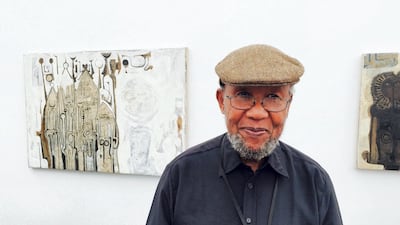
Ibrahim El-Salahi’s Untitled (1964) came to Guggenheim Abu Dhabi from the Sudanese artist’s personal collection. In a 2016 interview, the Guggenheim described it as a “cornerstone work” for the museum.
El-Salahi, 96, was a founding member of the Khartoum School, which developed a modern artistic language drawing on Sudan’s cultural heritage after independence in 1956. His work brought together Arabic calligraphy, Islamic motifs and African visual traditions with his training in painting.
Discussing Untitled, he recalled experimenting with spray paint during his time in the US, using it to plan the painting’s composition and responding to the soft effect it left on the canvas. He regarded the work as distinct from the paintings he made after returning to Sudan in 1965.

