
Galleries and institutions across Abu Dhabi, Dubai and Sharjah are marking the start of the new art season with a fresh wave of exhibitions.
Current highlights include Rana Begum’s Taking Form at The Third Line, which explores colour, geometry and material through textile, linen, wood and paper; Unseen Script at Rizq Art Initiative, bringing together 10 artists around the patterns and routines that shape everyday life; and The Sky Held It, The Earth Remembered at Ishara Art Foundation, where land, water and the cosmos become archives of memory and environmental change.
Together, the exhibitions span photography, painting, sculpture, textiles, moving image and installation, with subjects ranging from urban life and cultural memory to ecology and play.

Here are nine exhibitions to see across the UAE.
1. Precarious Beings at Tashkeel
Hamad Al Muzaini’s first solo exhibition examines the ways people adapt to cities and the everyday behaviours that quietly shape the places they call home. Presented at Tashkeel Nad Al Sheba, the exhibition grew from Al Muzaini’s participation in Tashkeel’s Critical Practice Programme, which supports artists through research, mentorship and the development of new work.
Trained as an architect, the Kuwaiti artist has gradually shifted his focus from designing places to questioning how and why they take shape. His practice considers the built environment through seemingly mundane details, asking what improvised interventions and habits can reveal about the people navigating urban spaces.
Working across photography, drawing and sculpture, Al Muzaini explores how negotiating, circumventing and inhabiting a city can become so routine that these behaviours eventually escape notice. The exhibition uses these observations to raise wider questions about urban planning, territoriality and whether cities adequately respond to the needs of their inhabitants.
Until October 11; Dubai
2. Unseen Script at Rizq Art Initiative

In Unseen Script, curated by Meena Vari, works by 10 artists explore the patterns people form through repetition, from familiar journeys and domestic objects to changing landscapes and gestures that become so ingrained they often go unnoticed.
The exhibition brings together art by Najat Makki, Nujoom Alghanem, Nasir Nasrallah, Abdulla PA, Ana Escobar Saavedra, Fadi Balhawan, Ismail Al Rifai, Joanna Barakat, Neveen Abu Samra and Simrin Mehra Agarwal. Across painting, sculpture, assemblage and mixed media, the artists return to recurring subjects within their practices, revealing how personal habits and ways of seeing become a kind of visual script.
Several works draw on the relationship between people and their surroundings. Abdulla reflects on abandoned homes and the ways nature reclaims human-made spaces, while Saavedra transforms seashells into delicate assemblages. Nasrallah draws on memories of his grandfather’s antique shop, Makki extends her abstract practice into steel and Alghanem examines the cityscape as a contemporary horizon.
While the exhibition touches on the way technology can identify and predict human patterns, its focus remains on subjective experience, asking what memory, consciousness and observation can reveal that data cannot.
Until October 28; Abu Dhabi
3. Taking Form at The Third Line
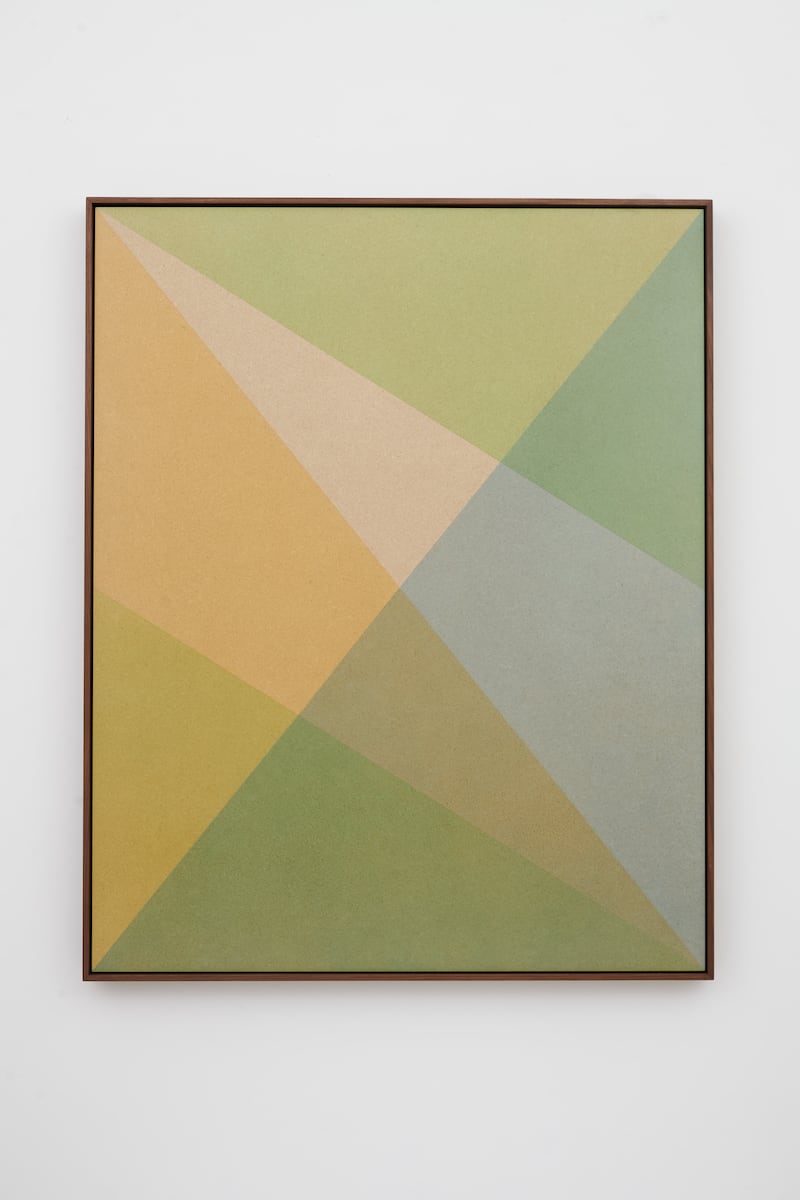
Taking Form is Rana Begum’s fifth solo exhibition at The Third Line, bringing together new works across textile, linen, wood and paper that continue her exploration of light, colour, geometry and material.
Large wool tapestries suspended from the ceiling form the centre of the exhibition. Woven with geometric patterns, their appearance shifts as visitors move around them. Elsewhere, diluted acrylic has seeped into linen, while smaller works on paper and wooden panels explore interactions between colour and surface.
The exhibition introduces a greater sense of softness to Begum’s practice while retaining the abstraction and geometric structures that have long shaped her work.
Until November 10; Dubai
4 & 5. Between Land and Sea, and Between a Fold and a Memory at Leila Heller Gallery

Two exhibitions at Leila Heller Gallery consider Emirati identity and heritage through the work of Azza Al Qubaisi and Karima Al Shomely.
Al Qubaisi’s Between Land and Sea, curated by Aysha Al Hemeiri, surveys a multidisciplinary practice spanning intimate jewellery and large-scale public works. Her use of natural resources and materials connects the UAE’s desert and coastal environments with ideas of memory, identity and place.
In Between a Fold and a Memory, Al Shomely turns to the clothing, textiles and objects associated with Emirati women. Photography, sculpture, textile and video explore how materials such as the burqa and traditional fabrics can carry memories of labour, social change and cultural knowledge across generations.
Until November 10; Dubai
6. Sojourner: The Difference is the Same at Efie Gallery

Kenyan artist Maggie Otieno transforms reclaimed materials into vessels of memory in Sojourner: The Difference is the Same, her first solo exhibition with Efie Gallery.
Otieno’s practice has centred on distressed and discarded materials for almost three decades. The exhibition includes works made from 150-year-old railway sleepers, whose histories are tied to East Africa’s colonial railway network, alongside sculptures incorporating fragments of wooden canoes produced during a residency at El Anatsui Studio in Ghana.
By cutting, assembling and reconfiguring these materials, Otieno shifts objects once associated with movement and infrastructure into forms concerned with stillness, memory and passage.
Until November 13; Dubai
7. The Horizon We Inherit at Iris Projects

Emirati artist Eman Al Hashemi examines the changing rhythms of urban life in the UAE in The Horizon We Inherit, her first solo exhibition with Iris Projects. Working across ceramics, printmaking and mixed media, she considers how cities shape attention, memory and everyday routines.
The sun, street lights, buildings and roundabouts recur throughout the works, turning familiar features of the UAE cityscape into forms that can appear both recognisable and strange. Al Hashemi is particularly interested in the routes people repeatedly travel and the traces left behind as places are altered through construction and redevelopment.
Rather than treating the built environment as a backdrop, the exhibition considers it as an active force in daily life and asks what remains when familiar places survive only through photographs, maps, memories or repeatedly travelled routes.
September 26 to November 26; Abu Dhabi
8. Vantage Point 13 at Sharjah Art Foundation

Vantage Point 13 marks a new chapter for Sharjah Art Foundation's long-running photography platform as it moves into the institution's dedicated photography gallery. Selected through an international open call, six artists present commissioned photographic series developed with the foundation's curatorial and production support.
The exhibition features work by Adam Rouhana, Guanyu Xu, Latifa AlBokhari, Luisa Dorr, Maheder Haileselassie and Sathish Kumar. Together, their projects demonstrate the breadth of contemporary photography, reflecting the programme's evolution from a platform for UAE-based photographers into an international exhibition embracing diverse approaches.
Introduced in 2013, Vantage Point has become one of the UAE's key photography initiatives. This edition also reflects the foundation's expanded commitment to supporting new work, with participating artists receiving production funding to create original projects specifically for the exhibition.
Until November 29; Sharjah
9. The Sky Held It, The Earth Remembered at Ishara Art Foundation
The exhibition brings together works by Shahana Rajani, Rohini Devasher and Sarker Protick to explore how land, water and the cosmos can act as archives of memory and history. Through photography, moving image and installation, the exhibition considers how ecological change and human intervention leave traces on the environment that can persist across generations.
Rajani’s three-channel film Lines That World a River focuses on communities displaced from the Indus Delta, where paintings and murals reconstruct villages submerged following the construction of dams and barrages. Devasher turns towards the cosmos with Latent Fields, monumental silk panels inspired by sunspots and other solar phenomena, while Protick’s Dhaka 1217 documents 15 years of transformation around the neighbourhood in Dhaka where he was born and continues to live.
Drawing together perspectives from Pakistan, India and Bangladesh, the exhibition considers ecological decline across national borders, and the ways landscapes can preserve histories of displacement, destruction and resilience.
Until December 15; Dubai
10. A Board Game Adventure at Louvre Abu Dhabi

A Board Game Adventure transforms Louvre Abu Dhabi into a giant playground, using some of the world's oldest games to explore how people have connected across cultures for thousands of years. Designed for children but engaging for all ages, the exhibition traces the journey of games including chess, Mancala, Ludo and Carrom as they travelled between ancient civilisations and evolved into the games still played today.
The exhibition combines immersive installations with rare artefacts borrowed from international museums, including some of the earliest known board game objects from ancient Egypt, Mesopotamia, Iran and India. Highlights include centuries-old chess pieces carved from ivory and rock crystal, engraved backgammon pieces, ancient six-sided dice and one of the earliest known predecessors of Ludo.
Interactive displays encourage visitors to solve puzzles, challenge artificial intelligence, play on oversized game boards and discover how strategy, chance and storytelling have always been part of human play. Throughout the exhibition, historical figures ranging from Queen Nefertari and Achilles to samurai Hatakeyama Shigetada are reimagined through playful “player profiles”, linking games to the personalities and cultures that shaped them.
Rather than presenting games as simple entertainment, A Board Game Adventure reveals them as cultural objects that have crossed borders, adapted to societies and brought people together for millennia.
Until April 25, 2027

