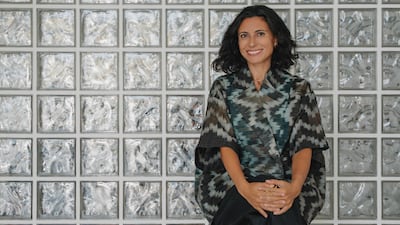

Dalia Hamati has been appointed curator of the UAE pavilion at the Venice Architecture Biennale 2027, with an exhibition exploring the country’s relationship with water and how it could inform building in a warming climate.
The architect and assistant professor at the American University of Sharjah was selected through an open call. Her proposal brings together UAE history, atmospheric science and environmental design.
“As the national pavilion, we are interested in telling an authentically UAE story,” Hamati tells The National. “That is inspiring how the team is comprised, who we’re approaching to research and collaborate with.”

The exhibition will examine how water has shaped communities, from where people settled to the systems they developed to share it. It will run from May 8 to November 21, 2027, at the UAE’s permanent pavilion in the Arsenale’s Sale d’Armi.

Its title and design are still being developed, with organisers expecting to announce further details in January.
Hamati began exploring the subject more closely in October last year, when she was invited to give a lecture at the Rhode Island School of Design to students researching water in the UAE. That work has led her to consider how historical practices could inform the way people live with water in a warming world.
Having spent much of her childhood and adult life in the UAE, she also looks to its gardens, parks and water displays as expressions of how people use and value water.
“We have an incredibly robust infrastructure that supplies water constantly,” she says. She views the gap between the country’s naturally arid conditions and its everyday use of water as a cultural question as much as a technical one.
“We’re looking back at some incredibly unique hydrocultural models that have been in the UAE for hundreds if not thousands of years, as a way to inform future innovative models that can respond to how we live with water today and in the future of a warming planet.”
Lessons from the UAE’s buildings
The country's older buildings offer examples of how design can respond to the climate. Hamati points to arish structures made from date palms, wind towers that capture breezes, and settlements where buildings were placed close together to shade the walkways between them. These approaches depended on an understanding of airflow, orientation and the local materials.
“We’re not importing materials from elsewhere. We have to work with what’s around us,” she says of those traditional practices. “So there’s also material intelligence there that is deeply rooted in place.”
Born in Sharjah in 1984, Hamati studied at the University of Bath and Columbia University before practising at Ennead Architects in New York. She now lives in Dubai, where she runs an independent architecture and design practice alongside her teaching in Sharjah.
Her work has repeatedly returned to the environmental consequences of construction, from clearing land to the energy used in buildings and the waste left after demolition.
“The whole question of being an environmentally responsible architect can be paradoxical at times. It’s something that has been on my mind since I entered practice, and especially after becoming a mother,” she says. “I have two young boys, and I’m often preoccupied about the world we’re building for them, for future generations.”
Her projects in the UAE include work as lead architect on Tarabot: Weaving a Living Forum, designed by Adib Dada’s practice, theOtherDada, and commissioned by Art Jameel. She also collaborated on ReRoot, an Abwab commission at Dubai Design Week in 2024, which used mycelium, a network of fungal threads, to create shelters for displaced communities.
The latter project responded to the need for housing in Gaza, while considering what would happen to temporary structures once they were no longer needed. The team investigated how the materials could eventually return to and nourish the soil.
Returning to Venice
The appointment builds on an earlier collaboration with the UAE National Pavilion in Venice. In 2021, Hamati worked with UAE studio Waiwai, the practice behind the UAE’s Wetland exhibition, which won the Golden Lion for best national participation.

Alongside that exhibition, she helped co-ordinate A Bench in Venice, an initiative inviting students to design benches from surplus materials supplied by participating exhibitors. Three designs were built and installed, with their placement intended to disrupt the boundaries separating national pavilions.
Next year will mark the UAE’s seventh participation in the architecture biennale. Its pavilion is commissioned by the Salama Bint Hamdan Al Nahyan Foundation and supported by the Ministry of Culture.
Hamati’s team is now developing research partnerships and an accompanying publication, drawing on researchers and practitioners based in the UAE.
She also wants the exhibition to explore Venice’s own relationship with water, including its environmental challenges and the practices that have developed there over time.
“They have their own challenges, but also their own hydrocultural histories that we’re interested in entering into a dialogue with in the exhibition,” says Hamati.

